Преглед в реален мащаб Преглед с AR Избор на принт Поръчайте ръчно рисувано репродукция на този колекционерски предмет Сподели
Подробности Ръководство Добави в любими Изтегляне Подобни артикули Рентгенова снимка Слайдшоу Статистика

Gotham News

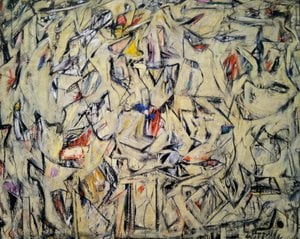
Willem de Kooning’s vibrant 'Gotham News' explodes with dynamic reds, yellows, and blues in this monumental abstract expressionist painting from 1955. Capturing a restless spirit of exploration, De Kooning’s bold brushstrokes convey raw emotion and movement—discover the captivating energy of American Abstract Expressionism.

Уилем де Кунинг (1904-1997) е ключова фигура в абстрактния експресионизъм. Известен с динамичните картини, серията "Жена" и влиянието си върху Ню Йоркската школа. Разгледайте творчеството му!

Закупете дигитално изображение с висока резолюция и подобрени характеристики, значително по-качествено от онлайн прегледа.

Всеки файл е щателно подготвен от нашите специалисти с помощта на съвременни инструменти и експертен ръчен ретуш. Гарантираме, че всяко изображение притежава изключителна яснота, прецизна цветова точност и фини детайли.

Окончателният файл се доставя по имейл в рамките на 72 часа, оптимизиран за незабавна употреба в професионални, редакционни и печатни среди. Това е същото качество, на което се доверяват водещи дизайнерски студия, издатели и галерии.

Дигитално изображение

Изтеглете файл с висока резолюция за лично съхранение, принтиране и творчески проекти. ( Избор на принт Поръчайте ръчно рисувано репродукция на този колекционерски предмет)

Крайна цена

$ 24,90

Включено във всяка поръчка за дигитални изображения

Експертна дигитална доставка, гарантирана

Избирайки WahooArt.com, вие не получавате просто изображение – вие придобивате професионално обработена дигитална творба, създадена с прецизност и подкрепена от гаранция за удовлетворение. Ето какво автоматично е включено във вашата поръчка:

shipping_icon
Бърза доставка по имейл

Вашето дигитално изображение с висока резолюция ще бъде изпратено по имейл в рамките на 72 часа от поръчката – готово за незабавно използване.

canvas_icon
Дигитален файл с подобрено качество чрез ИИ

Вашата картина е професионално оптимизирана с помощта на усъвършенствани инструменти за изкуствен интелект и ръчна редакция, осигурявайки максимална детайлност, яснота и точност на цветовете.

insurance_icon
Безплатна доживотна повторна доставка

Изгубили сте или сте изтрили файла си по погрешка? Не се притеснявайте – ще го изпратим отново на Вас по всяко време, безплатно.

tax_icon
Без митнически такси – завинаги

Насладете се на вашето произведение незабавно, без мита, данъци или такси за доставка – дигиталните изтегляния винаги са освободени от данъци.

color_icon
Гаранция за точност на цветовете

Гарантираме, че вашето дигитално изображение отразява оригиналните цветове възможно най-точно, чрез използването на професионални инструменти и системи за управление на цветовете.

return_icon
100-дневна гаранция за удовлетвореност

Ако не сте доволни от вашето дигитално изображение, ще го преработим или ще възстановим 100% от сумата в рамките на 100 дни – без излишни въпроси.

guarantee_icon
100% Гаранция за връщане на сумата

Не сте доволни? Получете пълен възврат на сумата в рамките на 100 дни от получаването на вашия цифров файл – без излишни въпроси.

discount_icon
Отстъпки за големи поръчки

Купете 3 изображения, спестете 10% - Купете 5, спестете 15% - Купете 10+, спестете 20%. Идеално за творчески проекти, галерии и агенства.

Бърза информация

  • Medium: Oil on canvas
  • Year: 1955
  • Influences: European Surrealism
  • Subject or theme: Urban landscape
  • Notable elements or techniques: Dynamic brushstrokes, bold color palette
  • Artistic style: Gestural abstraction
  • Movement: Abstract Expressionism

A Symphony of Color and Chaos

In the heart of the mid-century art world, few works capture the frenetic pulse of urban existence quite like Willem de Kooning’s "Gotham News," completed in 1955. This monumental piece serves as a visceral testament to the fervor of Abstract Expressionism, acting less as a window into a scene and more as an embodiment of emotion distilled into raw form. To gaze upon this canvas is to experience a profound reaction to the anxieties and dynamism of postwar America. De Kooning does not merely present a subject; he invites the viewer into a psychological landscape where the boundaries between reality and feeling dissolve into a vibrant, swirling vortex of pigment.

The painting functions as a masterclass in the "all-over" painting technique, a hallmark of the era that eschews traditional compositional boundaries. There is no single focal point to rest the eye; instead, the viewer’s gaze is pulled through a labyrinth of thick impasto and energetic gestures. Bold strokes of crimson, ochre yellow, deep blues, and verdant greens collide across the surface, creating ridges and valleys of paint that catch the light and lend the work a sculptural quality. Within this controlled chaos, one can discern ghostly traces of the material world—the suggestion of a boat drifting through a sea of color or the fleeting silhouette of a figure—yet these elements remain secondary to the overwhelming sense of movement and kinetic energy that defines the piece.

The Artist’s Unbound Spirit

Willem de Kooning’s approach was fundamentally rooted in the philosophy of capturing essence over accuracy. Born in Rotterdam, his journey from a restless youth in the Netherlands to a central figure in the New York School was marked by a rebellious spirit and a rejection of academic rigidity. He famously declared, “I don’t paint what I see; I paint what I feel,” a mantra that is palpably present in every aggressive brushstroke of "Gotham News." By abandoning representational accuracy, De Kooning tapped into a universal language of movement, allowing the frantic energy of New York City—the "Gotham" of the title—to manifest as pure, unadulterated motion.

For the discerning collector or interior designer, "Gotham News" offers more than just aesthetic brilliance; it provides a commanding presence that can anchor an entire room. The painting’s ability to balance intense color with complex textures makes it an ideal centerpiece for modern, sophisticated spaces. Whether placed in a minimalist gallery setting or a richly textured study, the work radiates a timeless sophistication. It is a piece that demands conversation, offering layers of depth that reveal new nuances with every viewing, making it a profound investment for those who seek to surround themselves with art that possesses both historical weight and an enduring, emotional resonance.


Биография на художника

A Life Forged in Abstraction

Willem de Kooning, a name synonymous with the raw energy and emotional depth of Abstract Expressionism, was born in Rotterdam, Netherlands, in 1904. His early life was marked by a familial split – his parents divorced when he was young – which perhaps instilled within him a sense of restless searching that would permeate his artistic journey. Leaving formal schooling at twelve, de Kooning apprenticed with a commercial art firm, laying the groundwork for his technical skill while simultaneously fueling a desire to break free from conventional constraints. Evening classes at the Academie van Beeldende Kunsten en Technische Wetenschappen in Rotterdam provided further foundational training, but it was a yearning for something more – a bolder, more expressive language – that ultimately propelled him towards America in 1926. His arrival wasn’t straightforward; he famously stowed away on a ship, embodying the spirit of an outsider seeking new horizons. New York City became his adopted home, and its vibrant, often gritty energy profoundly shaped his evolving style. He navigated various jobs – house painter, carpenter – all while relentlessly pursuing his artistic vision, absorbing the city’s pulse into his work.

From Urban Scenes to Abstract Fury

De Kooning's early paintings reflected his immediate surroundings: urban landscapes and portraits that captured the dynamism of New York life. These works, often rendered in muted tones and characterized by a sense of movement, offered a glimpse into the burgeoning metropolis. However, these were merely stepping stones towards a more profound exploration of form and emotion. A pivotal moment came with his connection to Arshile Gorky, whose influence proved transformative. Gorky encouraged de Kooning’s experimentation with abstraction, fostering a willingness to dismantle traditional representation in pursuit of something deeper. De Kooning began to loosen his brushwork, layering colors and creating gestural marks that conveyed feeling rather than precise detail. This shift marked the beginning of a radical departure from representational art, laying the foundation for his later, more abstract works. The 1930s saw de Kooning engage with social realism and mural projects through the Works Progress Administration (WPA), a period that honed his skills but also highlighted the limitations of purely representational art. He found himself drawn to the work of Stuart Davis and John Graham, artists who were pushing boundaries in their own right, exploring new ways to capture the energy and complexity of modern life. This confluence of influences gradually steered him away from literal depiction and toward an increasingly abstract vocabulary.

The Woman Series: A Landmark Achievement

Following World War II, de Kooning emerged as a central figure in the burgeoning Abstract Expressionist movement. This period marked a turning point, culminating in his iconic “Woman” series (1950-1953). These paintings – including the monumental *Woman I*, *Woman II*, and *Woman III* – are not merely depictions of female figures; they are visceral explorations of femininity, sexuality, and the complexities of human emotion. Characterized by aggressive brushstrokes, fragmented forms, and a jarring juxtaposition of colors, the “Woman” series challenged conventional notions of beauty and representation. They were controversial, even shocking to some, but their power lay precisely in their refusal to conform. De Kooning wasn’t interested in creating idealized images; he sought to capture the raw, untamed essence of his subjects. The figures are often distorted and unsettling, reflecting a deeper psychological landscape. Alongside this series, works like *The Glazier* and *Excavation* further demonstrated his dynamic approach to painting, showcasing a masterful command of texture, color, and composition. He didn't shy away from chaos or ambiguity; instead, he embraced them as integral components of his artistic language.

Evolving Landscapes and Enduring Legacy

In the 1960s and beyond, de Kooning’s style underwent another significant evolution. While abstraction remained central to his work, landscape elements began to play a more prominent role, often rendered with a brighter palette and a looser, more fluid brushstroke. He continued to experiment relentlessly throughout his life, exploring different techniques and materials, never content to rest on his laurels. He revisited themes from earlier periods, incorporating them into new compositions with a renewed sense of freedom and experimentation. His later works – such as *Easter Monday* (1976) – demonstrate a remarkable ability to reinvent himself while remaining true to his core artistic principles. De Kooning’s historical significance is undeniable. He helped establish New York City as a global center for art, challenging the dominance of European traditions and paving the way for future generations of artists. His work continues to inspire awe and provoke debate, reminding us of the power of abstraction to convey profound emotional truths. Willem de Kooning passed away in 1997, leaving behind a vast and influential body of work that stands as a testament to his unwavering commitment to artistic innovation and his enduring legacy as one of the most important American artists of the 20th century. His paintings are not just objects; they are windows into a complex and intensely felt inner world.

Key Influences

De Kooning’s artistic development was shaped by a diverse range of influences, both formal and personal. Early exposure to commercial art instilled in him a strong sense of technical skill and an understanding of visual communication. The work of European masters like Picasso and Matisse provided inspiration for his early explorations of form and color. However, it was the encounter with Arshile Gorky that proved particularly transformative, encouraging him to abandon traditional representation and embrace abstraction. Furthermore, the vibrant energy of New York City itself – its diverse population, its rapid pace of change, its gritty underbelly – served as a constant source of stimulation and inspiration. The works of Stuart Davis and John Graham also played a significant role in shaping his artistic vision, demonstrating the possibilities of capturing modern life through abstraction.

Уилям де Кунинг

Уилям де Кунинг

1904 - 1997 , Нидерландия

Кратка информация

  • Artistic Movement Or Style: Абстрактен експресионизъм
  • Artists Or Movements Influenced By This Artist: ['New York School']
  • Artists Who Influenced This Artist:
    • Аршиле Горки
    • Stuart Davis
    • John Graham
  • Date Of Birth: 24 април 1904
  • Date Of Death: 19 март 1997
  • Full Name: Willem de Kooning
  • Nationality: Нидерландски-американец
  • Notable Artworks:
    • Woman I
    • Marilyn Monroe
    • Reclining Man (JFK)
    • Excavation
  • Place Of Birth: Роттердам, Нидерландия