A Dance of Geometry: Unveiling Victor Vasarely’s ‘Uzok-III’
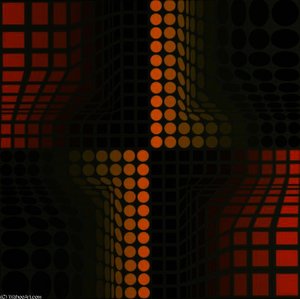
Victor Vasarely's 'Uzok-III,' painted in 1952, isn’t merely a visual experience; it’s an invitation to step into a world where perception itself is playfully challenged. This seminal work of Op Art—a movement that sought to disrupt the viewer’s sense of reality through optical illusions—radiates with a vibrant energy born from bold color contrasts and meticulously arranged geometric forms. More than just a static image, ‘Uzok-III’ feels like a contained explosion of dynamism, a testament to Vasarely's pioneering exploration of how we actually *see* the world.
Born in Pécs, Croatia (then part of Austria-Hungary), Vasarely’s artistic journey began unexpectedly. Initially pursuing medicine, he was drawn to the expressive potential of painting and, crucially, found mentorship with Sándor Bortnyik at Műhely – a school deeply rooted in the principles of Bauhaus design. This formative experience instilled within him a fascination with functional aesthetics and geometric abstraction, laying the foundation for his signature style. ‘Uzok-III’ embodies this legacy—a calculated interplay between order and chaos, precision and visual distortion.
The Language of Light and Form
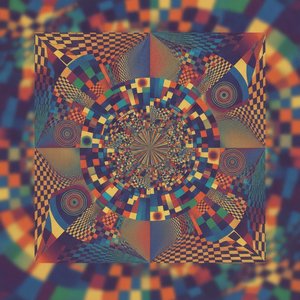
At first glance, 'Uzok-III' presents a seemingly complex arrangement of interlocking triangles and quadrilaterals. However, beneath the surface lies a carefully orchestrated balance. The composition is largely symmetrical, yet deliberately asymmetrical elements prevent it from feeling static. Vasarely masterfully employs flat planes of color—striking reds, greens, blues/purples, and oranges—without any gradients or shading. This deliberate lack of illusionistic depth forces the viewer to confront the image directly, intensifying its optical effects. The pervasive texture, created by a dense pattern of tiny dots, isn’t merely decorative; it subtly softens the sharp edges of the geometric shapes, introducing an element of controlled randomness that further enhances the work's dynamism.
Decoding the Optical Illusion
The absence of traditional perspective is key to understanding ‘Uzok-III.’ Vasarely deliberately avoids creating a sense of depth through linear recession. Instead, he relies on the overlapping and contrasting colors of the shapes to generate an illusion of spatial recession—a trick of the eye that draws the viewer into the composition without relying on conventional techniques. This technique is central to Op Art’s goal: to manipulate perception and create a disorienting yet captivating visual experience. The work feels simultaneously familiar and utterly alien, prompting us to question our own assumptions about how we interpret space and form.
A Legacy of Geometric Abstraction
'Uzok-III' is firmly rooted in the Op Art movement, but also reveals echoes of Constructivism—a Russian artistic movement that championed geometric abstraction and industrial aesthetics. The precise lines defining the shapes, combined with the bold color palette, speak to a desire for clarity and structure, while the dynamic arrangement suggests a more playful engagement with visual perception. Created using a screenprint or similar technique – likely ink on paper – this method allowed Vasarely to achieve the remarkable precision of the dot pattern and the vibrant intensity of the colors. It’s a testament to his meticulous approach and his understanding of how color and line can be used to manipulate our senses.
Beyond Representation: An Exploration of Perception
Ultimately, ‘Uzok-III’ is not about depicting anything recognizable; it's an exploration of pure form, color, and the very nature of perception. The work evokes a sense of energy, dynamism, and visual stimulation—a feeling that resonates with the viewer long after they’ve turned away. It’s a reminder that art doesn’t always need to represent reality to be profoundly impactful; sometimes, it simply needs to challenge our perceptions and invite us to see the world in a new way.



 Представи си го
 Купете ръчно рисувана картина
 Изпрати
 Сподели
 Детайли

 Изтегляне
 Подобни
 Рентгенова снимка
 Слайдшоу
 Статистика

 Прочетете повече






































 Стъклото е налично само в размери под 110 см