Преглед в реален мащаб Преглед с AR Поръчайте ръчно рисувано репродукция на този колекционерски предмет Превключване към дигитално изображение Сподели
Подробности Ръководство Добави в любими Изтегляне Подобни артикули Рентгенова снимка Слайдшоу Статистика

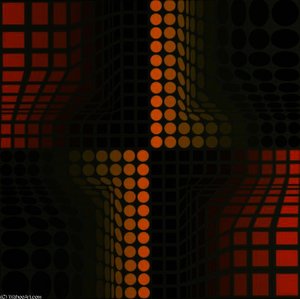
Tridem K

This artwork exemplifies Vasarely’s signature style, characterized by repetitive geometric forms and optical illusions that stimulate perception.

Разгледайте завладяващия свят на Виктор Вазарели (1906-1997)! От геометрични абстракции до оптически илюзии и трайно влияние върху модерното изкуство и дизайна. Експериментирайте с формите и цветовете на репродукции!

Изкуството, представено на тази страница, е защитено от законите за авторско право, което означава, че не можем законно да създаваме или продаваме идентични репродукции. Тази защита се прилага съгласно международни споразумения като Бернска конвенция и от националното законодателство, включително разпоредбите на Закон за авторското право на САЩ – Раздел 17.

Този метод е напълно съвместим с законите за авторско право, тъй като не включва копиране или дублиране на защитеното произведение. Вместо това става въпрос за творческа реинтерпретация – нова картина, която е вдъхновена от оригинала, но не е идентична с него.

Жикле / Художествен принт

Giclée печат или принт върху платно с музейно качество, бързо производство и гъвкави опции за завършен вид. ( Поръчайте ръчно рисувано репродукция на този колекционерски предмет Превключване към дигитално изображение)

Corner sample of the P118B picture frame: формован полистирол, 5 cm wide and 3 cm thick
P118B €10
Corner sample of the P118H picture frame: формован полистирол, 5 cm wide and 3 cm thick
P118H €10
Corner sample of the P118W picture frame: формован полистирол, 5 cm wide and 3 cm thick
P118W €10
Corner sample of the P438Z picture frame: формован полистирол, 5.5 cm wide and 3.5 cm thick
P438Z €10
Corner sample of the P508JH picture frame: формован полистирол, 7 cm wide and 3.5 cm thick
P508JH €12
Corner sample of the P508YH picture frame: формован полистирол, 7 cm wide and 3.5 cm thick
P508YH €12
Corner sample of the P805H picture frame: формован полистирол, 5 cm wide and 3.5 cm thick
P805H €10
Corner sample of the P805Z picture frame: формован полистирол, 5 cm wide and 3.5 cm thick
P805Z €10
Corner sample of the P919BZ picture frame: формован полистирол, 7 cm wide and 3.5 cm thick
P919BZ €10
Corner sample of the P919G picture frame: формован полистирол, 7 cm wide and 3.5 cm thick
P919G €10
Corner sample of the P919XJ picture frame: формован полистирол, 7 cm wide and 3.5 cm thick
P919XJ €10
Corner sample of the P959ZH picture frame: формован полистирол, 5 cm wide and 3 cm thick
P959ZH €10
Corner sample of the P968JZ picture frame: формован полистирол, 6 cm wide and 4 cm thick
P968JZ €12
Corner sample of the W106C picture frame: масивна дървесина, 5 cm wide and 3 cm thick
W106C €8
Corner sample of the W218G picture frame: масивна дървесина, 5 cm wide and 3 cm thick
W218G €10
Corner sample of the W218JH picture frame: масивна дървесина, 5 cm wide and 3 cm thick
W218JH €8
Corner sample of the W218Y picture frame: масивна дървесина, 5 cm wide and 3 cm thick
W218Y €10
Corner sample of the W307PJ picture frame: масивна дървесина, 6 cm wide and 3 cm thick
W307PJ €10
Corner sample of the W316G picture frame: масивна дървесина, 6 cm wide and 3 cm thick
W316G €10
Corner sample of the W316PJ picture frame: масивна дървесина, 6 cm wide and 3 cm thick
W316PJ €8
Corner sample of the W316Y picture frame: масивна дървесина, 6 cm wide and 3 cm thick
W316Y €10
Corner sample of the W398PJ picture frame: масивна дървесина, 5 cm wide and 3 cm thick
W398PJ €8
Corner sample of the W4111J picture frame: масивна дървесина, 6.5 cm wide and 3.5 cm thick
W4111J €10
Corner sample of the W500HY picture frame: масивна дървесина, 7 cm wide and 5 cm thick
W500HY €15
Corner sample of the W500JH picture frame: масивна дървесина, 7 cm wide and 5 cm thick
W500JH €15
Corner sample of the W692G picture frame: масивна дървесина, 8 cm wide and 4 cm thick
W692G €12
Corner sample of the W849H picture frame: масивна дървесина, 5 cm wide and 3 cm thick
W849H €8
Corner sample of the W940BG picture frame: масивна дървесина, 7.5 cm wide and 4.5 cm thick
W940BG €15
Corner sample of the W953PJ picture frame: масивна дървесина, 6 cm wide and 3.5 cm thick
W953PJ €8

Стандартен размер
по поръчка
CM
INCH

Изберете от нашите предварително зададени размери, които съответстват на оригиналните пропорции на произведението.

ширина
височина

Въведете необходимата ширина и височина, за да паснат на вашата рамка или стена. Принтовете могат само да се изрязват, но никога не могат да бъдат по-големи от оригиналната картина, така че при размер с различен формат част от изображението ще бъде загубена. Преди да започнем печат, ще ви изпратим дигитален мок업 за одобрение. Изображението, показано на тази страница, не показва реалното изрязване — само мок업ът го показва.

Доставка по целия свят () в рамките на 2 седмици вместо стандартните 4/5 седмици. (22 Октомври)

Безплатна експресна доставка по целия свят
Висококачествено ленено платно
Пълно застраховане на доставката
Гаранция за възстановяване на митнически такси
Гаранция за пълно съответствие на цветовете
Политика за връщане в рамките на 100 дни (само при дефекти)
100% Гаранция за връщане на сумата
Отстъпка при поръчка на повече произведения

Обща сума

€ 60

Tridem K

Жикле / Художествен принт

Размер на репродукцията

-

Крайна цена

€ 60

Бърза информация

  • Artist: Victor Vasarely
  • Medium: Tempera on panel
  • Subject or theme: City of tomorrow
  • Dimensions: 11 x 28 inches
  • Notable elements or techniques: Geometric abstraction, optical illusion
  • Location: Paris

Квиз за изкуство

За всеки въпрос има само един верен отговор.

Въпрос 1:
What artistic movement is Victor Vasarely primarily associated with?
Въпрос 2:
Where was the painting 'Tridem K' originally displayed?
Въпрос 3:
What is a prominent characteristic of Vasarely's visual style?
Въпрос 4:
The painting utilizes what medium?
Въпрос 5:
What inspired Vasarely's use of hexagonal rooms for the Fondation Vasarely?

Tridem K – A Geometric Revelation by Victor Vasarely

Victor Vasarely (1906-1997) stands as an undisputed titan of Op Art, a movement that revolutionized visual perception in the mid-20th century. Born Győző Vásárhelyi in Pécs, Hungary—a city steeped in Austro-Hungarian heritage—his artistic journey began unexpectedly with aspirations for medicine but swiftly pivoted towards the captivating realm of painting at Eötvös Loránd University in Budapest. This formative decision wasn’t merely a career change; it was an embrace of fundamental principles governing how our eyes perceive reality, propelling him toward groundbreaking explorations into geometric abstraction and optical illusions. The pivotal influence arrived with his enrollment in Sándor Bortnyik’s workshop – Műhely – where he absorbed the essence of Bauhaus design, fostering a dedication to functionality alongside artistic innovation.
  • The Artwork: Tridem K is a striking acrylic painting on canvas measuring approximately 150.18 x 200.66 inches (381.7 x 509 cm). Its dominant hue is black, serving as the backdrop for an intricate tapestry of vibrant geometric patterns—primarily blues, oranges, greens, purples, reds, and yellows—that dance across the surface.
  • Style: Vasarely’s signature style embodies Op Art's core tenets: illusionistic imagery designed to trick the eye into perceiving movement or depth where none exists. The painting exemplifies this aesthetic with its deliberate manipulation of perspective and color gradients, creating a mesmerizing visual experience.
  • Technique: Vasarely meticulously crafted Tridem K using a technique characterized by layering acrylic paints in precise geometric shapes—primarily triangles and squares—to generate optical effects. This painstaking process underscores his commitment to scientific rigor alongside artistic creativity.

Historical Context – Bauhaus Influence & The Rise of Kinetic Art

Vasarely’s artistic development coincided with the burgeoning Bauhaus movement, a German school that championed functional design and geometric abstraction as responses to the challenges posed by industrialization. Bortnyik's workshop instilled in him a profound appreciation for these principles, shaping his worldview and informing his creative process. This intellectual milieu fostered an interest in exploring how visual stimuli could stimulate sensory perception—a fascination that would ultimately propel him toward pioneering kinetic art, where movement itself becomes integral to the artwork’s impact. The painting reflects this broader artistic dialogue, embodying the spirit of experimentation and innovation characteristic of its time.

Symbolism & Emotional Resonance – Beyond Mere Decoration

Tridem K transcends mere decorative appeal; it speaks to deeper conceptual concerns rooted in Vasarely's exploration of perception and consciousness. The geometric patterns—particularly triangles and squares—represent fundamental building blocks of visual experience, symbolizing stability and order amidst apparent chaos. Furthermore, the vibrant colors evoke emotional responses associated with joy, energy, and dynamism—mirroring the movement-inducing qualities inherent in Op Art itself. Vasarely aimed to create artworks that stimulated not just sight but also thought, prompting viewers to question their assumptions about reality.

Location & Legacy – A Testament to Modern Artistic Vision

Currently housed at the Bechtler Museum of Modern Art in Charlotte, United States, Tridem K stands as a lasting monument to Victor Vasarely’s artistic legacy—a testament to his unwavering belief in the transformative power of geometric abstraction and Op Art. Its presence within this prestigious institution underscores its significance as a cornerstone of 20th-century art history, continuing to inspire artists and collectors alike with its captivating visual illusion and profound conceptual depth.

Въпроси и отговори

За какво се разказва в "Tridem K" и каква атмосфера предава?

"Tridem K" изобразява geometric abstraction, optical illusion, color pattern, symmetry, minimalism, bauhaus influence, modern art, texture, а уловеното настроение е Serene.

Каква атмосфера предава "Tridem K"?

Общото настроение на „Tridem K“ на Виктор Васарели е Serene. Настроението описва общата атмосфера на произведението.

Какво настроение изразява „Tridem K“ на Виктор Васарели в рамките на Op Art?

Tranquil емоцията на „Tridem K“ допълва нейния Op Art стил.


Биография на художника

A Life Forged in Geometry: The World of Victor Vasarely

Victor Vasarely’s journey to becoming a pioneer of Op Art and kinetic art was anything but predetermined. Born Károly Vaszary in 1906 in Pécs, a city then nestled within Austria-Hungary (now Croatia), his early life hinted at a path far removed from the canvas; he initially pursued medical studies at Eötvös Loránd University in Budapest. However, the allure of visual expression proved too strong, leading him to abandon medicine for the world of painting in 1927, enrolling at the Podolini-Volkmann Academy. This decision marked not merely a change in vocation but the beginning of a lifelong exploration into the fundamental principles governing perception and form. A pivotal moment arrived with his enrollment in Sándor Bortnyik’s workshop – Műhely – a school deeply influenced by the Bauhaus movement. Here, Vasarely absorbed the tenets of functional design and geometric abstraction, seeds that would blossom into his signature style. These formative years weren't simply about acquiring technique; they were about dismantling traditional artistic conventions and embracing a new visual language rooted in logic and precision. He sought to move beyond representational art, focusing on pure form and color relationships – a deliberate shedding of narrative content in favor of the essential elements of visual experience.

From Early Abstraction to the Dawn of Op Art

The late 1920s and early 1930s witnessed Vasarely’s gradual departure from representational art, as he delved deeper into the realm of geometric abstraction. Works like “Blue Study” and “Green Study,” created in 1929, exemplify this transition – a deliberate shedding of narrative content in favor of pure form and color relationships. He was influenced by masters such as Piet Mondrian and Kazimir Malevich, but he wasn’t content to simply emulate their styles. Vasarely sought to transcend the static compositions of his predecessors, aiming for a dynamism that would actively engage the viewer's perception. This quest led him to Paris in 1930, where he established himself as a graphic designer and advertising artist, honing his skills while continuing to develop his unique artistic vision. It was during this period that he began experimenting with techniques that would later become hallmarks of Op Art – manipulating shapes and colors to create illusions of movement and depth. The seeds were sown for a revolution in visual experience. He developed a systematic approach, using grids and mathematical principles to generate patterns designed to stimulate the viewer's perception.

The Systematic Illusion: Defining a Movement

By the 1960s, Victor Vasarely had fully emerged as a leading figure in the burgeoning Op Art movement. Unlike many artists who relied on intuition and spontaneous expression, Vasarely approached his work with a distinctly systematic methodology. He employed grids and mathematical principles to generate patterns that created powerful optical illusions – visual vibrations, swirling effects, and sensations of depth where none physically existed. This wasn’t about trickery; it was about revealing the inherent dynamism within perception itself. He believed in reproducibility and mass appeal, aiming to democratize art by making it accessible beyond the confines of galleries and museums. His work challenged viewers to question their own visual experience, forcing them to actively participate in the creation of meaning. He wasn’t merely painting pictures; he was constructing experiences.

Historical Significance & Lasting Legacy

Vasarely's contribution to art history is multifaceted. He moved beyond traditional painting techniques to create works that actively engage the viewer’s perception. His systematic approach challenged conventional notions of artistic creativity and paved the way for computer-generated art and digital design. By embracing reproducibility and commercial applications, Vasarely blurred the boundaries between fine art and popular culture, leaving an enduring mark on both. He wasn't simply creating aesthetically pleasing objects; he was conducting visual experiments that revealed fundamental truths about how we see the world. His work continues to resonate today, reminding us of the power of abstraction, the beauty of geometry, and the endless possibilities of human creativity. His influence extends beyond painting into graphic design, fashion, interior design, and even early computer graphics, inspiring generations with his innovative vision. The establishment of the Fondation Vasarely in Aix-en-Provence ensured the preservation and promotion of his extensive body of work, while a remarkable event – the inclusion of serigraphs aboard the French-Soviet spacecraft Salyut 7 in 1982 – symbolized the global recognition of his art and its connection to the broader human endeavor of exploration. Victor Vasarely’s legacy remains a testament to the power of visual experimentation and the enduring fascination with perception itself.
Виктор Васарели

Виктор Васарели

1906 - 1997 , Хърватия

Бързи факти

  • Artistic Movement Or Style: Оп арт, Кинетичен арт
  • Artists Or Movements Influenced By This Artist:
    • Графичен дизайн
    • Интериорен дизайн
  • Artists Who Influenced This Artist:
    • Пиет Мондриан
    • Казимир Малевич
  • Date Of Birth: 9 април 1906 г.
  • Date Of Death: 15 март 1997 г.
  • Full Name: Victor Vasarely
  • Nationality: Художник-френски/хърватски
  • Notable Artworks:
    • Синьо изследване
    • Зелено изследване
  • Place Of Birth: Пéч, Хърватия
Разгледайте произведения на изкуството, организирани по теми, стилове и характеристики.