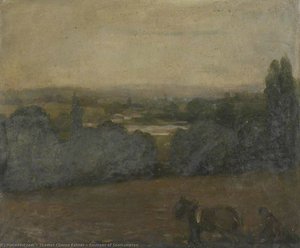
Thomas Clinton Balmer: A Painter of English Light and Shadow
Thomas Clinton Balmer, a name perhaps less familiar than many of his Victorian contemporaries, nevertheless possessed a remarkable talent for capturing the essence of English life and landscape during a pivotal era. Born in Liverpool in 1879 into a family deeply rooted in shipping, Balmer’s artistic journey began with formal training at the prestigious Mount Street School of Art, where he honed his skills under the tutelage of Frederick V. Burridge and Augustus C. John – figures whose influence would profoundly shape his distinctive style. His early works demonstrate a clear engagement with the Arts and Crafts movement, evident in their meticulous detail and celebration of traditional craftsmanship, yet quickly evolved into something uniquely his own.
Balmer’s artistic development was inextricably linked to his relocation to America in 1905, seeking opportunities and a new perspective. He spent several years in New York City, immersing himself in the vibrant art scene and experimenting with various techniques. However, a strong pull towards his native England eventually led him back across the Atlantic, establishing a home in Flushing, New York, and later residing in Brooklyn. This transatlantic experience undoubtedly broadened his artistic horizons, exposing him to diverse influences and informing his evolving approach to composition and color.
The Palette of St. Thomas’ Hospital
Balmer's most enduring legacy lies perhaps in his extensive body of work depicting scenes from St. Thomas’ Hospital in London. These paintings, executed primarily between 1908 and the 1930s, offer a poignant glimpse into the daily lives of patients, nurses, and doctors within this iconic institution. Unlike idealized depictions of medical practice common at the time, Balmer's work eschewed romanticism, presenting instead a realistic and often melancholic portrayal of illness, suffering, and resilience. His use of muted tones—particularly blues, greys, and browns—created an atmosphere of quiet contemplation, while his meticulous attention to detail captured the subtle nuances of human emotion.
The series is not merely a documentation of hospital life; it’s imbued with symbolic depth. Balmer frequently employed light and shadow to convey themes of mortality, hope, and the enduring spirit of humanity. His figures are often rendered in profile, lending them an air of solemnity and emphasizing their vulnerability. The compositions themselves—often featuring solitary individuals or small groups engaged in quiet moments—suggest a profound sense of isolation and introspection. Notably, his work was compared to that of William Morris, highlighting the influence of decorative arts and social commentary within his artistic vision.
Technique and Style
Balmer’s technique is characterized by a masterful command of oil paint, employing a layered approach known as *impasto* – building up thick textures with visible brushstrokes. This technique not only adds depth and richness to the paintings but also conveys a sense of immediacy and physicality. His use of color was restrained yet deliberate, prioritizing tonal harmony over vibrant hues. He skillfully manipulated light and shadow to create dramatic effects, emphasizing form and volume. His style can be described as a blend of realism and impressionism, capturing both the objective appearance of his subjects and their emotional essence.
Beyond hospital scenes, Balmer produced a diverse range of works including portraits, landscapes, and murals. His artistic versatility is evident in the variety of subject matter and stylistic approaches he embraced throughout his career. He also served as an instructor at the Westlake School of Art and Design in Los Angeles, further demonstrating his commitment to nurturing young talent.
Legacy and Recognition
Despite not achieving widespread fame during his lifetime, Thomas Clinton Balmer’s work has gained increasing recognition in recent decades. His paintings from St. Thomas’ Hospital are now considered important historical documents, offering a valuable insight into Victorian medical practice and the human condition. His ability to capture the quiet dignity of suffering patients—and the compassion of those who cared for them—has resonated deeply with viewers.
Balmer's contributions to the art world were acknowledged by organizations such as the New Haven Paint and Clay Club, where he served on the jury of award in 1922. His work continues to be exhibited and studied, cementing his place as a significant figure in late nineteenth- and early twentieth-century British painting. His legacy is one of quiet observation, profound empathy, and an unwavering commitment to capturing the beauty and complexity of everyday life.



 Представи си го
 Превключване към принт
 Изпрати
 Сподели
 Детайли

 Изтегляне
 Подобни
 Рентгенова снимка
 Слайдшоу
 Статистика

 Прочетете повече