БЕЗПЛАТНА КОНСУЛТАЦИЯ ЗА ИЗКУСТВО

x
Купи картина Купи картинаКупи изображение Купи изображение ИзпратиИзпрати
ДетайлиДетайли Добавяне към любими Добавяне към любими ИзтеглянеИзтегляне ПодобниПодобни Рентгенова снимкаРентгенова снимка СлайдшоуСлайдшоу

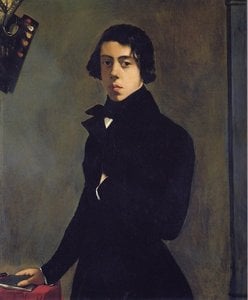
Self-Portrait

Explore Théodore Chassériau's 'Self-Portrait,' a captivating 1835 oil painting showcasing the artist’s restrained elegance and introspective style, housed in the Louvre.

Теодора Шасериау е френски романтичен художник, който съчетава класическите принципи на Жан-Адолф Дьо Мегре и драматизма на Ежена Делакроа. Известен с портрети и исторически картини, той остави трайно влияние върху изкуството.

Жикле / Художествен принт

Giclée печат или принт върху платно с музейно качество, бързо производство и гъвкави опции за завършен вид.

P118B $10
P118H $10
P118W $10
P438Z $10
P508JH $12
P508YH $12
P805H $10
P805Z $10
P919BZ $10
P919G $10
P919XJ $10
P959ZH $10
P968JZ $12
W106C $8
W218G $10
W218JH $8
W218Y $10
W307PJ $10
W316G $10
W316PJ $8
W316Y $10
W398PJ $8
W4111J $10
W500HY $15
W500JH $15
W692G $12
W849H $8
W940BG $15
W953PJ $8

Standard
custom
CM
INCH

Изберете от предварително зададените размери, които съответстват на оригиналните пропорции на произведението.

ширина
височина

Можете да въведете собствени размери, за да паснат на конкретна рамка или пространство. Ако избраният от Вас размер не съвпада с пропорциите на оригиналното изображение, ние ще изрежем произведението или ще разширим изображението с огледален или едноцветен ръб. Дигитален макет ще бъде изпратен за Ваше одобрение преди започването на производството.
Моля, имайте предвид, че предпрегледът на екрана не отразява реалното изрязване или разширяване. Само макетът ще покаже точно финалната композиция.
Въпреки че са налични персонализирани размери, препоръчваме да изберете размер от предварително дефинирания списък, за да запазите оригиналните пропорции.

Доставка по целия свят () в рамките на 2 седмици вместо стандартните 4/5 седмици. (7 Юли)

why_choose_icon
Безплатна експресна доставка по целия свят
why_choose_icon
Висококачествено ленено платно
why_choose_icon
Пълно застраховане при доставка
why_choose_icon
Гаранция за възстановяване на митнически такси
why_choose_icon
Гаранция за цветова точност
why_choose_icon
60-Дневен период за връщане (Само при дефекти)
why_choose_icon
100% Гаранция за връщане на парите
why_choose_icon
Предложение за отстъпка при поръчка на едро

Обща цена

-

reproduction

Self-Portrait

Жикле / Художествен принт

Размер на репродукцията

-

Обща цена

-

Бързи факти

  • Influences:
    • Ingres
    • Delacroix
  • Movement: Romanticism
  • Artist: Théodore Chassériau
  • Dimensions: 99 x 82 cm
  • Year: 1835
  • Location: Louvre, Paris
  • Artistic style: 19th-century

Тест за изкуство

Има само един верен отговор за всеки въпрос.

Въпрос 1:
What artistic movement is most closely associated with Théodore Chassériau’s ‘Self-Portrait’?
Въпрос 2:
The microphone stand visible in the painting 'Self-Portrait' suggests which of the following?
Въпрос 3:
What is the predominant color palette used in ‘Self-Portrait’?
Въпрос 4:
According to the description, what is a key characteristic of Chassériau’s technique in this painting?
Въпрос 5:
Théodore Chassériau was born in which country?

Описание на колекционерския предмет

The Enigmatic Self: Théodore Chassériau’s “Self-Portrait in a Redingote”

Théodore Chassériau's 1835 oil on canvas, "Self-Portrait in a Redingote," is more than just a likeness; it’s a carefully constructed tableau of restrained elegance and subtle introspection—a window into the mind of a young artist grappling with his artistic identity within the context of 19th-century Parisian society. Housed within the prestigious Musée du Louvre, this painting immediately draws the viewer in with its dark palette and the commanding presence of the subject, a young man radiating an almost melancholic intensity.

The work firmly anchors itself within the Romantic movement, yet it subtly resists simple categorization. While undeniably influenced by the dramatic flair of Eugène Delacroix – particularly evident in the dynamic lighting and the suggestion of movement – Chassériau retains a core Neoclassical discipline, meticulously rendered lines defining the sharp angles of his suit jacket and the precise contours of his face. This duality reflects the artist’s own journey: initially trained under the rigorous tutelage of Jean-Auguste-Dominique Ingres, he ultimately forged his own path, embracing a more expressive and emotionally charged style.

A Study in Light and Shadow – Technique and Composition

Chassériau's masterful technique is immediately apparent. The painting’s composition centers around the subject, occupying nearly the entire frame, creating an intimate and almost claustrophobic effect. He stands in a three-quarter pose, his gaze directed slightly to the left, inviting the viewer into his world. A subtle yet significant detail—a microphone stand discreetly positioned behind him on the left – hints at a performance context, perhaps suggesting Chassériau’s burgeoning career as a stage designer or illustrator, alongside his painting endeavors. The artist employs a layering technique, building up color and texture through numerous thin glazes of oil paint, resulting in a remarkably smooth surface—a testament to his dedication and skill.

The lighting is particularly noteworthy. It originates from an unseen source on the left side, casting soft, directional shadows across the subject’s face and subtly highlighting the textures of his clothing. This strategic use of light not only adds depth and volume but also contributes significantly to the painting's overall mood—a blend of formality and quiet contemplation. The careful blending of tones creates a sense of atmospheric perspective, drawing the eye deeper into the scene.

Symbolism and Emotional Resonance

Beyond its technical brilliance, “Self-Portrait in a Redingote” is rich in symbolic meaning. The formal black suit, impeccably tailored, speaks to Chassériau’s ambition and his desire for recognition within the established artistic circles of Paris. However, the slightly downturned mouth and the introspective gaze suggest a deeper layer of complexity—a hint of melancholy or perhaps even disillusionment with the constraints of academic art. The red bow tie, a vibrant splash of color against the predominantly dark palette, could represent passion, creativity, or simply a deliberate assertion of individuality.

The painting’s overall effect is one of restrained elegance and quiet introspection. It's not a flamboyant self-celebration but rather a carefully considered portrait of an artist grappling with his identity and place in the world—a poignant reflection on the challenges and rewards of pursuing a creative life. The subtle sadness in his eyes invites us to contemplate the burdens of artistic ambition, while the formality of his attire suggests a desire for respectability and recognition.

A Legacy of Romanticism – Historical Context

Created during a period of significant social and political upheaval—the aftermath of the Napoleonic Wars and the rise of Romanticism—Chassériau’s work reflects the movement's emphasis on emotion, individualism, and the sublime. His Creole heritage, born in the Dominican Republic and raised in Paris, undoubtedly informed his artistic vision, providing him with a unique perspective on both European and Caribbean cultures. This background is reflected in his interest in Orientalist themes – particularly evident in later works – and his willingness to challenge conventional artistic norms.

Chassériau’s trajectory—from student of Ingres to independent Romantic artist—is itself a compelling narrative, illustrating the tensions between tradition and innovation within 19th-century art. “Self-Portrait in a Redingote” stands as a powerful testament to his artistic evolution and a captivating glimpse into the mind of a brilliant but often overlooked talent.

Подобни произведения


Биография на художника

Théodore Chassériau: Bridging Neoclassicism and Romantic Passion

Théodore Chassériau (1819–1856) stands as a pivotal figure in the transition between Neoclassical elegance and Romantic fervor—a testament to artistic synthesis achieved during the mid-nineteenth century. Born under the radiant sun of Samaná, Dominican Republic, his Creole heritage instilled within him a unique perspective that would profoundly shape his artistic vision, differentiating him from many of his contemporaries. His father, Benoît Chassériau, was a French diplomat navigating the complexities of Caribbean politics, while his mother, Maria Magdalena Couret de la Blagniére, descended from Haitian and French lineages—a heritage that fueled his creative spirit and informed his understanding of cultural intersections. This early exposure to diverse influences would become an indelible mark on his oeuvre. ### Early Training and Ingres’s Influence Chassériau's artistic journey commenced with a formative apprenticeship under Jean-Auguste-Dominique Ingres, commencing at the tender age of eleven. Recognizing Chassériau’s exceptional talent—a conviction famously expressed by Ingres as “Come, gentlemen, come see, this child will be the Napoleon of painting”—the celebrated neoclassical master took him as his favored pupil, imparting to him the rigorous discipline and exacting standards synonymous with Ingres's style. This intensive training solidified Chassériau’s mastery of line, form, and classical composition—a foundation that would remain visible throughout his artistic career, even as he ventured into new expressive territories. The influence of Ingres is palpable in early works like *Venus* (1836) and *Suzanne*, demonstrating a dedication to idealized beauty and meticulous draughtsmanship. ### Embracing Romantic Expression: Delacroix and Algeria As Chassériau matured, the burgeoning Romantic movement exerted an irresistible pull, prompting him to experiment with looser brushwork, richer hues, and emotionally charged subject matter—a deliberate departure from Ingres’s stylistic constraints. Eugène Delacroix, whose dynamic compositions and vibrant palettes captivated Chassériau's imagination, served as a crucial catalyst for this artistic transformation. This wasn’t merely imitation; it was absorption—a masterful blending of classical precision with Romantic fervor. His travels to Algeria in 1846 provided an unparalleled stimulus for his creative exploration, exposing him to the exotic landscapes and captivating human stories of North Africa—themes that would become central to his artistic output. Paintings such as *Moorish Woman Leaving the Bath in the Seraglio* exemplify this newfound stylistic boldness and reflect Delacroix’s influence on Chassériau's visual language. ### Major Achievements: Decorative Murals and Artistic Legacy Chassériau achieved considerable renown for his ambitious decorative projects, most notably the murals adorning the Cour des Comptes in Paris—though tragically, these monumental artworks were destroyed by fire during the Franco-Prussian War of 1871. Despite this devastating loss, Chassériau’s artistic legacy endured, securing his place as one of the foremost Romantic painters of his era. His portraits captivated audiences with their elegance and psychological depth, capturing not only physical likeness but also inner character—exemplified by works such as *Comtesse de La Tour-Maubourg* and *Tocqueville*. Furthermore, Chassériau’s exploration of Orientalist themes contributed to a broader artistic fascination with the Middle East, paving the way for subsequent generations of artists to delve into these cultures and landscapes. His enduring influence can be observed in the works of later artists who admired his ability to synthesize tradition and innovation—a testament to his singular contribution to French art history. ### Conclusion: A Synthesis of Styles Théodore Chassériau’s artistic trajectory represents a remarkable convergence of stylistic currents—a harmonious blend of Neoclassical rigor and Romantic passion that cemented his position as one of the most distinctive voices of his time. He wasn't simply reacting against Ingres; he was transcending boundaries, forging a visual language that honored both classical heritage and expressive innovation. His paintings continue to resonate with viewers today, offering invaluable insights into the artistic landscape of 19th-century France—a legacy defined by beauty, technical brilliance, and an unwavering commitment to capturing the complexities of human experience.
Теодора Шасериау

Теодора Шасериау

1819 - 1856 , Доминиканска република

Бързи факти

  • Artistic Movement Or Style: Neoclassicism, Romanticism
  • Artists Or Movements Influenced By This Artist: ['Romantic painters']
  • Artists Who Influenced This Artist:
    • Jean-Auguste-Dominique Ingres
    • Eugène Delacroix
  • Date Of Birth: 20 Sept. 1819
  • Full Name: Théodore Chassériau
  • Nationality: French
  • Notable Artworks:
    • Desdemona
    • Othello
    • Moorish Woman
  • Place Of Birth: El Limón, Santo Domingo
Разгледайте произведения на изкуството, организирани по теми, стилове и характеристики.