Продавайте вашата изкуство
x
Представи си гоПредстави си го AR прегледAR преглед Превключване към печат Превключване към печатПревключване към изображение Превключване към изображение ИзпратиИзпрати
ДетайлиДетайли Добавяне към любими Добавяне към любими ИзтеглянеИзтегляне ПодобниПодобни Рентгенова снимкаРентгенова снимка СлайдшоуСлайдшоу

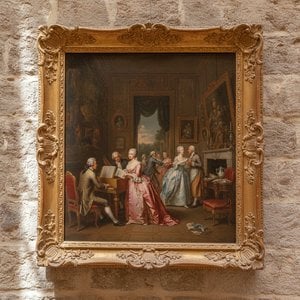
The Dancing Lesson

Pieter Jacobsz Codde's 'The Dancing Lesson' (1627) captures a lively domestic scene with a woman teaching dance, showcasing Dutch Golden Age genre painting’s realism and detail.

Pieter Jacobsz Codde (1599-1678) was a Dutch Golden Age painter known for genre scenes, musical companies & guardroom paintings. Discover his technically skilled style and notable works like 'Dancing Lesson' at the Louvre.

Ръчно изработена маслена репродукция

Ръчно рисувана маслена картина върху платно във вашия размер и рамка, изработена по поръчка от нашите художници. (Превключване към печат Превключване към печатПревключване към изображение Превключване към изображение)

P118B $10
P118H $10
P118W $10
P438Z $10
P508JH $12
P508YH $12
P805H $10
P805Z $10
P919BZ $10
P919G $10
P919XJ $10
P959ZH $10
P968JZ $12
W106C $8
W218G $10
W218JH $8
W218Y $10
W307PJ $10
W316G $10
W316PJ $8
W316Y $10
W398PJ $8
W4111J $10
W500HY $15
W500JH $15
W692G $12
W849H $8
W940BG $15
W953PJ $8

Standard
custom
CM
INCH

Изберете от предварително зададените размери, които съответстват на оригиналните пропорции на произведението.

ширина
височина

Можете да въведете свои собствени размери, за да пасне на конкретна рамка или пространство. Ако избраният от вас размер не съответства на пропорциите на оригиналното изображение, ние ще изрежем произведението или ще удължим картината с допълнителни ръчно рисувани елементи. Дигитален макет ще бъде изпратен за ваше одобрение преди започване на производството.
Моля, обърнете внимание, че прегледът на екрана не отразява действителното изрязване или разширяване. Само макетът ще покаже точно финалния състав.
Въпреки че са налични персонализирани размери, препоръчваме да изберете размер от предварително дефинирания списък, за да запазите оригиналните пропорции.

Примери за това какво може да се промени: Заменете лице с клиентска снимка; Добавете домашен любимец (например заменете котка с куче); Включете скрито послание на фона; Променете пейзажа или елементите на фона.
След поръчка, екипът на WahooArt.com ще изпрати имейл на клиента за инструкции и ще предостави преглед на макет.

Доставка по целия свят () в рамките на 3/4 седмици вместо стандартните 5 седмици. (10 Август). Без компромис с качеството.

why_choose_icon
Безплатна експресна доставка по целия свят
why_choose_icon
Висококачествено ленено платно
why_choose_icon
Пълно застраховане при доставка
why_choose_icon
Гаранция за възстановяване на митнически такси
why_choose_icon
Гаранция за цветова точност
why_choose_icon
60-Дневен период за връщане (Само при дефекти)
why_choose_icon
100% Гаранция за връщане на парите
why_choose_icon
Предложение за отстъпка при поръчка на едро

Обща цена

$ 272

reproduction

The Dancing Lesson

Репродукционен метод

Размер на репродукцията

-

Обща цена

$ 272

Бързи факти

  • Title: The Dancing Lesson
  • Notable elements or techniques: Chiaroscuro, meticulous detail, realism
  • Dimensions: 40 x 53 cm
  • Year: 1627
  • Artistic style: Genre painting
  • Movement: Dutch Golden Age

Описание на произведението

A Glimpse into the Golden Age: The Elegance of Motion

In the quiet, sun-drenched interiors of the seventeenth-century Netherlands, moments of domestic grace were often captured with profound reverence. Pieter Jacobsz Codde’s "The Dancing Lesson," painted in 1627, serves as a breathtaking window into this era of refined social ritual. At the heart of this composition stands a woman, her presence commanding yet graceful, draped in a striking black dress that anchors the scene's visual weight. As she guides her pupils through the rhythmic steps of a dance, the painting transcends a mere instructional moment, becoming a poetic meditation on poise, etiquette, and the structured beauty of Dutch social life. The room around her is alive with the subtle energy of a gathering, where the soft interplay of light and shadow breathes life into every figure and object.

The mastery of Codde lies in his ability to weave a complex narrative through meticulous detail and a sophisticated use of chiaroscuro. Influenced by the legendary Frans Hals, Codde employs a technique that emphasizes naturalism and psychological depth. Notice how the light falls upon the ruffled collar of the central figure, creating a brilliant contrast against the dark fabric of her gown, drawing the eye immediately to the focal point of the lesson. The surrounding figures, though partially obscured in the periphery, contribute to a sense of atmospheric depth, their positions suggesting a layered, bustling environment. Every element, from the heavy wooden chair to the books resting upon the dining table, is rendered with such precision that one can almost feel the stillness of the room punctuated by the soft shuffling of feet.

Beyond its technical brilliance, "The Dancing Lesson" carries a profound emotional resonance that makes it an enduring masterpiece for collectors and decorators alike. There is a sense of nostalgic tranquility in the scene—a celebration of a world where time moved to the tempo of music and tradition. For the interior designer, this piece offers more than just decoration; it provides a sophisticated focal point that introduces a sense of historical gravity and classical elegance to any space. The painting’s palette, rich with deep blacks, warm earth tones, and soft highlights, allows it to integrate seamlessly into both traditional and contemporary settings, acting as a conversation piece that invites viewers to contemplate the timeless dance between discipline and joy.

Owning a high-quality reproduction of this work is an opportunity to bring the spirit of the Dutch Golden Age into the modern home. It is an invitation to surround oneself with the artistry of a master who understood that the most profound stories are often found in the simplest of human interactions. Whether placed in a formal study or a grand living area, Codde’s vision continues to inspire awe, reminding us of the enduring beauty found in the choreographed movements of life.


Биография на художника

The Silvery Light of the Dutch Golden Age

Pieter Jacobsz Codde, a name synonymous with the refined elegance of the seventeenth-century Dutch Golden Age, lived a life as textured and layered as the canvases he produced. Born in Amsterdam in 1599 to a family of modest means—his father serving as a city official responsible for port fees—Codde emerged from an environment steeped in the maritime commerce and burgeoning prosperity of the Netherlands. While historical records regarding his early training remain somewhat enigmatic, whispers of an apprenticeship under the legendary Frans Hals have long circulated among art historians. However, more recent scholarship suggests he may have refined his technical prowess under Barent van Someren or Cornelis van der Voort. Regardless of his specific master, Codde’s development was marked by a profound ability to capture the quiet, often silvery-gray tonalities that would become his aesthetic signature.

His early years were not merely defined by the brush, but also by a literary sensibility that added depth to his visual narratives. In the early decades of the 1600s, Codde was known to engage with the poetic and dramatic arts, appearing in publications such as Hollande Nachtegaelken. This intersection of word and image allowed him to approach genre painting not just as a recorder of reality, but as a storyteller capable of weaving classical and amorous themes into the fabric of everyday life. His move to the fashionable Sint Antoniesbreestraat in Amsterdam placed him at the very heart of the artistic community, surrounded by the vibrant energy of a city defining its cultural identity.

Mastery of the Genre and the Guardroom

As his career matured, Codde became a master of several distinct genres, most notably the guardroom scene, the musical company, and the intimate portrait. His work is celebrated for its meticulous attention to detail and a sophisticated use of chiaroscibility—the dramatic interplay of light and shadow that breathes life into inanimate objects and human subjects alike. In his guardroom paintings, he captured the rugged, often tense atmosphere of military life, yet he infused these scenes with a technical grace that elevated them beyond mere reportage. His ability to render the cold glint of steel, the heavy texture of fabric, and the soft glow of candlelight created an immersive experience for the viewer.

Beyond the martial themes, Codde found immense success in depicting the social harmonies of his era. His musical compositions are particularly evocative, capturing moments of shared leisure and artistic devotion. In works such as Dancing Lesson and The Lute Player, one can sense the rhythmic pulse of the music through his precise brushwork. These paintings often feature a delicate, silvery palette that lends a dreamlike, nostalgic quality to the scenes, making them feel both immediate and timeless. Through these small-scale masterpieces, Codde invited the viewer into the private, harmonious corners of Dutch domesticity, where melody and movement converged.

A Legacy Etched in Light and Shadow

The life of Pieter Codde was not without its shadows, mirroring the darker tones found in his more somber compositions. His personal history was marked by turbulence, including a high-profile legal accusation and a divorce that saw his wife move into the home of the painter Paulus Potter. Yet, even amidst personal upheaval, his professional trajectory remained one of significant achievement. By 1657, he had secured a prestigious residence on the Keizersgracht, a testament to the stability and success his talent had afforded him. His later years were spent in the very heart of Amsterdam's grandeur, continuing to refine the techniques that would influence generations of Dutch painters.

The historical significance of Codde lies in his role as a bridge between the raw naturalism of the early Golden Age and the more refined, polished aesthetics of the mid-seventeenth century. His contributions to the development of genre painting provided a blueprint for how light could be used to sculpt emotion and atmosphere. Today, his works reside in some of the world's most esteemed institutions, including:

  • The Louvre, where his Dancing Lesson serves as a pinnacle of his musical genre.
  • The Rijksmuseum, housing his profound religious works like the Adoration of the Shepherds.
  • The Uffizi Gallery, which preserves his delicate conversational scenes.
  • The Philadelphia Museum of Art, home to his evocative Lute Player.

Ultimately, Pieter Jacobsz Codde remains a vital figure in the canon of Western art, remembered not just for his technical skill, but for his ability to capture the fleeting, luminous essence of human connection and the quiet dignity of everyday existence.

Бързи факти

  • Artistic Movement Or Style: Dutch Golden Age
  • Artists Or Movements Influenced By This Artist: ['Golden Age Art']
  • Artists Who Influenced This Artist: ['Frans Hals']
  • Date Of Birth: December 11, 1599
  • Date Of Death: October 12, 1678
  • Full Name: Pieter Jacobsz Codde
  • Nationality: Dutch
  • Notable Artworks:
    • The Music Lesson
    • Dancing Lesson
    • Merry Company
  • Place Of Birth: Amsterdam, Netherlands