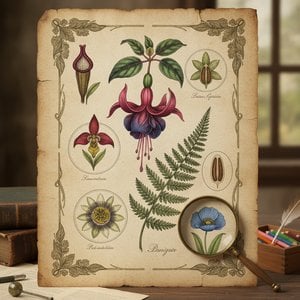
Преглед в реален мащаб Преглед с AR Поръчайте ръчно рисувано репродукция на този колекционерски предмет Превключване към дигитално изображение Сподели
Подробности Ръководство Добави в любими Изтегляне Подобни артикули Рентгенова снимка Слайдшоу Статистика

(Untitled--Flower Study)

Discover Mary Vaux Walcott’s exquisite watercolor ‘Untitled--Flower Study’ (1886). A delicate botanical masterpiece showcasing wildflowers, reflecting her pioneering spirit & Audubon-like talent.

Мари Ваукс Уолъцът (1860-1940) е известна като „А Audubon на ботаниката“, с изтънчени акварелни рисунки на цветя и принос към естествените науки. Разгледайте детайлните й флорални произведения на изкуството!

Жикле / Художествен принт

Giclée печат или принт върху платно с музейно качество, бързо производство и гъвкави опции за завършен вид. ( Поръчайте ръчно рисувано репродукция на този колекционерски предмет Превключване към дигитално изображение)

P118B $10
P118H $10
P118W $10
P438Z $10
P508JH $12
P508YH $12
P805H $10
P805Z $10
P919BZ $10
P919G $10
P919XJ $10
P959ZH $10
P968JZ $12
W106C $8
W218G $10
W218JH $8
W218Y $10
W307PJ $10
W316G $10
W316PJ $8
W316Y $10
W398PJ $8
W4111J $10
W500HY $15
W500JH $15
W692G $12
W849H $8
W940BG $15
W953PJ $8

Стандартен размер
по поръчка
CM
INCH

Изберете от нашите предварително зададени размери, които съответстват на оригиналните пропорции на произведението.

ширина
височина

Можете да въведете собствени размери, за да паснат на конкретна рамка или пространство. Ако избраният от Вас размер не съвпада с пропорциите на оригиналното изображение, ние ще изрежем произведението или ще разширим изображението с огледален или едноцветен ръб. Дигитален макет ще бъде изпратен за Ваше одобрение преди започването на производството.
Моля, имайте предвид, че предпрегледът на екрана не отразява реалното изрязване или разширяване. Само макетът ще покаже точно финалната композиция.
Въпреки че са налични персонализирани размери, препоръчваме да изберете размер от предварително дефинирания списък, за да запазите оригиналните пропорции.

Доставка по целия свят () в рамките на 2 седмици вместо стандартните 4/5 седмици. (27 Септември)

why_choose_icon
Безплатна експресна доставка по целия свят
why_choose_icon
Висококачествено ленено платно
why_choose_icon
Пълно застраховане на доставката
why_choose_icon
Гаранция за възстановяване на митнически такси
why_choose_icon
Гаранция за пълно съответствие на цветовете
why_choose_icon
Политика за връщане в рамките на 100 дни (само при дефекти)
why_choose_icon
100% Гаранция за връщане на сумата
why_choose_icon
Отстъпка при поръчка на повече произведения

Обща сума

$ 68

reproduction

(Untitled--Flower Study)

Жикле / Художествен принт

Размер на репродукцията

-

Крайна цена

$ 68

Бърза информация

  • Artistic style: Botanical illustration
  • Dimensions: 23 x 14 cm
  • Notable elements: Diverse floral bouquet
  • Influences: Audubon
  • Year: 1886
  • Title: Untitled--Flower Study
  • Artist: Mary Vaux Walcott

Квиз за изкуство

За всеки въпрос има само един верен отговор.

Въпрос 1:
What is the primary subject of this watercolor painting?
Въпрос 2:
According to the description, what type of flowers are prominently featured in the painting?
Въпрос 3:
Which of the following best describes Mary Vaux Walcott's artistic reputation?
Въпрос 4:
In what year was this painting created?
Въпрос 5:
The painting’s composition features the vase of flowers positioned towards which element?

A Moment Preserved: Mary Vaux Walcott’s “Untitled – Flower Study”

Mary Vaux Walcott's "Untitled – Flower Study," painted in 1886, is more than just a watercolor depiction of blossoms; it’s a poignant glimpse into the life and artistic vision of a pioneering naturalist and artist. Measuring a modest 23 x 14 cm, this intimate piece belies the depth of observation and meticulous detail that characterized Walcott's work – earning her the affectionate title “the Audubon of Botany.” The painting captures a vibrant bouquet, dominated by shades of purple, white, and delicate pink, arranged within a simple yet elegant vase. It’s a scene brimming with life, radiating an almost palpable sense of summer’s fleeting beauty.

Walcott's artistic journey began in Philadelphia during a time when women’s roles were largely confined to domesticity. Yet, from her early childhood fascination with wildflowers – a gift of watercolor paints at the tender age of eight – she forged a path that defied societal expectations. The painting itself speaks to this resilience and determination; each petal is rendered with astonishing precision, capturing not just their outward appearance but also the subtle textures and delicate veins that reveal their inherent structure. Her technique leans heavily on wet-on-wet watercolor washes, creating luminous layers of color and a soft, atmospheric quality that evokes the hazy light filtering through a summer garden.

The Botanist’s Eye: Scientific Observation and Artistic Expression

Walcott's work was deeply rooted in scientific observation. Her extensive travels throughout North America, particularly her expeditions to the Canadian Rockies alongside her husband, Charles Doolittle Walcott (himself a renowned paleontologist), provided her with unparalleled access to a vast array of wildflowers. These journeys weren’t merely recreational; they were meticulously documented through detailed botanical illustrations and field notes. “Untitled – Flower Study” exemplifies this approach—it's not simply a pretty picture, but a carefully recorded specimen, a testament to Walcott’s dedication to cataloging the natural world.

The arrangement of flowers within the vase is deliberate, suggesting a thoughtful composition rather than a random assortment. Notice how she groups similar blooms together – clusters of purple lupines and white daisies create visual harmony while highlighting their individual characteristics. This careful attention to detail reflects Walcott’s scientific rigor, but it also reveals an innate artistic sensibility—a desire to capture not just the *what* of the flowers, but also the *how* they interact with light and space.

A Pioneer in a Male-Dominated Field

Mary Vaux Walcott's story is one of remarkable perseverance in a field dominated by men. She faced considerable resistance to her artistic pursuits, particularly from her family who initially favored more traditional roles for women. Yet, she persisted, driven by an unwavering passion for botany and a desire to share her observations with the world. Her work was eventually recognized by the Smithsonian Institution, where it remains a treasured part of their collection – a testament to her enduring legacy as “the Audubon of Botany.”

The painting’s historical context is crucial to understanding its significance. During the late 19th century, there was growing interest in natural history and scientific illustration. Artists like Walcott were commissioned to document the flora and fauna of North America, contributing significantly to our knowledge of the region's biodiversity. Her work stands as a vital record of a bygone era, capturing the beauty and fragility of wildflowers before widespread environmental change threatened their existence.

Emotional Resonance: A Quiet Moment of Beauty

"Untitled – Flower Study" possesses a quiet emotional resonance that transcends its simple subject matter. The soft colors, delicate brushstrokes, and intimate scale create a sense of serenity and contemplation. It’s a reminder to pause, appreciate the beauty of the natural world, and reflect on the interconnectedness of all living things. The painting invites us into a private moment—a glimpse of summer's fleeting grace captured forever on paper.

WahooArt offers meticulously crafted hand-painted reproductions of this exquisite watercolor, allowing you to bring this captivating piece of art history into your home or office. Each reproduction is created with the same care and attention to detail as the original, ensuring that you experience the full beauty and emotional impact of Mary Vaux Walcott’s masterpiece.


Биография на художника

A Life Blossoming in Watercolor: The World of Mary Vaux Walcott

Born into the refined world of Philadelphia’s Quaker society in 1860, Mary Morris Vaux seemed destined for a life of quiet domesticity. Yet, from an early age, a vibrant artistic spirit stirred within her, ignited by a simple gift – a set of watercolor paints at the tender age of eight. These weren't merely tools for recreation; they were keys unlocking a lifelong passion for capturing the delicate beauty of the natural world, particularly wildflowers. Little could anyone have predicted that this early inclination would blossom into a remarkable career, earning her the affectionate title “the Audubon of Botany.” Her story is not simply one of artistic talent, but also of resilience, scientific curiosity, and a pioneering spirit that defied societal expectations. The weight of familial responsibility fell upon young Mary after her mother’s death in 1880, compelling her to dedicate herself to caring for her father and two younger brothers. This devotion didn't extinguish her creative flame; rather, it fueled a deep connection with the landscapes they explored during their annual summer expeditions to the Canadian Rockies.

The Allure of the Rockies: Nature as Muse and Subject

These journeys were transformative. The rugged grandeur of the Canadian Rockies became Mary’s artistic laboratory. Alongside her brothers, she didn't merely observe the landscape; she meticulously documented it – studying mineralogy, charting glacial movements through drawings and photographs, and immersing herself in the intricate details of alpine flora. This wasn’t passive observation but active engagement with the scientific underpinnings of nature. It was during these expeditions that Mary began to hone her skills as a botanical illustrator, initially at the request of botanists eager for accurate depictions of rare species. Her approach was revolutionary for its time: she rendered plants to scale, showcasing their delicate stuctures and vibrant colors with unparalleled precision. Unlike many floral paintings of the era, which often romanticized or stylized their subjects, Walcott’s work prioritized scientific accuracy alongside artistic expression. The vastness of the landscape also fostered a spirit of adventure; in 1900, she became the first woman recorded to summit Mount Stephen, a feat that underscored her physical courage and unwavering determination. She meticulously documented the changing glaciers, recognizing their impact on the surrounding environment – a crucial observation for understanding climate change decades before it became a widely discussed concern.

A Partnership Forged in Science and Art

Mary’s life took another significant turn in 1914 when she married Charles Doolittle Walcott, then Secretary of the Smithsonian Institution and a renowned paleontologist. This union wasn't merely a personal connection; it was a meeting of minds deeply committed to scientific exploration. They shared a passion for understanding the natural world, and their marriage fostered a unique partnership where art and science intertwined seamlessly. Their expeditions to the Rockies continued, with Charles pursuing his geological research while Mary dedicated herself to her botanical paintings. These weren’t separate endeavors but complementary pursuits, each enriching the other. The Smithsonian Institution became a crucial platform for showcasing Mary's work, culminating in the publication of *North American Wild Flowers* in 1925 – a monumental five-volume collection featuring over 400 of her meticulously crafted illustrations. This publication cemented her reputation as a leading botanical artist and earned her the enduring moniker “the Audubon of Botany,” acknowledging the parallel between her detailed floral studies and John James Audubon’s iconic depictions of birds. The proceeds from the book were generously donated to the Smithsonian, ensuring its long-term preservation and accessibility for researchers and art enthusiasts alike.

The Delicate Artistry: Technique and Style

Mary Vaux Walcott's artistic style was characterized by a remarkable attention to detail and a commitment to scientific accuracy. She didn’t simply paint flowers; she meticulously rendered their structures, capturing the nuances of each petal, leaf, and stem with astonishing precision. Her watercolors were often executed on large-format paper, providing ample space for her detailed observations. She employed a technique known as “scale rendering,” ensuring that her illustrations accurately reflected the size and proportions of the plants they depicted. This meticulous approach was unusual for botanical illustration at the time, which frequently prioritized aesthetic appeal over scientific accuracy. Her color palettes were equally deliberate, reflecting the subtle hues and shades found in nature. Walcott’s work is notable for its ability to evoke both the beauty and complexity of the natural world, inviting viewers to appreciate the intricate details that often go unnoticed. She was a master of capturing light and shadow, creating paintings that seemed to shimmer with life.

Legacy and Recognition

Mary Vaux Walcott's influence extends far beyond the beauty of her paintings. Her work represents a unique synthesis of artistic skill, scientific observation, and adventurous spirit. She wasn’t simply documenting flowers; she was capturing their essence, revealing their intricate structures, and celebrating their vital role in the natural world. Her illustrations continue to be valued by both art enthusiasts and botanists alike, serving as invaluable resources for identifying and studying North American flora. Beyond her artistic achievements, Walcott also demonstrated a commitment to public service, serving on the federal Board of Indian Commissioners from 1927 to 1932 and actively advocating for improved conditions on Native American reservations. Upon her death in 1940, she bequeathed a substantial sum to the Smithsonian Institution, ensuring that future generations would benefit from scientific research and publication. A mountain peak in Jasper National Park, Mount Mary Vaux, stands as a lasting tribute to her adventurous spirit and enduring legacy. Her story serves as an inspiration, demonstrating how passion, dedication, and a deep connection with nature can blossom into a life of remarkable achievement.

Key Achievements & Recognition

  • Pioneering Botanical Illustration: Renowned for her scientifically accurate and artistically exquisite watercolor paintings of wildflowers.
  • “The Audubon of Botany”: Affectionately known by this title, recognizing the significance of her work in botanical art.
  • *North American Wild Flowers* (1925): Publication of a five-volume collection showcasing over 400 of her illustrations, solidifying her reputation.
  • First Woman to Summit Mount Stephen: A testament to her adventurous spirit and physical endurance.
  • Contributions to Glacial Geology: Documented glacial recession in the Canadian Rockies alongside her brothers, providing valuable data for climate change studies.
  • Philanthropic Legacy: Bequeathed a substantial sum to the Smithsonian Institution to support scientific research.

Мари Ваукс Уолъцът

Мари Ваукс Уолъцът

1860 - 1940 , Съединени американски щати

Бързи факти

  • Artistic Movement Or Style: Ботаническо изкуство
  • Artists Or Movements Influenced By This Artist: ['Оудрюън']
  • Artists Who Influenced This Artist: ['Джон Джеймс Оудрюън']
  • Date Of Birth: 31 юли 1860 г.
  • Date Of Death: 22 август 1940 г.
  • Full Name: Mary Vaux Walcott
  • Nationality: Американка
  • Notable Artworks:
    • Сезонни листа
    • Гаилдария аристотата
    • Роза боржуаiana
    • Фремондекон ригидум
  • Place Of Birth: Филаделфия, САЩ
Разгледайте произведения на изкуството, организирани по теми, стилове и характеристики.