Преглед в реален мащаб Преглед с AR Избор на принт Поръчайте ръчно рисувано репродукция на този колекционерски предмет Сподели
Подробности Ръководство Добави в любими Изтегляне Подобни артикули Рентгенова снимка Слайдшоу Статистика

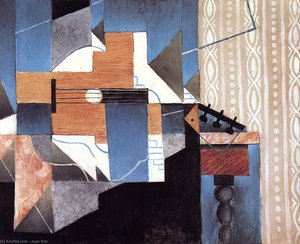
Violin and Guitar

Explore Juan Gris’s ‘Violin and Guitar’ (1913), a groundbreaking Cubist still life. Geometric forms, cool tones & layered glazes define this iconic piece – a must-see for art collectors.

Хуан Грис (1887-1927) е испански кубист, известен с геометричния си стил и използването на колаж. Неговите творби са символ на модернизма и влияят върху съвременните художници.

Закупете дигитално изображение с висока резолюция и подобрени характеристики, значително по-качествено от онлайн прегледа.

Всеки файл е щателно подготвен от нашите специалисти с помощта на съвременни инструменти и експертен ръчен ретуш. Гарантираме, че всяко изображение притежава изключителна яснота, прецизна цветова точност и фини детайли.

Окончателният файл се доставя по имейл в рамките на 72 часа, оптимизиран за незабавна употреба в професионални, редакционни и печатни среди. Това е същото качество, на което се доверяват водещи дизайнерски студия, издатели и галерии.

Дигитално изображение

Изтеглете файл с висока резолюция за лично съхранение, принтиране и творчески проекти. ( Избор на принт Поръчайте ръчно рисувано репродукция на този колекционерски предмет)

Крайна цена

$ 24,90

Включено във всяка поръчка за дигитални изображения

Експертна дигитална доставка, гарантирана

Избирайки WahooArt.com, вие не получавате просто изображение – вие придобивате професионално обработена дигитална творба, създадена с прецизност и подкрепена от гаранция за удовлетворение. Ето какво автоматично е включено във вашата поръчка:

shipping_icon
Бърза доставка по имейл

Вашето дигитално изображение с висока резолюция ще бъде изпратено по имейл в рамките на 72 часа от поръчката – готово за незабавно използване.

canvas_icon
Дигитален файл с подобрено качество чрез ИИ

Вашата картина е професионално оптимизирана с помощта на усъвършенствани инструменти за изкуствен интелект и ръчна редакция, осигурявайки максимална детайлност, яснота и точност на цветовете.

insurance_icon
Безплатна доживотна повторна доставка

Изгубили сте или сте изтрили файла си по погрешка? Не се притеснявайте – ще го изпратим отново на Вас по всяко време, безплатно.

tax_icon
Без митнически такси – завинаги

Насладете се на вашето произведение незабавно, без мита, данъци или такси за доставка – дигиталните изтегляния винаги са освободени от данъци.

color_icon
Гаранция за точност на цветовете

Гарантираме, че вашето дигитално изображение отразява оригиналните цветове възможно най-точно, чрез използването на професионални инструменти и системи за управление на цветовете.

return_icon
100-дневна гаранция за удовлетвореност

Ако не сте доволни от вашето дигитално изображение, ще го преработим или ще възстановим 100% от сумата в рамките на 100 дни – без излишни въпроси.

guarantee_icon
100% Гаранция за връщане на сумата

Не сте доволни? Получете пълен възврат на сумата в рамките на 100 дни от получаването на вашия цифров файл – без излишни въпроси.

discount_icon
Отстъпки за големи поръчки

Купете 3 изображения, спестете 10% - Купете 5, спестете 15% - Купете 10+, спестете 20%. Идеално за творчески проекти, галерии и агенства.

Бърза информация

  • Dimensions: 60 x 81 cm
  • Artist: Juan Gris
  • Location: Museo Reina Sofia
  • Notable elements: Geometric shapes,
  • Artistic style: Synthetic Cubism
  • Influences:
    • Picasso
    • Braque
  • Medium: Oil on canvas

Квиз за изкуство

За всеки въпрос има само един верен отговор.

Въпрос 1:
What artistic movement is ‘Violin and Guitar’ primarily associated with?
Въпрос 2:
In ‘Violin and Guitar’, what is a key characteristic of the depiction of the objects?
Въпрос 3:
Which of the following best describes Juan Gris’s approach to Cubism as seen in this work?
Въпрос 4:
The use of ‘papier collé’ (collage) in ‘Violin and Guitar’ primarily serves to:
Въпрос 5:
What does the fragmented spatial representation in ‘Violin and Guitar’ suggest about Gris's artistic approach?

A Fragmented Harmony: Juan Gris’s “Violin and Guitar”

Juan Gris’s “Violin and Guitar,” painted in 1913, isn't merely a still life; it’s a meticulously constructed exploration of perception and the very nature of representation. Emerging from the fertile ground of early Cubism, this work embodies the movement’s revolutionary shift away from traditional perspective and towards a fractured, multi-faceted view of reality. More than just depicting musical instruments, Gris offers us a glimpse into his innovative approach to visual language – a deliberate dismantling and reassembling of form that speaks volumes about the artist's intellectual rigor and artistic vision.

The canvas is dominated by the assertive presence of a guitar and violin, rendered with an almost startling degree of realism despite their fragmented composition. However, these recognizable objects are not presented in a straightforward manner. Instead, they’re broken down into geometric planes – sharp angles, interlocking rectangles, and subtly curved lines—that suggest multiple viewpoints simultaneously. This is the hallmark of Synthetic Cubism, where elements from various perspectives are layered upon one another to create an illusion of depth and volume within a flattened space. The background, hinted at through a suggestion of a window and curtain, further reinforces this sense of spatial ambiguity, inviting the viewer to actively participate in constructing the image.

The Language of Cubism: Deconstruction and Reconstruction

Gris’s approach is deeply rooted in the principles pioneered by Picasso and Braque. He embraced the analytical cubist method – a process of dissecting objects into their constituent parts, analyzing them from multiple angles, and then reconstructing them on the canvas. Yet, “Violin and Guitar” marks a significant departure from the purely analytical style. It’s a prime example of Synthetic Cubism, where pre-existing elements—fragments of color, texture, and form—are collaged together to create a new, unified image. The use of *papier collé*, or pasted paper, is subtly present in the background, adding another layer of complexity and visual interest.

Noticeably absent is the dense, monochromatic palette often associated with early Cubism. Instead, Gris employs a vibrant and carefully considered color scheme – cool blues and grays juxtaposed against warm reds and greens. These colors aren’t merely decorative; they contribute to the overall sense of dynamism and visual tension within the composition. The deliberate use of contrasting hues draws attention to specific areas of the painting, guiding the viewer's eye through the intricate network of lines and shapes.

Symbolism and Emotional Resonance

While “Violin and Guitar” is undeniably a formal masterpiece, it also carries a subtle layer of symbolic meaning. Music itself has long been associated with harmony, emotion, and creativity. The instruments depicted—the violin and guitar—represent these concepts in tangible form. The fragmentation of the objects can be interpreted as reflecting the complexities of human experience – the way we perceive reality through multiple lenses and the challenges of integrating disparate elements into a cohesive whole.

Furthermore, the painting’s overall mood is one of quiet contemplation. The muted colors, the fragmented forms, and the sense of spatial ambiguity create an atmosphere of detachment and introspection. It's not a celebratory or overtly emotional work; rather, it invites the viewer to engage in a process of careful observation and interpretation. The deliberate lack of strong shadows contributes to this feeling of flatness and abstraction, emphasizing the painting’s formal qualities over its representational ones.

A Legacy of Innovation

“Violin and Guitar” stands as a pivotal work in Juan Gris's artistic development and a cornerstone of Cubist innovation. It demonstrates his mastery of geometric form, his innovative use of color, and his ability to create complex visual narratives through seemingly simple compositions. Gris’s unique approach—combining rigorous analytical study with a poetic sensibility—established him as one of the most influential artists of the 20th century, leaving an indelible mark on the development of modern art.


Биография на художника

A Spanish Visionary of Cubism: The Life and Art of Juan Gris

Born José Victoriano González-Pérez in Madrid in 1887, the artist who would become known as Juan Gris embarked on a journey that profoundly shaped the course of early 20th-century art. His initial path wasn’t immediately aligned with canvas and brush; he pursued engineering at the Madrid School of Arts and Sciences, revealing an analytical mind – one that would later deeply inform his artistic approach. Even during these formative years, a creative spark flickered, evidenced by his contributions to local periodicals through drawings, hinting at a burgeoning visual talent waiting to be unleashed. It was in 1905 that he adopted the pseudonym Juan Gris, a name resonating with newfound identity and purpose as he began formal painting studies under José Moreno Carbonero – a pivotal shift that set him firmly on a trajectory toward artistic innovation.

Parisian Awakening and the Embrace of Cubism

The year 1906 marked a transformative relocation to Paris, a city then brimming with unparalleled artistic energy. Gris immersed himself completely in this vibrant milieu, forging enduring friendships with luminaries such as Henri Matisse, Georges Braque, and Fernand Léger. Initially, he honed his observational skills and developed a keen sense of visual wit through satirical illustration for publications like *L'Assiette au Beurre*, skillfully capturing the nuances of Parisian life. However, the magnetic pull of Pablo Picasso proved particularly influential, sparking a period of intense study and emulation. Around 1910, Gris began to dedicate himself wholeheartedly to painting, deliberately moving away from caricature and embracing the burgeoning language of Cubism – not merely imitating its style, but actively seeking a new visual order based on deconstruction and reconstruction. His early explorations were characterized by a deliberate departure from traditional representation, prioritizing abstraction as a means of capturing reality’s underlying structure and essence.

The Geometry of Perception: Style and Key Works

Juan Gris's artistic output is distinguished by an exceptional clarity and intellectual rigor. He didn’t simply break down objects; he meticulously rebuilt them, emphasizing geometric forms and employing a carefully considered palette. This approach led to what became known as his “crystal period,” exemplified in masterpieces such as *Still Life Before an Open Window* (1912) and *Place Ravignan* (1915). These works showcase a remarkable interplay of planes and angles, creating a sense of depth and solidity while simultaneously challenging conventional notions of perspective. The use of overlapping forms and fragmented viewpoints allowed him to represent multiple perspectives within a single image, reflecting the complexities of modern perception. After 1913, Gris wholeheartedly embraced Synthetic Cubism, pioneering the innovative use of *papier collé* – collage – incorporating real-world materials like newspaper clippings, fabric scraps, and wood grain into his compositions. This technique added another layer of complexity and tactile richness to his work, blurring the boundaries between painting and sculpture and inviting viewers to engage with the artwork on a more visceral level. Notable examples include *Guitar in front of the sea* (1925), a testament to his simplified forms and adherence to cubist principles, and *Homage à Pablo Picasso* (1912), which signaled his growing recognition within the avant-garde art world as he paid tribute to his influential mentor.

The Influence of Color and Form

Gris’s artistic development was profoundly shaped by both visual and intellectual influences. He studied the works of Cézanne, whose emphasis on geometric forms and spatial relationships served as a foundational influence. The principles of mathematics, particularly those explored by Jean Metzinger, also played a significant role in his approach to composition, guiding him toward a more structured and rational representation of reality. Furthermore, he was deeply inspired by the vibrant colors and expressive brushwork of Henri Matisse, incorporating bold hues and dynamic contrasts into his paintings. This synthesis of influences – Cézanne’s geometry, Metzinger's mathematics, and Matisse’s color palette – resulted in a uniquely innovative style characterized by clarity, precision, and emotional resonance.

Legacy and Lasting Influence

Juan Gris’s contribution to Cubism extends far beyond mere stylistic innovation; he brought an unparalleled intellectual depth and structural clarity to the movement. He moved past the analytical phase, transitioning towards a more organized and synthetic approach, emphasizing order and precision. His work profoundly influenced the Purist style championed by Amédée Ozenfant and Charles Edouard Jeanneret (Le Corbusier), advocating for a return to classical principles of form and composition. Gris’s emphasis on geometric forms, harmonious color palettes, and the integration of everyday objects into his art established him as a pivotal figure in 20th-century art. His legacy continues to inspire artists today, demonstrating the enduring power of Cubism and the visionary genius of Juan Gris – a Spanish master who reshaped our understanding of perception and representation.
Хуан Грис

Хуан Грис

1887 - 1927 , Испания

Кратка информация

  • Artistic Movement Or Style: Кубизъм, Синтетичен кубизъм
  • Artists Or Movements Influenced By This Artist:
    • Пуризъм
    • Озенфан
    • Ле Корбюзье
  • Artists Who Influenced This Artist:
    • Пикасо
    • Матис
    • Брак
  • Date Of Birth: 23 март 1887
  • Date Of Death: 11 май 1927
  • Full Name: José Victoriano González-Pérez
  • Nationality: Испанец
  • Notable Artworks:
    • Guitar in front of the sea
    • Homage à Pablo Picasso
    • The Miller
  • Place Of Birth: Мадрид, Испания