Преглед в реален мащаб Преглед с AR Избор на принт Превключване към дигитално изображение Сподели
Подробности Ръководство Добави в любими Изтегляне Подобни артикули Рентгенова снимка Слайдшоу Статистика

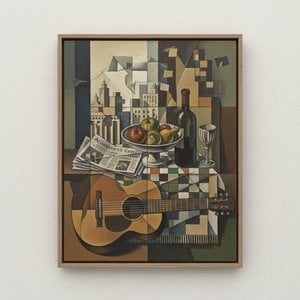
Violin and guitar - -

Explore Juan Gris’s Synthetic Cubism masterpiece – Violin and Guitar! This vibrant abstract depiction captures the essence of early 20th-century art with geometric shapes and fragmented forms, inviting you to discover a timeless classic.

Хуан Грис (1887-1927) е испански кубист, известен с геометричния си стил и използването на колаж. Неговите творби са символ на модернизма и влияят върху съвременните художници.

Ръчно изработена маслена репродукция

Ръчно рисувана маслена картина върху платно във вашия размер и рамка, изработена по поръчка от нашите художници. ( Избор на принт Превключване към дигитално изображение)

P118B $10
P118H $10
P118W $10
P438Z $10
P508JH $12
P508YH $12
P805H $10
P805Z $10
P919BZ $10
P919G $10
P919XJ $10
P959ZH $10
P968JZ $12
W106C $8
W218G $10
W218JH $8
W218Y $10
W307PJ $10
W316G $10
W316PJ $8
W316Y $10
W398PJ $8
W4111J $10
W500HY $15
W500JH $15
W692G $12
W849H $8
W940BG $15
W953PJ $8

Стандартен размер
по поръчка
CM
INCH

Изберете от нашите предварително зададени размери, които съответстват на оригиналните пропорции на произведението.

ширина
височина

Можете да въведете свои собствени размери, за да паснат на конкретна рамка или пространство. Ако избраният от вас размер не съответства на пропорциите на оригиналното изображение, ние ще изрежем произведението или ще разширим картината с допълнителни ръчно рисувани елементи. Дигитален макет ще бъде изпратен за ваше одобрение преди започване на производството.
Моля, обърнете внимание, че предпрогледа на екрана не отразява действителното изрязване или разширяване. Само макетът ще покаже точно финалната композиция.
Въпреки че са налични персонализирани размери, препоръчваме да изберете размер от предварително дефинирания списък, за да запазите оригиналните пропорции.

Примери за възможности за персонализация: Заменете лицето с фотография на клиента; Добавете домашен любимец (например заменете котка с куче); Включете скрито послание на фона; Променете пейзажа или елементите на фона.
След получаване на поръчка, екипът на WahooArt.com ще изпрати имейл до клиента с инструкции и ще предостави примерен макет за преглед.

Доставка по целия свят () в рамките на 3-4 седмици вместо стандартните 5 седмици. (25 Септември). Без компромис с качеството.

why_choose_icon
Безплатна експресна доставка по целия свят
why_choose_icon
Висококачествено ленено платно
why_choose_icon
Пълно застраховане на доставката
why_choose_icon
Гаранция за възстановяване на митнически такси
why_choose_icon
Гаранция за пълно съответствие на цветовете
why_choose_icon
Политика за връщане в рамките на 100 дни (само при дефекти)
why_choose_icon
100% Гаранция за връщане на сумата
why_choose_icon
Отстъпка при поръчка на повече произведения

Обща сума

$ 272

reproduction

Violin and guitar - -

Техника на репродукция

Размер на репродукцията

-

Крайна цена

$ 272

Бърза информация

  • Location: Private Collection
  • Movement: Cubism
  • Year: 1913
  • Subject or theme: Musical instruments
  • Notable elements or techniques: Geometric abstraction
  • Influences: Picasso
  • Artist: Juan Gris

Квиз за изкуство

За всеки въпрос има само един верен отговор.

Въпрос 1:
What artistic movement is Violin and Guitar by Juan Gris primarily associated with?
Въпрос 2:
In what year was Violin and Guitar created?
Въпрос 3:
Which artist collaborated with Juan Gris on the development of Synthetic Cubism?
Въпрос 4:
What is a key characteristic of Synthetic Cubism exemplified in Violin and Guitar?
Въпрос 5:
Where was Juan Gris born?

A Symphony in Geometric Fragments

In the quiet intersection of melody and mathematics lies Juan Gris’s 1913 masterpiece, Violin and Guitar. This evocative work serves as a profound emblem of Synthetic Cubism, a movement that fundamentally redefined the visual language of the early twentieth century. Rather than offering a mere window into a room, Gris presents us with a meticulously constructed reality where the boundaries between object and space dissolve into a rhythmic dance of planes. The composition, measuring 100 x 66 cm, invites the viewer to look beyond the surface of the musical instruments and instead experience the structural harmony that binds them together. Through his expert use of geometric deconstruction, Gris transforms the familiar curves of a violin and the resonant body of a guitar into a complex tapestry of overlapping shapes, creating an illusion of depth that feels both intellectually stimulating and visually mesmerizing.

The technique employed in this piece is a testament to Gris’s unique ability to synthesize form and color. Unlike the more analytical approach of his contemporaries, which often stripped subjects down to monochromatic fragments, Gris embraced the richness of Synthetic Cubism. He utilized a palette that balances muted, earthy tones with sudden, vibrant accents, allowing each geometric shard to hold its own weight within the frame. The application of oil on canvas is deliberate and precise, reflecting his early training in engineering. This precision allows for a fascinating spatial ambiguity; one moment, a curve suggests the neck of a violin, and the next, it becomes part of a larger, abstract pattern. For the discerning collector or interior designer, this interplay of light and shadow offers a dynamic energy that can anchor a room, providing a sophisticated focal point that rewards prolonged contemplation.

The Resonance of Modernity and Memory

Beyond its formal brilliance, Violin and Guitar carries a deep emotional and historical resonance. Created during a period of intense artistic upheaval in Paris, the painting captures the spirit of an era caught between tradition and the radical unknown. The choice of musical instruments is far from accidental; the violin and guitar are symbols of harmony, culture, and the human voice, yet here they are fractured and reassembled. This fragmentation can be seen as a metaphor for the modern experience—a world being broken down by rapid technological advancement and reconstructed through new, multifaceted perspectives. There is a certain poignant nostalgia in the way these classical objects are presented, even as they are subjected to the radical deconstruction of the Cubist lens.

For those seeking to bring a piece of art history into a contemporary living space, this reproduction offers more than just aesthetic beauty; it offers a conversation. The artwork’s ability to blend abstract complexity with recognizable motifs makes it an ideal choice for modern interiors that value intellectual depth and stylistic versatility. Whether placed in a minimalist gallery-style setting or a richly textured study, the painting radiates a sense of structured elegance. It is a work that does not merely decorate a wall but enriches the atmosphere, inviting anyone who gazes upon it to find their own rhythm within its beautiful, fragmented symphony.


Биография на художника

A Spanish Visionary of Cubism: The Life and Art of Juan Gris

Born José Victoriano González-Pérez in Madrid in 1887, the artist who would become known as Juan Gris embarked on a journey that profoundly shaped the course of early 20th-century art. His initial path wasn’t immediately aligned with canvas and brush; he pursued engineering at the Madrid School of Arts and Sciences, revealing an analytical mind – one that would later deeply inform his artistic approach. Even during these formative years, a creative spark flickered, evidenced by his contributions to local periodicals through drawings, hinting at a burgeoning visual talent waiting to be unleashed. It was in 1905 that he adopted the pseudonym Juan Gris, a name resonating with newfound identity and purpose as he began formal painting studies under José Moreno Carbonero – a pivotal shift that set him firmly on a trajectory toward artistic innovation.

Parisian Awakening and the Embrace of Cubism

The year 1906 marked a transformative relocation to Paris, a city then brimming with unparalleled artistic energy. Gris immersed himself completely in this vibrant milieu, forging enduring friendships with luminaries such as Henri Matisse, Georges Braque, and Fernand Léger. Initially, he honed his observational skills and developed a keen sense of visual wit through satirical illustration for publications like *L'Assiette au Beurre*, skillfully capturing the nuances of Parisian life. However, the magnetic pull of Pablo Picasso proved particularly influential, sparking a period of intense study and emulation. Around 1910, Gris began to dedicate himself wholeheartedly to painting, deliberately moving away from caricature and embracing the burgeoning language of Cubism – not merely imitating its style, but actively seeking a new visual order based on deconstruction and reconstruction. His early explorations were characterized by a deliberate departure from traditional representation, prioritizing abstraction as a means of capturing reality’s underlying structure and essence.

The Geometry of Perception: Style and Key Works

Juan Gris's artistic output is distinguished by an exceptional clarity and intellectual rigor. He didn’t simply break down objects; he meticulously rebuilt them, emphasizing geometric forms and employing a carefully considered palette. This approach led to what became known as his “crystal period,” exemplified in masterpieces such as *Still Life Before an Open Window* (1912) and *Place Ravignan* (1915). These works showcase a remarkable interplay of planes and angles, creating a sense of depth and solidity while simultaneously challenging conventional notions of perspective. The use of overlapping forms and fragmented viewpoints allowed him to represent multiple perspectives within a single image, reflecting the complexities of modern perception. After 1913, Gris wholeheartedly embraced Synthetic Cubism, pioneering the innovative use of *papier collé* – collage – incorporating real-world materials like newspaper clippings, fabric scraps, and wood grain into his compositions. This technique added another layer of complexity and tactile richness to his work, blurring the boundaries between painting and sculpture and inviting viewers to engage with the artwork on a more visceral level. Notable examples include *Guitar in front of the sea* (1925), a testament to his simplified forms and adherence to cubist principles, and *Homage à Pablo Picasso* (1912), which signaled his growing recognition within the avant-garde art world as he paid tribute to his influential mentor.

The Influence of Color and Form

Gris’s artistic development was profoundly shaped by both visual and intellectual influences. He studied the works of Cézanne, whose emphasis on geometric forms and spatial relationships served as a foundational influence. The principles of mathematics, particularly those explored by Jean Metzinger, also played a significant role in his approach to composition, guiding him toward a more structured and rational representation of reality. Furthermore, he was deeply inspired by the vibrant colors and expressive brushwork of Henri Matisse, incorporating bold hues and dynamic contrasts into his paintings. This synthesis of influences – Cézanne’s geometry, Metzinger's mathematics, and Matisse’s color palette – resulted in a uniquely innovative style characterized by clarity, precision, and emotional resonance.

Legacy and Lasting Influence

Juan Gris’s contribution to Cubism extends far beyond mere stylistic innovation; he brought an unparalleled intellectual depth and structural clarity to the movement. He moved past the analytical phase, transitioning towards a more organized and synthetic approach, emphasizing order and precision. His work profoundly influenced the Purist style championed by Amédée Ozenfant and Charles Edouard Jeanneret (Le Corbusier), advocating for a return to classical principles of form and composition. Gris’s emphasis on geometric forms, harmonious color palettes, and the integration of everyday objects into his art established him as a pivotal figure in 20th-century art. His legacy continues to inspire artists today, demonstrating the enduring power of Cubism and the visionary genius of Juan Gris – a Spanish master who reshaped our understanding of perception and representation.

Хуан Грис

Хуан Грис

1887 - 1927 , Испания

Бързи факти

  • Artistic Movement Or Style: Кубизъм, Синтетичен кубизъм
  • Artists Or Movements Influenced By This Artist:
    • Пуризъм
    • Озенфан
    • Ле Корбюзье
  • Artists Who Influenced This Artist:
    • Пикасо
    • Матис
    • Брак
  • Date Of Birth: 23 март 1887
  • Date Of Death: 11 май 1927
  • Full Name: José Victoriano González-Pérez
  • Nationality: Испанец
  • Notable Artworks:
    • Guitar in front of the sea
    • Homage à Pablo Picasso
    • The Miller
  • Place Of Birth: Мадрид, Испания
Разгледайте произведения на изкуството, организирани по теми, стилове и характеристики.