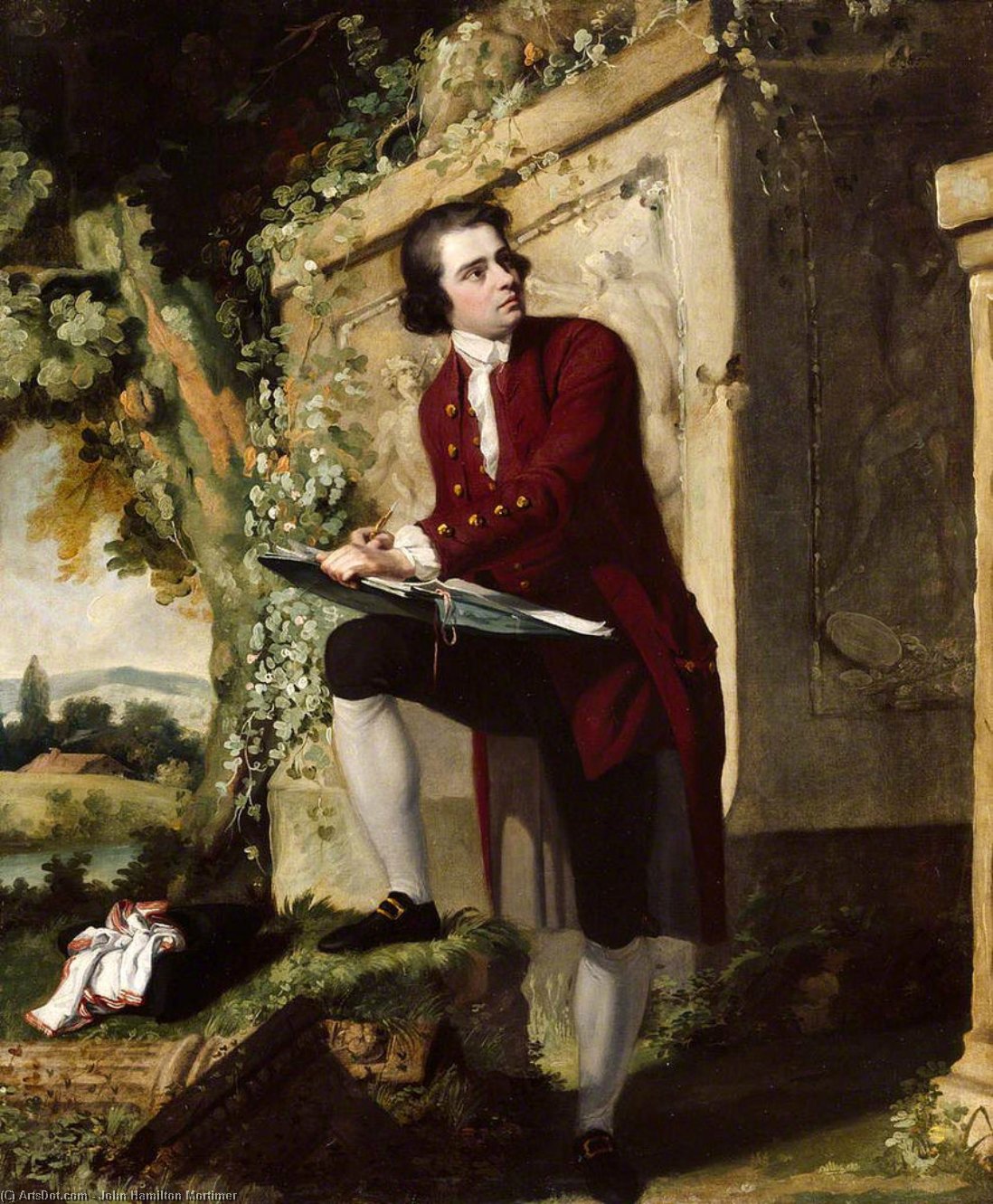
Биография на художника
John Hamilton Mortimer (1740–1779): A Life Painted in Romantic Hues
John Hamilton Mortimer, a name perhaps less instantly recognizable than his contemporaries like Reynolds or Wright of Derby, nevertheless occupies a significant and fascinating niche within the landscape of 18th-century British art. Born in Eastbourne, Sussex, on September 17th, 1740, Mortimer’s brief but intensely productive life—he died at just thirty-nine years old—was marked by artistic ambition, a restless spirit, and an evolving style that mirrored the shifting tastes of his era. His father, Thomas Mortimer, was a customs officer with mercantile interests, providing a stable if unremarkable background for a young man destined to pursue a path steeped in creativity. By 1757, Mortimer had already gravitated towards London, enrolling at the Duke of Richmond’s Academy, where he forged a lifelong friendship with Joseph Wright, a bond that would prove mutually supportive throughout their careers. This early immersion into the artistic milieu fostered not only technical skill but also an awareness of the burgeoning intellectual currents shaping British art—particularly the fascination with classical ideals and the growing interest in dramatic narratives.
From Michelangelo to Rosa: The Foundations of Style
Mortimer’s formative years were dedicated to mastering foundational techniques, beginning with meticulous studies after Michelangelo's *Bacchus* and exploring the intricacies of life drawing. These exercises instilled a disciplined approach that would underpin his subsequent artistic endeavors. He quickly gained recognition for his historical paintings, notably *St Paul Preaching to the Ancient Druids in Britain*, which remains housed in the Guildhall at High Wycombe. This monumental canvas exemplifies Mortimer’s commitment to conveying emotion and capturing pivotal moments with palpable energy—a characteristic that would define much of his oeuvre. However, Mortimer refused to simply replicate established conventions; he possessed a remarkable sensitivity to aesthetic trends emerging during his time. He studied alongside other promising talents like Thomas Jones and William Pars at St Martin’s Lane Academy, absorbing influences from masters such as Cipriani, Robert Edge Pine, and Sir Joshua Reynolds himself—a lineage that championed both realism and expressive dynamism.
The Bandit Landscape: Embracing Romantic Sensibility
A decisive stylistic shift occurred in Mortimer's artistic trajectory during the 1770s. He moved away from the prevailing emphasis on refined elegance and aristocratic grandeur towards depictions of rugged landscapes populated by bandits and soldiers—a deliberate embrace of Salvator Rosa’s dramatic aesthetic. Rosa, a Neapolitan painter celebrated for his untamed scenes of outlaws and heroic figures battling against overwhelming odds, served as an undeniable inspiration. Mortimer's fascination with this darker side of human experience resonated deeply with the burgeoning Romantic movement, foreshadowing its artistic dominance in subsequent decades. He even created an etching after Rosa’s self-portrait, demonstrating his profound admiration for Rosa’s uncompromising vision and stylistic boldness. This newfound passion for landscape painting—characterized by turbulent skies, dramatic lighting, and evocative compositions—marked a pivotal moment in Mortimer's artistic evolution.
Collaboration and Artistic Leadership: Shaping the Visual Landscape of Britain
Mortimer wasn’t solely a solitary artist; he actively engaged in collaborative projects with fellow artists, bolstering his reputation and expanding his creative horizons. He frequently contributed figure work to canvases by others, most notably assisting Thomas Jones on ambitious undertakings like *A Land Storm, with the Story of Dido and Aeneas*, *The Death of Orpheus*, and a pair of paintings inspired by Milton’s *Allegro* and *Penseroso*. These collaborations underscored his versatility and willingness to contribute his skills to larger artistic endeavors—a testament to his collaborative spirit. Furthermore, Mortimer played a crucial role in the opulent decoration of Brocket Hall, Hertfordshire, collaborating with Francis Wheatley and James Durno on the saloon’s interior scheme. In 1774, he achieved a zenith of his professional life when elected President of the Society of Artists—a position that afforded him considerable influence within the artistic community during a period of significant transformation.
A Legacy Tempered by Early Loss: The Fleeting Brilliance of Talent
Despite his successes and accomplishments, Mortimer’s career was tragically curtailed by an undisclosed illness on February 4th, 1779. His marriage to Jane Hurrel seemed to impact his artistic output, and he succumbed at the young age of thirty-nine—leaving behind a legacy that remains largely unrealized. Though he exhibited at the Royal Academy in 1778—presenting five works including *Sir Arthegal* and bandit scenes—and was elected an Associate shortly before his demise, Mortimer’s potential for future artistic development was tragically cut short. While Horace Walpole dismissed him as a mere imitator of Salvator Rosa—a critique that arguably overlooks Mortimer's distinctive contribution to British art—scholarly research has illuminated his life, artistic progression, and enduring influence. Today, John Hamilton Mortimer is increasingly recognized as a significant figure whose paintings—characterized by their dramatic narratives, expressive brushwork, and exploration of complex themes—offer a compelling glimpse into the artistic sensibilities of his time. His work bridged the gap between classical traditions and Romanticism, paving the way for subsequent generations to embrace emotion, imagination, and storytelling in their own creative endeavors.