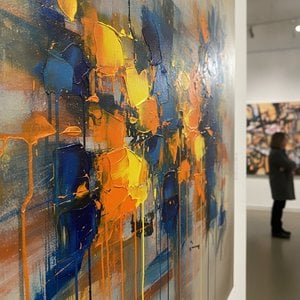
Joan Miró: Exploring Inner Landscapes Through Geometric Abstraction
Joan Miró (1893 – 1983), born in Barcelona, Spain, remains an undisputed titan of Catalan and international art history. His prolific output spanned decades, encompassing painting, sculpture, ceramics, lithographs, and textiles—each medium serving as a vehicle for his singular vision: a profound engagement with the subconscious mind and a celebration of Catalan cultural heritage.
Early Influences & Artistic Formation
Miró’s formative years were marked by illness and familial anxieties regarding his artistic inclinations. Despite initial reservations from his parents, he pursued his passion relentlessly, nurtured by an unwavering belief in the power of visual expression to transcend rational thought. Gaudí's architectural innovations—particularly the undulating curves and organic forms of Sagrada Familia—provided a subtle yet formative influence on Miró’s evolving aesthetic sensibilities. This fascination with natural shapes would later translate into the geometric abstractions that characterize his mature oeuvre.
The Birth of Geometric Abstraction
By the mid-1920s, Miró embarked upon a radical stylistic transformation, abandoning representational painting for a groundbreaking approach rooted in geometric abstraction. Inspired by Surrealist principles—particularly automatism—he sought to bypass conscious control and tap into the realm of dreams and instinctual impulses. His canvases became populated with stylized figures—often resembling birds or insects—arranged in asymmetrical compositions dominated by circles, squares, and triangles.
Symbolism & Catalan Identity
Miró’s artwork is laden with symbolism reflecting his deep connection to Catalan culture and folklore. Recurring motifs such as the snail—representing perseverance and regeneration—the bird—symbolizing freedom and aspiration—and stylized human figures embody archetypal themes of birth, death, and transformation. The artist deliberately employed a palette of earthy hues—ochres, reds, yellows—to evoke the landscapes and traditions of Catalonia.
Technique & Artistic Legacy
Miró’s technique involved layering pigments onto canvas with meticulous care, utilizing brushstrokes that varied in texture and direction to create dynamic visual surfaces. He frequently employed collage techniques incorporating paper fragments and textile scraps—a deliberate gesture honoring the artisanal traditions of Barcelona. His influence extends far beyond his own lifetime, inspiring generations of artists who embraced abstraction as a means of conveying emotion and exploring psychological depths. Today, Miró’s paintings continue to captivate audiences worldwide, serving as enduring emblems of artistic innovation and humanist contemplation.
- Notable Works: “The Astronomer,” “Barcelona,” “Silence”
- Style: Geometric Abstraction
- Medium: Oil Paint on Canvas
- Historical Context: Surrealism, Catalan Modernisme



 Преглед в реален мащаб
 Поръчайте ръчно рисувано репродукция на този колекционерски предмет
 Сподели
 Сподели
 Подробности
 Ръководство

 Изтегляне
 Подобни артикули
 Рентгенова снимка
 Слайдшоу
 Статистика

 Разгърни целия текст






































 Опцията със стъкло е налична само за размери под 110 см