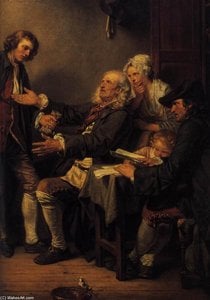
Jean-Baptiste Greuze: A Master of Sentiment and the Soul of Rococo
Born in the tranquil Burgundian town of Tournus in 1725, Jean-Baptiste Greuze’s life was a testament to both extraordinary talent and persistent struggle. His early years were marked by modest circumstances – his father a roofer, his mother a seamstress – yet within him burned an undeniable passion for art, a spark that defied the limitations imposed upon him. It was through the guidance of Grandon, a Lyon artist who recognized Greuze’s innate gift, that this nascent talent began to blossom, leading to formative studies in Lyon and ultimately, the prestigious Royal Academy in Paris under Charles-Joseph Natoire. This Parisian sojourn proved pivotal, shaping his artistic vision while simultaneously pushing him towards a path of independent exploration, diverging from the prevailing academic focus on grand historical narratives.
The Dawn of a New Genre: Painting the Everyday
Greuze’s breakthrough arrived in 1755 with *Le Père de famille expliquant la Bible à ses enfants* (The Father Explaining the Bible to His Children). This wasn't merely a depiction of domestic life; it was an embodiment of the Enlightenment’s core values, a poignant portrayal of familial piety and moral instruction. The painting resonated profoundly with the contemporary public, capturing a spirit of bourgeois virtue – a burgeoning sense of morality and social responsibility – that was rapidly gaining traction within French society. The discerning collector Ange-Laurent de La Live de Jully immediately recognized its significance, acquiring it and catapulting Greuze to instant fame. He swiftly followed this success with a series of genre scenes—intimate glimpses into the lives of ordinary people, imbued with an extraordinary depth of emotional resonance and subtle moral undertones. A journey to Italy in 1755, undertaken alongside Abbé Louis Gougenot, broadened his artistic horizons, exposing him to classical influences while simultaneously reinforcing his commitment to depicting the realities of French life rather than idealized historical settings. This period saw a refinement of his technique, a deepening understanding of composition and light, but crucially, a firm establishment of his unique style—one characterized by an unparalleled ability to evoke genuine feeling: joy, sorrow, remorse, and everything in between.
The Language of Emotion: Techniques and Symbolism
Greuze’s genius lay not simply in his technical skill, but in his profound understanding of human psychology and his masterful manipulation of visual language. He was a meticulous observer of everyday life, capturing the subtle gestures, fleeting expressions, and unspoken emotions that defined the experiences of ordinary people. His compositions were often carefully staged—a bare timbered room, strategically lit to draw attention to key figures; a simple arrangement of objects—each carrying symbolic weight. He employed a distinctive palette, favoring muted tones and soft pastels, creating an atmosphere of intimacy and vulnerability. The use of dramatic lighting – pools of light illuminating faces and hands – heightened the emotional impact of his scenes, drawing the viewer into the heart of the narrative. Greuze’s ability to convey inner turmoil through facial expressions alone was legendary; a single glance could reveal a lifetime of sorrow or a fleeting moment of joy. His work wasn't merely representational; it was an exploration of the human condition—a meditation on morality, faith, and the complexities of family relationships.
The Academy’s Resistance: A Struggle for Recognition
Despite his burgeoning fame and critical acclaim, Greuze faced persistent resistance from the Académie Royale de Peinture et de Sculpture. Initially denied full membership, he was relegated to the status of a genre painter—a category considered less prestigious than history painting, which encompassed mythological and religious subjects. This rejection fueled his ambition and intensified his determination to be recognized as a serious artist. He attempted a bold transition into historical painting with *Septimius Severus Reproaching Caracalla* (1769), a monumental work that showcased his technical prowess but ultimately failed to impress the Academy’s conservative judges. The composition, while ambitious in scale, lacked the clarity and emotional depth expected of a history painting, and it was met with harsh criticism. This setback further solidified his position as a genre painter—a label he initially resisted, yet one that ultimately defined his career.
Later Years and a Legacy of Sentiment
The rejection by the Academy marked a turning point in Greuze’s life, leading to a period of isolation and disillusionment. He withdrew from exhibiting at the Salon for many years, becoming increasingly reclusive and embittered. His later works often explored darker themes—the allure of seduction, the consequences of moral transgression, and the vulnerability of youth. While technically proficient, these paintings lacked the emotional resonance and moral clarity that characterized his earlier masterpieces. He died in poverty within the Louvre itself in 1805, a poignant reminder of the challenges he faced throughout his career. Despite this decline, Jean-Baptiste Greuze’s influence on French art remains profound. He pioneered a new form of genre painting—one focused on contemporary life and exploring universal human emotions—and paved the way for later artists who sought to depict the realities of everyday existence with honesty and sensitivity. His legacy endures as a testament to the power of sentiment, the beauty of the ordinary, and the enduring appeal of a master storyteller.
Key Works & Their Significance
- Le Père de famille expliquant la Bible à ses enfants (1755): A cornerstone of his early success, embodying Enlightenment ideals of familial piety.
- La Jeune Fille qui pleure son oiseau mort (c. 1765): Demonstrates Greuze’s mastery of emotional expression and poignant storytelling.
- Savoyard with a Dancing Doll (c. 1763): Captures the spirit and vulnerability of childhood, showcasing his skill in portraiture.
- Septimius Severus Reproaching Caracalla (1769): A failed attempt at historical painting that highlighted his strengths lay elsewhere.
- The Broken Pitcher (c. 1770s): Represents a shift towards more sensual and morally ambiguous themes in his later work.



 Преглед в реален мащаб
 Избор на принт
 Сподели
 Сподели
 Подробности
 Ръководство

 Изтегляне
 Подобни артикули
 Рентгенова снимка
 Слайдшоу
 Статистика


 Разгърни целия текст






































 Опцията със стъкло е налична само за размери под 110 см