Francesco Bacchiacca: A Florentine Master of Dramatic Emotion
Born Francesco d’Ubertino Verdi in Florence on March 1, 1494, and known universally as il Bacchiacca (meaning “the hunchback” – a nickname referencing his prominent nose), this Italian painter stands as a pivotal figure bridging the late Renaissance and the burgeoning Mannerism. His life was inextricably linked to the vibrant artistic milieu of Florence, a city renowned for its patronage and innovative spirit. Bacchiacca’s career unfolded within a family already steeped in artistic tradition; his father, Ubertino di Bartolomeo, was a skilled goldsmith, while older brother Bartolomeo d'Ubertino Verdi (Baccio) was himself a painter. This familial legacy undoubtedly shaped his early training and provided a fertile ground for artistic exploration.
Early influences were deeply rooted in the Florentine school of painting. He apprenticed under Perugino, a master known for his serene compositions and refined technique, gaining invaluable experience in fresco painting and understanding classical principles. However, Bacchiacca quickly distinguished himself through a distinctly personal style – one characterized by intense emotion, dynamic movement, and a willingness to challenge conventional artistic norms. He wasn't simply replicating the idealized beauty of the High Renaissance; instead, he sought to capture the raw energy and psychological depth of human experience.
A Palette of Passion: Style and Technique
Bacchiacca’s distinctive style is immediately recognizable through its dramatic use of color, bold brushstrokes, and a pronounced sense of movement. Unlike the balanced compositions favored by his contemporaries, Bacchiacca often employed asymmetrical arrangements, creating a feeling of instability and tension. His figures are frequently depicted in moments of intense emotion – grief, ecstasy, violence – rendered with remarkable realism and psychological acuity. He was particularly adept at portraying women, imbuing them with a captivating blend of vulnerability and strength.
His technique involved layering colors to create rich textures and luminous effects. He utilized a technique known as “impasto,” applying paint thickly to the canvas to build up three-dimensional forms and heighten visual impact. Bacchiacca’s compositions are often crowded with figures, creating a sense of immediacy and immersing the viewer in the scene. He frequently incorporated elements from contemporary prints – particularly Venetian scenes – into his paintings, reflecting the artistic exchange that characterized Renaissance Florence.
Courtly Patronage and Artistic Circles
In 1540, Bacchiacca secured a prestigious position as an artist at the court of Duke Cosimo I de’ Medici in Florence. This appointment marked a significant turning point in his career, providing him with access to considerable wealth and influence. He became a valued member of the Medici circle, collaborating with other leading artists such as Andrea del Sarto, Jacopo Pontormo, and Francesco Granacci. The Duke commissioned Bacchiacca to decorate the walls and ceiling of his private study, a project that showcased his ability to create complex allegorical scenes filled with plants, animals, and landscapes – reflecting Cosimo’s interest in natural history.
Beyond the court, Bacchiacca was involved in various artistic projects, including the decoration of cassone (chest) panels and spalliera (wainscot), as well as designing tapestries for the Medici tapestry workshops. His work during this period demonstrates a remarkable versatility and an ability to adapt his style to different commissions and patrons.
Key Works and Legacy
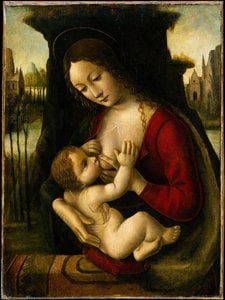
Among Bacchiacca’s most celebrated works are “The Beheading of St. John the Baptist,” now housed in Berlin, and “Ghismonda with Heart of Guiscardo,” a dramatic portrayal of a tragic love story displayed at the Lowe Art Museum in Miami. His "Madonna and Child" is held by the Metropolitan Museum of Art in New York, a painting that exemplifies his ability to infuse religious subjects with intense emotion and psychological depth.
Bacchiacca’s influence extended beyond his own lifetime. He was a mentor to several younger artists, including his brother Antonio d'Ubertino Verdi (who also used the name Bachiacca), and his work served as an inspiration for later Mannerist painters. Despite the relatively small number of surviving paintings attributed to him, Bacchiacca’s contribution to the development of Renaissance art is undeniable. He remains a compelling figure – a master of dramatic emotion who pushed the boundaries of artistic convention and left an enduring legacy on the Florentine school.
A Family Affair: The Verdi Artistic Dynasty
It's crucial to understand that Bacchiacca’s artistic lineage was part of a larger, interconnected family. The Verdi brothers – Francesco, Bartolomeo, and Antonio – all shared a passion for art and worked together in various capacities. This familial collaboration created a unique artistic environment where ideas were exchanged, techniques were refined, and a distinctive style emerged. The family’s involvement extended beyond painting; Antonio was also an embroiderer, further diversifying their creative output.
Tracing the lineage of Bacchiacca's work reveals a complex network of apprenticeships, collaborations, and stylistic influences. The Verdi family’s artistic legacy continued for generations, with subsequent members carrying on the tradition of painting and embroidery. This familial dedication to art ensured that Bacchiacca’s influence would endure long after his death in 1557.



 Преглед в реален мащаб
 Избор на принт
 Сподели
 Сподели
 Подробности
 Ръководство

 Изтегляне
 Подобни артикули
 Рентгенова снимка
 Слайдшоу
 Статистика
 Разгърни целия текст