The Soul of the Barkenhoff: The Artistic Odyssey of Heinrich Vogeler
Johann Heinrich Vogeler was far more than a mere painter; he was a visionary architect of atmosphere, a man whose brush captured the delicate transition from the romanticized dreamscapes of the late nineteenth century to the stark, unyielding realities of the twentieth. Born in Bremen in 1872, Vogeler’s early life was steeped in the rigorous traditions of the
Kunstakademie Düsseldorf. Between 1890 and 1895, he immersed himself in the academic excellence of this prestigious institution, absorbing the light-drenched techniques of Impressionism and the structural depth of Post-Impressionism. His formative travels through Belgium and Italy further enriched his visual vocabulary, introducing him to the timeless grandeur of Renaissance art, which would later provide a classical foundation for his more experimental endeavors.
The true heartbeat of Vogeler’s life, however, was found in the
Worpswede colony. Joining this vibrant community of artists in 1894, he sought refuge from the industrializing world within the idyllic landscapes of northern Germany. In 1895, he purchased a cottage that would become legendary: the
Barkenhoff. By planting vast groves of birch trees around his home—a literal and symbolic act of renewal—he created a sanctuary that mirrored his own artistic evolution. Here, amidst the silver bark and soft light, Vogelers developed a style that seamlessly blended the ethereal beauty of Symbolism with the flowing, organic lines of
Art Nouveau. His work from this period often feels like a whispered secret, capturing the quiet magic of the Bremen region through a lens of romantic idealism.
From Aesthetic Beauty to Social Conscience
As the decades progressed, the tranquil, dreamlike quality of Vogeler’s early landscapes began to yield to a more profound and turbulent engagement with the world. The turn of the century brought not only new artistic movements like Fauvism, which introduced bolder palettes and more expressive brushwork to his repertoire, but also a deepening political consciousness. His travels through the industrial heartlands of Europe—witnessing the struggles in the slums of Glasgow and Manchester—ignited a deep sympathy for the working class. This period marked a seismic shift in his oeuvre; the delicate, decorative elegance of his book illustrations and Arts & Crafts designs began to coexist with a growing preoccupation with social justice and human struggle.
The devastation of the First World War served as the ultimate catalyst for this transformation. Serving as a communications officer on the Eastern Front in 1915, Vogeler’s exposure to the vast landscapes of Poland, Romania, and Russia, coupled with his encounter with Bolshevik ideology, fundamentally altered his worldview. He emerged from the conflict not merely as a painter of beauty, but as a committed pacifist and a socialist activist. His art began to reflect this new, gritty reality, moving away from the escapism of the
Künstlerkolonie toward a style of
Social Realism. This evolution was nothing short of revolutionary, as he sought to bridge the gap between aesthetic excellence and ethical responsibility, using his art to advocate for peace and the dignity of the common man.
A Lasting Legacy of Art and Activism
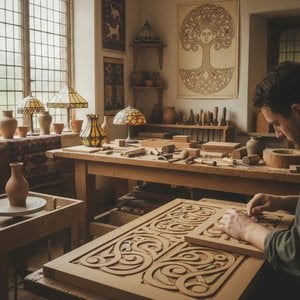
The historical significance of Heinrich Vogeler lies in his refusal to remain static. He remains a pivotal figure because he embodied the complex contradictions of his era: the tension between the nostalgic longing for a pastoral past and the urgent, often violent, birth of a modern, politically charged future. Whether through his intricate wood carvings, his decorative paintings for the Bremen town hall, or his later, socially conscious compositions, Vogeler’s work remains a testament to the power of art to evolve alongside the human spirit.
His life's work can be summarized by several enduring contributions:
- The Creation of the Barkenhoff: Establishing a physical and spiritual center for the Worpswede movement that continues to inspire artists today.
- Mastery of Art Nouveau: His ability to integrate decorative arts, book illustration, and fine painting into a cohesive aesthetic language.
- Artistic Transformation: The rare and successful transition from Romantic Symbolism to a profound Social Realism driven by political conviction.
- Cultural Synthesis: Blending the academic rigor of the Düsseldorf School with the expressive freedom of modern European movements.
Though his later years were marked by political upheaval and the shadows of a changing Germany, Vogeler’s legacy endures as a bridge between two worlds—the beautiful and the just, the dream and the reality.



 Представи си го
 Купете ръчно рисувана картина
 Изпрати
 Сподели
 Детайли

 Изтегляне
 Подобни
 Рентгенова снимка
 Слайдшоу

 Прочетете повече






































 Стъклото е налично само в размери под 110 см