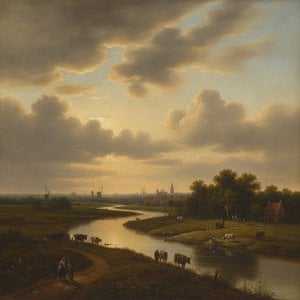
introduction to hans vredeman de vries
hans vredeman de vries, a renowned dutch renaissance architect, painter, and engineer, was born in 1527 in leeuwarden, netherlands. he is known for his publication on garden design in 1583 and his books featuring many examples of ornaments (1565) and perspective (1604). de vries' work had a significant impact on the development of dutch architecture and art.
early life and education
de vries was raised in friesland, where he developed an interest in architecture and painting. in 1546, he moved to amsterdam and kampen, furthering his education and skills. he studied vitruvius and sebastiano serlio, becoming an internationally known specialist in perspective.
career
de vries continued his career in antwerp, where he was appointed city architect and fortification engineer. after 1585, he fled the city due to the spanish occupation by alessandro farnese. he then worked in wolfenbüttel, designing a fortification and a new layout of the city for julius, duke of brunswick-lüneburg. de vries also worked in hamburg, danzig (1592), prague (1596), and amsterdam (1600).
artistic style
de vries' artistic style is characterized by his use of perspective and ornaments. his books featuring examples of these elements have been widely admired and studied.
hans vredeman de vries tried to get an appointment at the university of leiden in 1604, but it is not known when and where he died.
legacy
de vries' legacy can be seen in his numerous works, including his publications on garden design and perspective. his son paul, also a painter, continued his father's work. de vries' impact on dutch architecture and art is still celebrated today.
museums and collections
the
museum huis ten bosch in the hague, netherlands, features works by de vries and other famous artists, including
pieter de grebber,
salomon de bray, and
jacob jordaens. the museum's collection includes over 500 works spanning different periods and styles.
important works by de vries can be found in various museums and collections, including the
van gogh museum in amsterdam. his legacy continues to inspire artists and architects around the world.
conclusion
hans vredeman de vries was a talented artist and architect who left a lasting impact on dutch art and architecture. his work can be seen in various museums and collections, including the
museum huis ten bosch and the
van gogh museum. his legacy continues to inspire artists and architects today.



 Представи си го
 Превключване към принт
 Изпрати
 Сподели
 Детайли

 Изтегляне
 Подобни
 Рентгенова снимка
 Слайдшоу
 Статистика


 Прочетете повече






































 Стъклото е налично само в размери под 110 см