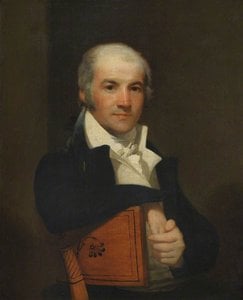
Amasa Davis’s Quiet Dignity: Gilbert Stuart's Portrait of a Statesman
Gilbert Charles Stuart’s “General Amasa Davis, C.1820 (Oil on Panel)” is more than just a likeness; it’s a carefully constructed tableau of civic virtue and understated power. Painted in the early 19th century, during a period of intense national self-definition following the American Revolution, this portrait captures General Davis – a prominent figure in Ohio’s burgeoning industrial landscape – with an arresting blend of formality and approachable humanity. Stuart, already establishing his reputation as America's foremost portraitist, masterfully employs the Neoclassical style, drawing inspiration from the classical ideals of balance, harmony, and restrained emotion that were so prevalent at the time. The painting isn’t a dramatic depiction of military prowess; instead, it offers a glimpse into the character of a man deeply involved in shaping his community – a quiet force dedicated to progress and prosperity.
The Brushstroke and Technique: Stuart's Nuanced Approach
Stuart’s technique is characterized by its remarkable subtlety. He eschews overly theatrical lighting or dramatic poses, favoring instead a soft, diffused illumination that gently reveals the subject’s features. Note the meticulous attention to detail in Davis’s attire – the rich fabric of his coat, the precise folds of his waistcoat, and the carefully rendered buttons all speak to Stuart's commitment to realism and accuracy. The artist skillfully utilizes layering techniques, building up color gradually to create a sense of depth and volume. The brushwork itself is remarkably delicate, almost hesitant in places, contributing to the overall impression of quiet contemplation. This restrained approach was a deliberate choice by Stuart, reflecting his belief that true character resided not in outward display but in inner integrity.
Symbolism Within the Composition: Order and Civic Duty
The composition of the portrait is laden with symbolic meaning. Davis sits within a richly appointed interior – a simple yet elegant room suggesting both wealth and refinement. The placement of his chair, angled slightly towards the viewer, invites engagement and establishes a sense of direct address. His hands rest calmly on a table, not gesturing emphatically but conveying an air of thoughtful deliberation. These seemingly small details contribute to a larger narrative about civic responsibility and the importance of reasoned leadership. Davis’s posture embodies the ideals of republican virtue – self-control, prudence, and a dedication to the common good. The background, though subtly rendered, reinforces this theme with its suggestion of domestic comfort and stability.
Historical Context: Ohio's Industrial Rise and Stuart's National Portraiture
“General Amasa Davis” was painted during a pivotal moment in American history – the rapid industrialization of the Midwest, particularly in states like Ohio. Davis himself played a significant role in this transformation, overseeing the construction of vital infrastructure projects that fueled economic growth. Stuart’s decision to paint him reflects this broader trend, capturing a man at the forefront of a nation undergoing profound change. Simultaneously, Stuart was establishing his place as *the* portraitist of early America, producing iconic images of presidents, statesmen, and prominent figures who would shape the nation's destiny. His work served not only as visual records but also as powerful symbols of American identity and values.
Emotional Resonance: A Portrait of Measured Strength
Ultimately, “General Amasa Davis” is a portrait that transcends mere representation. It evokes a sense of quiet dignity, understated strength, and profound integrity. The painting’s subdued palette and restrained composition invite the viewer to contemplate the qualities of leadership – not through grand gestures or boastful pronouncements, but through thoughtful action and unwavering commitment. It's a reminder that true influence often resides in the realm of quiet virtue and dedicated service—a timeless message rendered with Stuart’s unparalleled skill and sensitivity.
Въпроси и отговори
Налична ли е версия за изтегляне с висока резолюция на "General Amasa Davis"?
За да получите цифров файл на „General Amasa Davis“ на Жилбер Стьюарт, поръчайте дигитално изтегляне на изображение с висока резолюция на неговата страница Дигитален образ.
Мога ли да видя рентгенов образ на „General Amasa Davis“ на Жилбер Стьюарт?
„General Amasa Davis“ може да бъде разгледан слой по слой на страницата Рентгенови лъчи на произведението – интерактивен преглед, вдъхновен от светлинната маса на реставратор, предлагащ единадесет оптични слоя на изображението.
Позволява ли авторското право на „General Amasa Davis“ на Жилбер Стьюарт възпроизвеждане?
Авторското право върху „General Amasa Davis“ на Жилбер Стьюарт е ясно: произведението е в обществено достояние – авторското му право е изтекло. Присъствието му в Детройтският институт за изкуства не променя този статус.



 Преглед в реален мащаб
 Избор на принт
 Сподели
 Сподели
 Подробности
 Ръководство

 Изтегляне
 Подобни артикули
 Рентгенова снимка
 Слайдшоу
 Статистика


 Разгърни целия текст






































 Опцията със стъкло е налична само за размери под 110 см