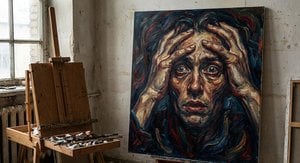
Georges Rouault’s “Spring”: A Chronicle of Human Empathy
Georges Rouault's "Spring," painted in 1911, is far more than a simple depiction of a forest scene; it’s a profound meditation on humanity – its joys, sorrows, and the quiet dignity found within everyday life. Executed with Rouault’s signature style, immediately recognizable for its stark contrasts and emotionally charged palette, this work offers a window into the artist's deeply felt empathy for the marginalized and suffering, a core tenet of his artistic vision. The painting captures a fleeting moment of rural tranquility, yet it resonates with an underlying sense of melancholy and contemplation – qualities that would become hallmarks of Rouault’s oeuvre.
The composition itself is deliberately un-idealized. There are no heroic figures or grand vistas; instead, we encounter three individuals engaged in seemingly simple activities: one seated, another standing attentively, and a third observing from a distance. A dog lies nearby, adding to the sense of domesticity and companionship. Rouault’s masterful use of dark contours – a technique inherited directly from his apprenticeship with stained glass artisans – frames luminous color fields, creating an almost theatrical effect. This layering of light and shadow isn't merely aesthetic; it serves to heighten the emotional impact of each figure, drawing our attention to their individual expressions and postures.
The Roots of Rouault’s Vision: Glass and Spiritual Seeking
Understanding Georges Rouault requires acknowledging his unique artistic journey. Born in the immediate aftermath of the Paris Commune, a period of immense upheaval and violence, Rouault's early life was shaped by hardship and a profound sense of loss. This experience profoundly influenced his worldview, fostering a deep compassion for those less fortunate. His apprenticeship as a glass painter from the age of fourteen proved formative, instilling in him an appreciation for vibrant color and precise execution – skills he would later translate to canvas with remarkable power.
Rouault’s fascination with stained glass extended beyond mere technical skill; it was deeply intertwined with his spiritual seeking. The luminous quality of the glass, its ability to transform light into something ethereal, mirrored his own desire for transcendence. This influence is readily apparent in “Spring,” where the use of dark outlines and intense color fields evokes a sense of sacredness, reminiscent of medieval religious art. His mother’s devout Catholic upbringing further solidified this spiritual connection, shaping his artistic themes and fueling his commitment to portraying the dignity of ordinary people.
Symbolism and Emotional Resonance
While seemingly straightforward, “Spring” is rich in symbolic potential. The figures themselves – a seated individual, perhaps representing contemplation or rest; two standing ones, possibly engaged in conversation or observation – invite interpretation. The dog, a traditional symbol of loyalty and companionship, adds to the painting’s sense of warmth and connection. Rouault wasn't interested in simply recording a scene; he was striving to capture an *emotion*, a feeling of quiet beauty amidst the complexities of human existence.
The muted color palette – dominated by browns, greens, and ochres – contributes significantly to the painting’s melancholic mood. However, strategically placed bursts of brighter hues – particularly in the figures' clothing – draw our eye and emphasize their presence. This careful manipulation of color creates a dynamic tension between darkness and light, reflecting the inherent duality of human experience. “Spring” is not a celebration of springtime itself; it’s an exploration of the human condition—a poignant reminder of life’s fleeting beauty and enduring sorrows.
Въпроси и отговори
Кой е създал "Spring"?
„Spring“ е създадена от Жорж Руо”. Информацията на тази страница описва оригиналната творба на Жорж Руо”.
На каква възраст е бил Жорж Руо”, когато е създадена „Spring“?
Жорж Руо” е бил на 40 години, когато създава „Spring“ през 1911. Възрастта е изчислена въз основа на годината на раждане на художника, 1871.
Как се позиционира „Spring“ сред често срещаните теми в творчеството на Жорж Руо”?
"Spring" изобразява forest scene, figures outdoors, dog companion, rouault style, human interaction, 1911 painting, religious themes, докато утвърдените теми на Жорж Руо” са stained glass influence, catholic faith, marginalized figures, social critique, fauvist color, emotional intensity, spiritual seeking, existential themes. Сравнението между двете показва как произведението се свързва с обичайните сюжети на художника.
Как "Spring" се вписва в темите и стила на Жорж Руо”?
В творчеството на Жорж Руо”, „Spring“ е изработена в стила на Fauvism, съчетавайки се с темите за stained glass influence, catholic faith, marginalized figures, social critique, fauvist color, emotional intensity, spiritual seeking, existential themes.
Каква емоция предава произведението от Fauvism „Spring“?
Nostalgic емоцията на „Spring“ допълва нейния Fauvism стил.
„Spring“ на Жорж Руо” светла или тъмна творба ли е?
По отношение на възприеманата яркост, „Spring“ на Жорж Руо” е balanced.
Коя е датата на създаване на „Spring“ на Жорж Руо”?
"Spring" датира от 1911. Тази дата поставя произведението в контекста на кариерата на Жорж Руо” и неговата епоха.



 Преглед в реален мащаб
 Поръчайте ръчно рисувано репродукция на този колекционерски предмет
 Сподели
 Сподели
 Подробности
 Ръководство

 Изтегляне
 Подобни артикули
 Рентгенова снимка
 Слайдшоу
 Статистика

 Разгърни целия текст






































 Опцията със стъкло е налична само за размери под 110 см