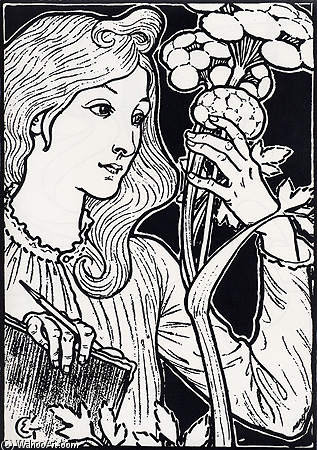
Биография на художника
A Pioneer of Art Nouveau: The Life and Legacy of Eugène Samuel Grasset
Eugène Samuel Grasset, born in Lausanne, Switzerland on May 25th, 1845 (though some sources cite 1841), emerged as a pivotal figure bridging the gap between traditional craftsmanship and the burgeoning aesthetic of Art Nouveau. His journey began within an artistic household; his father, a skilled cabinet designer and sculptor, instilled in young Eugène both a practical understanding of materials and a deep appreciation for creative expression. This early exposure fostered a sensitivity to form and detail that would become hallmarks of Grasset’s distinctive style. Initial studies under François-Louis David Bocion honed his drawing skills, but it was a subsequent foray into architectural studies in Zurich that broadened his artistic horizons, though ultimately proved insufficient to contain his burgeoning creativity. A transformative experience followed – a voyage to Egypt after completing his formal education. This journey ignited a lifelong fascination with exoticism and ancient design principles, profoundly influencing the decorative motifs that would later define his work. Equally significant was his growing admiration for Japanese art, particularly its emphasis on flowing lines, flattened perspectives, and harmonious compositions—elements he masterfully integrated into his own unique visual language.
Early Training and Influences
Grasset’s artistic inclinations were nurtured from a young age by his father's profession as sculptor and cabinetmaker. This familial connection instilled in him not only technical proficiency but also an innate understanding of sculptural form and material texture—skills that would prove invaluable throughout his career. Recognizing the importance of formal training, Grasset enrolled at École Supérieure des Beaux-Arts in Zurich where he studied architecture alongside fellow artists like Auguste Rodin. However, it was Bocion’s guidance that solidified his foundational drawing skills, establishing a meticulous attention to detail and an unwavering commitment to capturing natural forms with precision. The influence of Gothic architecture—particularly stained glass windows—was palpable during this period, shaping Grasset's aesthetic sensibilities and informing his later explorations of historical symbolism. Simultaneously, he absorbed the essence of Japanese art, captivated by its serene landscapes, stylized representations of nature, and understated elegance—elements that would become integral to his distinctive visual vocabulary.
From Diverse Crafts to Defining a Style
By 1869-1870, Grasset established himself as both a painter and sculptor in Lausanne, demonstrating remarkable versatility across multiple artistic mediums. He quickly gained recognition for his sculptural works, characterized by graceful curves and refined surfaces—a stylistic hallmark that would persist throughout his life. Driven by ambition and fueled by an unwavering desire to expand his creative horizons, Grasset relocated to Paris in 1871, embarking on an extraordinarily diverse career that encompassed furniture design, fabric creation, tapestry weaving, ceramic artistry, and jewelry making. These weren’t merely exercises in applied arts; Grasset elevated them to high art, employing luxurious materials like ivory and gold with a meticulous attention to detail and innovative combinations of textures and forms. His creations swiftly became foundational elements of the Art Nouveau movement, embodying its organic aesthetic and rejecting rigid academic conventions. He meticulously studied Gothic* architecture and stained glass windows, and became friendly with Eugène Viollet-le Duc, the architect responsible for the restoration of Notre-Dame.*
The Flowering of Artistic Expression
Grasset’s artistic output spanned a remarkable range of disciplines—painting, sculpture, graphic design, furniture design, textile art, and jewelry making. He approached each project with unwavering dedication and pursued excellence in every endeavor. His furniture designs were particularly noteworthy for their incorporation of flowing lines and natural motifs—a deliberate departure from the geometric forms prevalent in earlier styles. Similarly, his fabric creations showcased a masterful command of color and texture, reflecting Grasset’s profound understanding of visual harmony. He skillfully blended historical influences with contemporary sensibilities, creating works that resonated deeply with the spirit of the Belle Époque. His meticulous attention to detail—evident in every piece he crafted—served as a testament to his unwavering commitment to craftsmanship and artistic integrity.
A Legacy Enduring Through Time
Grasset’s contribution to Art Nouveau extends far beyond mere stylistic imitation; it represents a fundamental rethinking of aesthetic principles. He championed the use of organic forms inspired by nature—particularly floral motifs—and skillfully synthesized elements from Gothic architecture and Japanese art, forging a distinctive visual language that captivated audiences across Europe. His iconic poster designs—most notably *Jeanne d'Arc Sarah Bernhardt*—became emblems of Art Nouveau’s expressive power and enduring beauty. Furthermore, he established École Guérin (1890–1903) and Académie de la Grande Chaumière (1904–13), nurturing the talents of future generations of artists and designers. His typeface, “Grasset,” continues to be utilized today—a lasting testament to his influence on typographic design and a symbol of Art Nouveau’s enduring aesthetic legacy. Eugène Samuel Grasset passed away on October 23rd, 1917, in Sceaux, France, leaving behind an unparalleled artistic oeuvre that continues to inspire admiration and scholarly study. He remains one of the most influential figures in Art Nouveau—a visionary who redefined decorative art and graphic design while simultaneously upholding the highest standards of craftsmanship and artistic expression.