Преглед в реален мащаб Преглед с AR Избор на принт Превключване към дигитално изображение Сподели
Подробности Ръководство Добави в любими Изтегляне Подобни артикули Рентгенова снимка Слайдшоу Статистика

Springtime

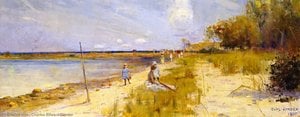
Charles Conder's 'Springtime' captures a serene Australian countryside scene with figures and nature bathed in sunlight. A beautiful example of Heidelberg School art.

Билдърът Чарлз Едуард Кондер е ключова фигура в австралийския импресионизъм и движението Хеidelberg Школа. Разгледайте неговите ярки пейзажи, морски сцени и френските картини на WahooArt.

Ръчно изработена маслена репродукция

Ръчно рисувана маслена картина върху платно във вашия размер и рамка, изработена по поръчка от нашите художници. ( Избор на принт Превключване към дигитално изображение)

Corner sample of the P118B picture frame: формован полистирол, 5 cm wide and 3 cm thick
P118B €10
Corner sample of the P118H picture frame: формован полистирол, 5 cm wide and 3 cm thick
P118H €10
Corner sample of the P118W picture frame: формован полистирол, 5 cm wide and 3 cm thick
P118W €10
Corner sample of the P438Z picture frame: формован полистирол, 5.5 cm wide and 3.5 cm thick
P438Z €10
Corner sample of the P508JH picture frame: формован полистирол, 7 cm wide and 3.5 cm thick
P508JH €12
Corner sample of the P508YH picture frame: формован полистирол, 7 cm wide and 3.5 cm thick
P508YH €12
Corner sample of the P805H picture frame: формован полистирол, 5 cm wide and 3.5 cm thick
P805H €10
Corner sample of the P805Z picture frame: формован полистирол, 5 cm wide and 3.5 cm thick
P805Z €10
Corner sample of the P919BZ picture frame: формован полистирол, 7 cm wide and 3.5 cm thick
P919BZ €10
Corner sample of the P919G picture frame: формован полистирол, 7 cm wide and 3.5 cm thick
P919G €10
Corner sample of the P919XJ picture frame: формован полистирол, 7 cm wide and 3.5 cm thick
P919XJ €10
Corner sample of the P959ZH picture frame: формован полистирол, 5 cm wide and 3 cm thick
P959ZH €10
Corner sample of the P968JZ picture frame: формован полистирол, 6 cm wide and 4 cm thick
P968JZ €12
Corner sample of the W106C picture frame: масивна дървесина, 5 cm wide and 3 cm thick
W106C €8
Corner sample of the W218G picture frame: масивна дървесина, 5 cm wide and 3 cm thick
W218G €10
Corner sample of the W218JH picture frame: масивна дървесина, 5 cm wide and 3 cm thick
W218JH €8
Corner sample of the W218Y picture frame: масивна дървесина, 5 cm wide and 3 cm thick
W218Y €10
Corner sample of the W307PJ picture frame: масивна дървесина, 6 cm wide and 3 cm thick
W307PJ €10
Corner sample of the W316G picture frame: масивна дървесина, 6 cm wide and 3 cm thick
W316G €10
Corner sample of the W316PJ picture frame: масивна дървесина, 6 cm wide and 3 cm thick
W316PJ €8
Corner sample of the W316Y picture frame: масивна дървесина, 6 cm wide and 3 cm thick
W316Y €10
Corner sample of the W398PJ picture frame: масивна дървесина, 5 cm wide and 3 cm thick
W398PJ €8
Corner sample of the W4111J picture frame: масивна дървесина, 6.5 cm wide and 3.5 cm thick
W4111J €10
Corner sample of the W500HY picture frame: масивна дървесина, 7 cm wide and 5 cm thick
W500HY €15
Corner sample of the W500JH picture frame: масивна дървесина, 7 cm wide and 5 cm thick
W500JH €15
Corner sample of the W692G picture frame: масивна дървесина, 8 cm wide and 4 cm thick
W692G €12
Corner sample of the W849H picture frame: масивна дървесина, 5 cm wide and 3 cm thick
W849H €8
Corner sample of the W940BG picture frame: масивна дървесина, 7.5 cm wide and 4.5 cm thick
W940BG €15
Corner sample of the W953PJ picture frame: масивна дървесина, 6 cm wide and 3.5 cm thick
W953PJ €8

Стандартен размер
по поръчка
CM
INCH

Изберете от нашите предварително зададени размери, които съответстват на оригиналните пропорции на произведението.

ширина
височина

Въведете необходимата ширина и височина, за да паснат на вашата рамка или стена. Тъй като това е ръчна работа, при избор на размер с различен формат, художникът може да нарисува малко повече около картината или да отреже малко от периферията — вие избирате. Преди да започне рисуването, ще ви изпратим дигитален мок업 за одобрение. Картината, показана на тази страница, не е реалният резултат — само мок업ът го показва.

Примери за възможности за персонализация: Заменете лицето с фотография на клиента; Добавете домашен любимец (например заменете котка с куче); Включете скрито послание на фона; Променете пейзажа или елементите на фона.
След получаване на поръчка, екипът на WahooArt.com ще изпрати имейл до клиента с инструкции и ще предостави примерен макет за преглед.

Доставка по целия свят () в рамките на 3-4 седмици вместо стандартните 5 седмици. (24 Октомври). Без компромис с качеството.

Безплатна експресна доставка по целия свят
Висококачествено ленено платно
Пълно застраховане на доставката
Гаранция за възстановяване на митнически такси
Гаранция за пълно съответствие на цветовете
Политика за връщане в рамките на 100 дни (само при дефекти)
100% Гаранция за връщане на сумата
Отстъпка при поръчка на повече произведения

Обща сума

€ 239

Springtime

Техника на репродукция

Размер на репродукцията

-

Крайна цена

€ 239

Бърза информация

  • Medium: Oil on canvas
  • Title: Springtime
  • Movement: Heidelberg School
  • Location: NGV, Melbourne
  • Artist: Charles Conder

Квиз за изкуство

За всеки въпрос има само един верен отговор.

Въпрос 1:
What artistic movement is Charles Edward Conder primarily associated with?
Въпрос 2:
In 'Springtime', what is the primary subject matter depicted?
Въпрос 3:
What year was 'Springtime' painted?
Въпрос 4:
Charles Edward Conder was born in which city?
Въпрос 5:
Which of the following best describes Conder's style as evident in 'Springtime'?

Charles Edward Conder’s “Springtime,” A Window into Heidelberg’s Soul

Charles Edward Conder's "Springtime," painted in 1888, isn’t merely a depiction of a rural scene; it’s a vibrant distillation of the Heidelberg School’s artistic philosophy – a celebration of light, color, and the fleeting beauty of the Australian landscape. This oil on canvas captures a moment of idyllic tranquility nestled within the rolling hills of New South Wales, yet it resonates with a deeper sense of observation and emotional resonance that distinguishes Conder's work from purely topographical representations.

The painting immediately draws the eye to the luminous quality of the light, characteristic of the Heidelberg School’s approach. Conder masterfully employs broken brushstrokes and a palette dominated by greens, blues, and yellows – not in a photographic realism, but rather as an expression of how these colors *feel* under the intense Australian sun. The composition is deceptively simple: a meandering dirt track cuts through a field dotted with grazing sheep and cows, leading towards distant trees that are rendered with a hazy, atmospheric quality. A small group of figures – likely children – are visible in the foreground, adding a touch of human presence to this otherwise serene vista.

The Heidelberg School and its Artistic Roots

To fully appreciate “Springtime,” it’s crucial to understand the context within which Conder was working. The Heidelberg School, emerging in Melbourne during the 1880s, represented a significant shift away from the academic traditions of European art that had previously dominated Australian painting. Artists like Conder, Tom Roberts, and Frederick McCubbin sought inspiration directly from the Australian landscape, rejecting idealized representations in favor of capturing its raw beauty and inherent drama. They embraced *plein air* painting – working outdoors directly from nature – a technique championed by Impressionist painters in Europe.

Conder’s early life, marked by his mother's death in India and subsequent relocation to England before returning to Australia, undoubtedly shaped his artistic sensibility. His experiences as a surveyor instilled a keen eye for detail and an appreciation for the natural world, while his time spent studying art in London exposed him to the burgeoning Impressionist movement. However, Conder ultimately forged his own unique style, blending European influences with a distinctly Australian perspective.

Symbolism and Emotional Resonance

Beyond its picturesque subject matter, “Springtime” is rich in symbolic meaning. The dirt track suggests a journey – perhaps a metaphorical one – while the grazing animals represent the bounty of the land. The figures in the foreground invite us to contemplate our relationship with nature and the simple pleasures of rural life. There’s an underlying sense of nostalgia for a bygone era, a yearning for connection with the earth and its rhythms.

The hazy atmosphere and diffused light contribute significantly to the painting's emotional impact. It evokes a feeling of warmth, tranquility, and perhaps even melancholy – a recognition that such moments of beauty are fleeting and precious. Conder’s use of color is particularly effective in conveying this mood, creating a sense of depth and luminosity that draws the viewer into the scene.

A Legacy of Australian Impressionism

“Springtime” stands as a pivotal work in the development of Australian Impressionism. It exemplifies the Heidelberg School’s commitment to capturing the essence of the Australian landscape with vibrant color, loose brushwork, and an emphasis on light and atmosphere. Conder's ability to imbue his paintings with both visual beauty and emotional depth cemented his place as one of Australia’s most important artists. Reproductions of this captivating work continue to resonate with audiences today, offering a glimpse into the soul of Heidelberg and the enduring appeal of the Australian landscape.

Въпроси и отговори

Как "Springtime" се вписва в темите и стила на Чарлз Едуард Кондер?

"Springtime" споделя със другите творби на Чарлз Едуард Кондер своя Heidelberg School стил и заложените теми: heidelberg school realism, australian landscape painting, impressionistic light study, rural life depiction”, “conder’s artistic evolution”.

Показва ли "Springtime" силен светлотеневи контраст?

Нивото на контраст в „Springtime“ на Чарлз Едуард Кондер е Bold.

Какъв размер и ориентация се препоръчват за печат на „Springtime“ на Чарлз Едуард Кондер?

Препоръчителният размер за печат на „Springtime“ на Чарлз Едуард Кондер е Medium с ориентация Landscape.


Биография на художника

Early Life and Artistic Journey

Charles Edward Conder (1868 – 1909) was an English-born painter, lithographer and designer. He emigrated to Australia and was a key figure in the Heidelberg School*, arguably the beginning of a distinctively Australian tradition in Western art.

Conder was born in Tottenham, Middlesex, the second son, of six children, of James Conder, civil engineer and Mary Ann Ayres.
He spent several years as a young child in India before the death of his mother on 14 May 1873 in Bombay, aged 31 years; he was then sent back to England and attended a number of schools including a boarding school at Eastbourne, which he attended from 1877. He left school at 15, and his very religious, non-artistic father, against Charles's natural artistic inclinations, decided that he should follow in his footsteps as a civil engineer.

Artistic Career in Australia

In 1884, at the age of 16, he was sent to Sydney, Australia, where he worked for his uncle, a land surveyor for the New South Wales government. However he disliked the work, much preferring to draw the landscape rather than surveying it. In 1886, he left the job and became an artist for the “Illustrated Sydney News”, where he was in the company of other artists such as Albert Henry Fullwood, Frank Mahoney and Benjamin Edwin Minns.
He also attended the painting classes of Alfred James Daplyn and had joined the Art Society of New South Wales.

Short of cash, Conder apparently paid off his landlady by sexual means, catching syphilis in the process, which was to plague the later years of his life.

The Heidelberg School and Notable Works

Conder’s masterpiece, Departure of the Orient – Circular Quay (1888) showcased his newfound mastery of form and brushwork.
This dockside scene, depicting the bustling harbour at sydney cove, was quickly purchased by the Art Gallery of New South Wales, making it Conder’s first work to enter a public collection.

A holiday at Mentone (1888), a fun-loving painting showcasing men and women relaxing on the beach, is another notable example of Conder's work.
Conder’s association with G. P. Nerli, an itinerant italian painter, significantly influenced his development as an artist.

His contributions to the 9 by 5 impression exhibition in melbourne, alongside tom roberts and arthur streeton, solidified his position within the Heidelberg School movement.

Legacy and Later Life

Conder’s later years were plagued by poor health, including paralysis and a bout of delirium tremens.
Despite this, he continued to paint, leaving behind a legacy as a key figure in the heidelberg school. His art was better received in england than in paris, with his portrait being painted by Henri de Toulouse-Lautrec in 1892.

View Conder’s works at the Art Gallery of New South Wales or explore more about the Heidelberg School on WahooArt's charles edward conder page.
Discover more about Conder's life and works on wikipedia's charles conder page. Explore WahooArt's collection of Conder's paintings, including A Holiday at Mentone (1888) and Departure of the Orient – Circular Quay (1888), on WahooArt's website.

Чарлз Едуард Кондер

Чарлз Едуард Кондер

1868 - 1909 , Великобритания

Бързи факти

  • Artistic Movement Or Style: Heidelberg School
  • Artists Who Influenced This Artist:
    • Alfred Daplyn
    • Victor Mann
    • Julian Ashton
  • Date Of Birth: October 24, 1868
  • Date Of Death: February 9, 1909
  • Full Name: Charles Edward Conder
  • Nationality: British
  • Notable Artworks:
    • Departure of the Orient – Circular Quay
    • A holiday at Mentone
    • Under The Southern Sun
  • Place Of Birth: Tottenham, United Kingdom
Разгледайте произведения на изкуството, организирани по теми, стилове и характеристики.