Early Life and Artistic Journey
Charles Edward Conder (1868 – 1909) was an English-born painter, lithographer and designer. He emigrated to Australia and was a key figure in the Heidelberg School*, arguably the beginning of a distinctively Australian tradition in Western art.
Conder was born in Tottenham, Middlesex, the second son, of six children, of James Conder, civil engineer and Mary Ann Ayres.
He spent several years as a young child in India before the death of his mother on 14 May 1873 in Bombay, aged 31 years; he was then sent back to England and attended a number of schools including a boarding school at Eastbourne, which he attended from 1877. He left school at 15, and his very religious, non-artistic father, against Charles's natural artistic inclinations, decided that he should follow in his footsteps as a civil engineer.
Artistic Career in Australia
In 1884, at the age of 16, he was sent to Sydney, Australia, where he worked for his uncle, a land surveyor for the New South Wales government. However he disliked the work, much preferring to draw the landscape rather than surveying it. In 1886, he left the job and became an artist for the “Illustrated Sydney News”, where he was in the company of other artists such as Albert Henry Fullwood, Frank Mahoney and Benjamin Edwin Minns.
He also attended the painting classes of Alfred James Daplyn and had joined the Art Society of New South Wales.
Short of cash, Conder apparently paid off his landlady by sexual means, catching syphilis in the process, which was to plague the later years of his life.
The Heidelberg School and Notable Works
Conder’s masterpiece, Departure of the Orient – Circular Quay (1888) showcased his newfound mastery of form and brushwork.
This dockside scene, depicting the bustling harbour at sydney cove, was quickly purchased by the Art Gallery of New South Wales, making it Conder’s first work to enter a public collection.
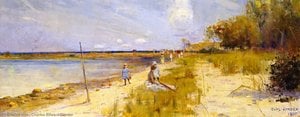
A holiday at Mentone (1888), a fun-loving painting showcasing men and women relaxing on the beach, is another notable example of Conder's work.
Conder’s association with G. P. Nerli, an itinerant italian painter, significantly influenced his development as an artist.
His contributions to the 9 by 5 impression exhibition in melbourne, alongside tom roberts and arthur streeton, solidified his position within the Heidelberg School movement.
Legacy and Later Life
Conder’s later years were plagued by poor health, including paralysis and a bout of delirium tremens.
Despite this, he continued to paint, leaving behind a legacy as a key figure in the heidelberg school. His art was better received in england than in paris, with his portrait being painted by Henri de Toulouse-Lautrec in 1892.
View Conder’s works at the Art Gallery of New South Wales or explore more about the Heidelberg School on WahooArt's charles edward conder page.
Discover more about Conder's life and works on wikipedia's charles conder page. Explore WahooArt's collection of Conder's paintings, including A Holiday at Mentone (1888) and Departure of the Orient – Circular Quay (1888), on WahooArt's website.



 Преглед в реален мащаб
 Поръчайте ръчно рисувано репродукция на този колекционерски предмет
 Сподели
 Сподели
 Подробности
 Ръководство

 Изтегляне
 Подобни артикули
 Рентгенова снимка
 Слайдшоу
 Статистика


 Разгърни целия текст






































 Опцията със стъкло е налична само за размери под 110 см