x
Представи си гоПредстави си го AR прегледAR преглед Купете ръчно рисувана картина Купете ръчно рисувана картинаКупете изображение Купете изображение ИзпратиИзпрати
ДетайлиДетайли Добавяне към любими Добавяне към любими ИзтеглянеИзтегляне ПодобниПодобни Рентгенова снимкаРентгенова снимка СлайдшоуСлайдшоу

MIrage

Discover "Mirage" by Charles Conder – a captivating Australian Impressionist painting of a woman and a ball. Explore this iconic work's details & history on WahooArt.

Билдърът Чарлз Едуард Кондер е ключова фигура в австралийския импресионизъм и движението Хеidelberg Школа. Разгледайте неговите ярки пейзажи, морски сцени и френските картини на WahooArt.

Жикле / Художествен принт

Giclée печат или принт върху платно с музейно качество, бързо производство и гъвкави опции за завършен вид. (Купете ръчно рисувана картина Купете ръчно рисувана картинаКупете изображение Купете изображение)

P118B $10
P118H $10
P118W $10
P438Z $10
P508JH $12
P508YH $12
P805H $10
P805Z $10
P919BZ $10
P919G $10
P919XJ $10
P959ZH $10
P968JZ $12
W106C $8
W218G $10
W218JH $8
W218Y $10
W307PJ $10
W316G $10
W316PJ $8
W316Y $10
W398PJ $8
W4111J $10
W500HY $15
W500JH $15
W692G $12
W849H $8
W940BG $15
W953PJ $8

Стандартен
по поръчка
CM
INCH

Изберете от предварително зададените размери, които съответстват на оригиналните пропорции на произведението.

ширина
височина

Можете да въведете собствени размери, за да паснат на конкретна рамка или пространство. Ако избраният от Вас размер не съвпада с пропорциите на оригиналното изображение, ние ще изрежем произведението или ще разширим изображението с огледален или едноцветен ръб. Дигитален макет ще бъде изпратен за Ваше одобрение преди започването на производството.
Моля, имайте предвид, че предпрегледът на екрана не отразява реалното изрязване или разширяване. Само макетът ще покаже точно финалната композиция.
Въпреки че са налични персонализирани размери, препоръчваме да изберете размер от предварително дефинирания списък, за да запазите оригиналните пропорции.

Доставка по целия свят () в рамките на 2 седмици вместо стандартните 4/5 седмици. (5 Септември)

why_choose_icon
Безплатна експресна доставка по целия свят
why_choose_icon
Висококачествено ленено платно
why_choose_icon
Пълно застраховане при доставка
why_choose_icon
Гаранция за възстановяване на митнически такси
why_choose_icon
Гаранция за цветова точност
why_choose_icon
60-Дневен период за връщане (Само при дефекти)
why_choose_icon
100% Гаранция за връщане на парите
why_choose_icon
Предложение за отстъпка при поръчка на едро

Обща цена

$ 68

reproduction

MIrage

Жикле / Художествен принт

Размер на репродукцията

-

Обща цена

$ 68

Бързи факти

  • Artistic style: Impressionism
  • Movement: Heidelberg School
  • Medium: Watercolor on paper
  • Title: Mirage
  • Location: Private Collection
  • Year: 1889
  • Artist: Charles Conder

Тест за изкуство

Има само един верен отговор за всеки въпрос.

Въпрос 1:
What artistic movement is Charles Conder most associated with?
Въпрос 2:
In 'Mirage,' what prominent element is depicted near the center of the painting, suggesting a change in weather conditions?
Въпрос 3:
What year was 'Mirage' painted by Charles Edward Conder?
Въпрос 4:
Charles Conder was born in which city?
Въпрос 5:
The painting 'Mirage' primarily showcases a scene of:

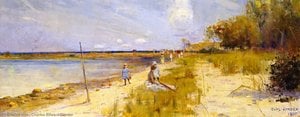
A Mirage of Light and Leisure: Charles Edward Conder’s “Mirage”

Charles Edward Conder's "Mirage," painted in 1889, isn’t merely a depiction of a landscape; it’s an invitation into a realm where reality subtly bends, inviting contemplation on the ephemeral nature of perception and the allure of the Australian outback. Born in Tottenham, London, Conder’s journey led him to Australia, where he became a pivotal figure within the Heidelberg School – a movement that championed a distinctly Australian artistic voice, rejecting European academic traditions in favor of capturing the light, color, and spirit of the continent.

The painting immediately draws the eye with its vibrant palette. Warm ochres dominate the foreground, punctuated by the cool blues and greens of distant trees and sky. Conder masterfully employs an Impressionistic technique, utilizing loose brushstrokes and broken colors to capture the shimmering heat haze that defines the Australian landscape. This isn’t a photographic representation; rather, it's a subjective experience translated onto canvas – a distillation of light, color, and atmosphere. The composition itself is deceptively simple: a woman holding a ball in her hand, positioned beside a solitary tree against a backdrop of rolling hills. Yet, within this apparent stillness lies a subtle dynamism, a sense of movement created by the play of light and shadow.

The Symbolism of Leisure and Illusion

While superficially appearing as a charming pastoral scene, “Mirage” is rich in symbolic meaning. The woman holding the ball evokes a sense of carefree leisure – a quintessential image of Australian summer. It speaks to a time of relaxation, social gatherings, and the simple pleasures of life. However, the presence of the ball itself introduces an element of illusion. Balls are often associated with games, entertainment, and even fleeting moments of joy. In this context, it suggests that these experiences, like the mirage itself, can be deceptive – beautiful but ultimately transient.

The solitary tree further amplifies this theme. Trees represent resilience, strength, and connection to the earth. Yet, its isolation within the vast landscape hints at a sense of loneliness or detachment. The woman’s position beside it suggests a moment of quiet contemplation, perhaps questioning the nature of her own place in this world.

A Window into the Heidelberg School

"Mirage" exemplifies the core tenets of the Heidelberg School – a group of Australian artists who sought to capture the unique character of their homeland. Unlike their European counterparts, they were deeply interested in portraying the light and color of the Australian landscape, often focusing on scenes of rural life and leisure. Conder’s work is characterized by its vibrant colors, loose brushstrokes, and emphasis on capturing the fleeting effects of light and atmosphere. His use of local pigments and his rejection of academic conventions firmly established him as a key figure in shaping Australian art.

Capturing the Essence of an Illusion

Conder’s skill lies not just in depicting a scene, but in conveying its *feeling*. The painting isn't about literal accuracy; it’s about capturing the subjective experience of being immersed in the heat haze of the Australian outback. The shimmering quality of the landscape, the sense of distance and ambiguity, all contribute to a powerful emotional impact. “Mirage” invites us to question our perceptions, to appreciate the beauty of illusion, and to contemplate the transient nature of life itself. It remains a captivating testament to Conder’s artistic vision and his profound connection to the Australian landscape.


Биография на художника

Early Life and Artistic Journey

Charles Edward Conder (1868 – 1909) was an English-born painter, lithographer and designer. He emigrated to Australia and was a key figure in the Heidelberg School*, arguably the beginning of a distinctively Australian tradition in Western art.

Conder was born in Tottenham, Middlesex, the second son, of six children, of James Conder, civil engineer and Mary Ann Ayres.
He spent several years as a young child in India before the death of his mother on 14 May 1873 in Bombay, aged 31 years; he was then sent back to England and attended a number of schools including a boarding school at Eastbourne, which he attended from 1877. He left school at 15, and his very religious, non-artistic father, against Charles's natural artistic inclinations, decided that he should follow in his footsteps as a civil engineer.

Artistic Career in Australia

In 1884, at the age of 16, he was sent to Sydney, Australia, where he worked for his uncle, a land surveyor for the New South Wales government. However he disliked the work, much preferring to draw the landscape rather than surveying it. In 1886, he left the job and became an artist for the “Illustrated Sydney News”, where he was in the company of other artists such as Albert Henry Fullwood, Frank Mahoney and Benjamin Edwin Minns.
He also attended the painting classes of Alfred James Daplyn and had joined the Art Society of New South Wales.

Short of cash, Conder apparently paid off his landlady by sexual means, catching syphilis in the process, which was to plague the later years of his life.

The Heidelberg School and Notable Works

Conder’s masterpiece, Departure of the Orient – Circular Quay (1888) showcased his newfound mastery of form and brushwork.
This dockside scene, depicting the bustling harbour at sydney cove, was quickly purchased by the Art Gallery of New South Wales, making it Conder’s first work to enter a public collection.

A holiday at Mentone (1888), a fun-loving painting showcasing men and women relaxing on the beach, is another notable example of Conder's work.
Conder’s association with G. P. Nerli, an itinerant italian painter, significantly influenced his development as an artist.

His contributions to the 9 by 5 impression exhibition in melbourne, alongside tom roberts and arthur streeton, solidified his position within the Heidelberg School movement.

Legacy and Later Life

Conder’s later years were plagued by poor health, including paralysis and a bout of delirium tremens.
Despite this, he continued to paint, leaving behind a legacy as a key figure in the heidelberg school. His art was better received in england than in paris, with his portrait being painted by Henri de Toulouse-Lautrec in 1892.

View Conder’s works at the Art Gallery of New South Wales or explore more about the Heidelberg School on WahooArt's charles edward conder page.
Discover more about Conder's life and works on wikipedia's charles conder page. Explore WahooArt's collection of Conder's paintings, including A Holiday at Mentone (1888) and Departure of the Orient – Circular Quay (1888), on WahooArt's website.

Чарлз Едуард Кондер

Чарлз Едуард Кондер

1868 - 1909 , Великобритания

Бързи факти

  • Artistic Movement Or Style: Heidelberg School
  • Artists Who Influenced This Artist:
    • Alfred Daplyn
    • Victor Mann
    • Julian Ashton
  • Date Of Birth: October 24, 1868
  • Date Of Death: February 9, 1909
  • Full Name: Charles Edward Conder
  • Nationality: British
  • Notable Artworks:
    • Departure of the Orient – Circular Quay
    • A holiday at Mentone
    • Under The Southern Sun
  • Place Of Birth: Tottenham, United Kingdom
Разгледайте произведения на изкуството, организирани по теми, стилове и характеристики.