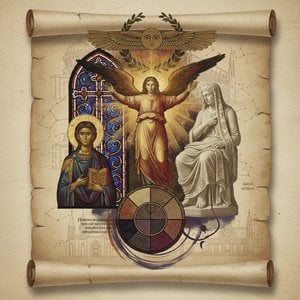
A Life Etched in Form: The World of Leonard Baskin
Leonard Baskin, born August 15, 1922, in New Brunswick, New Jersey, emerged as a powerful and singular voice in American art—a steadfast champion of figurative expression during an era increasingly dominated by abstraction. His journey began steeped in the traditions of his Jewish heritage; the son of a rabbi who relocated to New York when Baskin was seven, he carried this cultural weight throughout his life, imbuing much of his work with themes of mortality, remembrance, and spiritual searching. Early artistic inclinations led him to an apprenticeship with Maurice Glickman at the Educational Alliance in New York City from 1937 to 1939, a formative experience that laid the groundwork for his technical skill and conceptual approach. Formal studies followed at New York University School of Architecture and Applied Arts (1939-1941), but it was a scholarship to Yale University (1941-1943) that proved truly pivotal. There, amidst the hallowed halls and ancient texts, Baskin discovered the illuminated books of William Blake—a revelation that ignited his passion for printmaking and set him on a path defined by narrative power and visual intensity.Gehenna Press and the Revival of Fine Art Printing
Even as a student at Yale in 1942, Baskin’s commitment to artistic creation took tangible form with the founding of Gehenna Press—one of the earliest fine art presses in the United States. The name itself, drawn from *Paradise Lost*, hints at the press's preoccupation with weighty themes and its dedication to a profound aesthetic vision. More than just a workshop, Gehenna Press became a crucible for collaboration, bringing together poets and artists in a shared pursuit of artistic excellence. Over the course of five decades, it produced over 100 books, each one a meticulously crafted object of art—a testament to Baskin’s belief in the book as a total work of art. He collaborated with some of the most important literary figures of his time, including James Baldwin, Anthony Hecht, Ruth Fainlight, and notably Ted Hughes, for whom he created striking illustrations for *Crow* and *A Primer of Birds*. The poet Sylvia Plath even dedicated her poem “Sculptor” to Baskin, a poignant acknowledgment of the profound impact he had on the artistic community. This dedication to printmaking wasn’t merely technical; it was an act of resistance against the prevailing trends in art, a reaffirmation of the power of craft and narrative.A Sculptor of Stark Memorials: Themes and Style
Baskin's artistic style is immediately recognizable—characterized by starkness, energy, and often dramatic depictions of figures. He remained resolutely committed to figurative art, even as abstract expressionism gained prominence, believing in the enduring power of the human form to convey universal truths. His work frequently grapples with profound themes: mortality, the weight of history, Jewish identity, and the complexities of the human condition. This exploration often manifested in unsettling imagery—figures merging with animals, distorted anatomies, and a pervasive sense of existential angst. He worked across a diverse range of media – sculpture (in bronze, limestone, and wood), illustration, wood engraving, printmaking, and graphic art – but it was perhaps his bold black-and-white prints that truly captured the essence of his vision. These works are not merely representations; they are visceral experiences—raw, emotive, and deeply unsettling. His public commissions, such as the bas relief for the Franklin Delano Roosevelt Memorial and the bronze statue for the Holocaust Memorial in Ann Arbor, Michigan, demonstrate his ability to translate personal artistic concerns into powerful statements of collective memory and mourning.Legacy and Enduring Influence
Leonard Baskin’s historical significance lies not only in the quality of his art but also in his unwavering dedication to a particular aesthetic philosophy. He stood as a bulwark against the tide of abstraction, demonstrating the continued relevance and expressive potential of figurative art. His work with Gehenna Press played a crucial role in revitalizing fine press printing in America, elevating it from a niche craft to a respected artistic discipline. Today, his works are held in prestigious museum collections worldwide—The Metropolitan Museum of Art, The Museum of Fine Arts, Boston, and the British Museum among them—testifying to their enduring appeal and artistic merit. In 1992, a fifty-year retrospective of Gehenna Press books was held at the Library of Congress, further cementing its place in American cultural history. Later in life, Baskin moved to Lurley Manor in Devon, England, in 1974, seeking proximity to Ted Hughes, before returning to the United States in 1984 and taking a teaching position at Hampshire College. He passed away on June 3, 2000, in Northampton, Massachusetts, leaving behind a rich and complex body of work that continues to challenge, provoke, and inspire. The archive of his work from Gehenna Press was acquired by the Bodleian Library at Oxford University, ensuring its preservation and accessibility for generations to come—a fitting tribute to an artist who dedicated his life to the power of image and word.A Final Reflection
- Influences: William Blake’s illuminated books were a foundational influence, shaping Baskin's approach to printmaking and narrative art.
- Key Themes: Mortality, Jewish heritage (including Holocaust remembrance), the human condition, and existential angst are central to his work.
- Artistic Style: Characterized by starkness, energy, dramatic figures, often grotesque features, and a masterful use of black-and-white contrast.
- Major Achievements: Founding Gehenna Press, collaborations with prominent poets like Ted Hughes and Sylvia Plath, significant public commissions (FDR Memorial, Holocaust Memorial).
- Historical Significance: A champion of figurative art during the abstract expressionist era, revitalizing fine press printing, and leaving a lasting legacy in museums and libraries worldwide.
الأسئلة والأجوبة
من أي بلد ينتمي Leonard Baskin؟
وُلد Leonard Baskin في United States of America.
أين يمكنني مشاهدة المخطط اللوني لأعمال Leonard Baskin؟
يمكن دراسة استخدام Leonard Baskin للألوان عبر الأعمال المدرجة في هذا الموقع من خلال صفحة بصمة الألوان الخاصة بالفنان.
هل يمكنني زيارة متحف افتراضي لأعمال Leonard Baskin؟
يمكن مشاهدة أعمال Leonard Baskin الفنية في معرض ثلاثي الأبعاد عبر صفحة متحف ثلاثي الأبعاد الخاصة بالفنان.