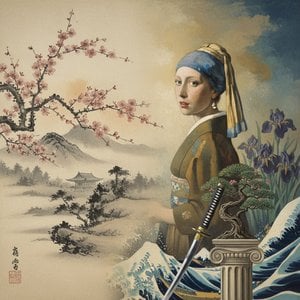
Top 3 works: Kagen Higuchi - Life/One’s Self Only This Road
Museums on this site: Imago Mundi
Born: Japan
Kagen Higuchi: Weaver of Silent Landscapes
Kagen Higuchi’s artistic journey is a quiet yet profound exploration of Japanese aesthetics, deeply rooted in the traditions of *sumi-e* (ink wash painting) and informed by the evocative imagery of Ueda Akinari and Shinoda Taro. Born in Japan, Higuchi's work transcends mere representation; it seeks to capture the essence of nature – its serenity, its impermanence, and its subtle connections to the human spirit. While biographical details remain somewhat sparse, a careful examination of his oeuvre reveals a deliberate and considered approach to his craft, one that speaks volumes despite the relative lack of readily available personal information. His artistic lineage is particularly notable, drawing inspiration from the literary landscapes of Ueda Akinari, famed for his atmospheric tales of wandering monks and forgotten temples, alongside the minimalist elegance of Shinoda Taro, whose focus on capturing the essence of objects through subtle brushstrokes mirrors Higuchi’s own sensibilities.
The Essence of Sumi-e: Technique and Philosophy
Higuchi's distinctive style is firmly anchored in the principles of *sumi-e*. He masterfully employs a limited palette – primarily black ink, often diluted with water to varying degrees – to create textures and tonal shifts that evoke atmosphere and mood. Unlike Western painting’s emphasis on precise detail, *sumi-e* prioritizes suggestion and implication. Higuchi's landscapes are rarely sharply defined; instead, he utilizes broken lines, washes of ink, and negative space to convey a sense of depth, distance, and the ephemeral nature of existence. This technique is not simply about depicting a scene but rather about evoking an emotional response – a feeling of contemplation, solitude, or perhaps even melancholy. The deliberate use of imperfections—a slight smudge here, a subtle variation in tone there—adds a layer of authenticity and human touch to his work, reminding the viewer that these are not merely copies of nature but interpretations imbued with personal sensibility.
‘Life/One’s Self Only This Road’: A Meditation on Passage
Perhaps Higuchi's most celebrated piece, ‘Life/One’s Self Only This Road,’ exemplifies his artistic philosophy. Rendered in Japanese paper and style, the work is a deceptively simple composition – a solitary path winding through a vast, open landscape. Yet, within this apparent simplicity lies a profound meditation on mortality, impermanence, and the journey of life. The path itself represents the individual’s journey, while the expansive background symbolizes the boundless nature of existence. The use of Japanese paper adds an element of fragility and transience to the piece, reinforcing the theme of fleeting beauty and the acceptance of change. The work's quiet dignity and understated elegance invite viewers to contemplate their own place within the larger scheme of things—a sentiment deeply resonant with the spirit of Ueda Akinari’s literary works.
Influences and Artistic Context
Beyond his acknowledged admiration for Ueda Akinari and Shinoda Taro, Higuchi's work also reflects broader currents in contemporary Japanese art. The minimalist aesthetic prevalent in much of 21st-century Japanese art—a reaction against the excesses of Western modernism—finds a subtle echo in Higuchi’s restrained compositions and emphasis on essential forms. Furthermore, his use of traditional materials like Japanese paper connects him to centuries of artistic heritage, while simultaneously positioning him as a contemporary voice within that tradition. The influence of *wabi-sabi*, the Japanese aesthetic philosophy emphasizing beauty in imperfection and impermanence, is palpable throughout his oeuvre, shaping both his subject matter and his approach to technique.
Legacy and Continuing Relevance
Despite the relative obscurity surrounding Kagen Higuchi’s personal life, his artistic legacy continues to resonate with viewers seeking a deeper connection to nature and the human condition. His work stands as a testament to the enduring power of *sumi-e*—a medium capable of conveying profound emotions and philosophical insights through deceptively simple means. Higuchi's ability to capture the essence of Japanese landscapes, imbued with a sense of quiet contemplation and acceptance, ensures that his art will continue to be appreciated for its beauty, subtlety, and enduring relevance in an increasingly complex world. His work serves as a reminder of the value of slowing down, observing carefully, and finding meaning in the seemingly mundane aspects of existence—a message particularly poignant in our fast-paced modern lives.
بقلم فريق تحرير WahooArt.com
اختبر حدة بصرك الفني
لكل سؤال إجابة صحيحة واحدة فقط.
سؤال 1:
Kagen Higuchi is primarily known for his work in which art form?
سؤال 2:
Which of the following best describes a key theme explored in Kagen Higuchi's artwork 'Life/One’s Self Only This Road'?
سؤال 3:
Kagen Higuchi’s artistic style is often influenced by which traditional Japanese art form?
سؤال 4:
Ueda Akinari, a significant influence on Kagen Higuchi, is most famous for his works depicting:
سؤال 5:
What medium is most commonly associated with Kagen Higuchi's artistic creations?
Explore the profound influence of Japanese artistry on global masterpieces. From Ukiyo-e prints to Zen aesthetics, discover how Eastern elegance transformed Western art history in this deep cultural reflection for fine art enthusiasts and collectors.
Explore the profound beauty of Japanese landscape painting. From Hokusai's iconic vistas to Zen-inspired compositions, discover the spiritual depth and historical mastery of Ukiyo-e art in this expert cultural retrospective.