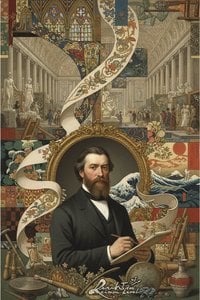
Early Life and Artistic Training
Julius Moser was born on 25 November 1805 in Gumbinnen. His early years were shaped by the structured environment of the Gymnasium in Königsberg, where he focused on his studies before turning toward the visual arts. This academic foundation provided the discipline required for the technical rigors of formal training.
In 1831, he moved to Berlin to begin his studies at the Academy. For five years, until 1836, he focused his attention on history and genre painting. During this time, he worked under the guidance of Wilhelm Hensel. These years in Berlin allowed him to develop the specific techniques used to capture both historical narratives and the quiet details of everyday life.
Years in Paris and Rome
Between 1837 and 1840, Moser lived in Paris. He spent his first year there, from 1837 to 1838, studying under Léon Cogniet. After this period, he moved into the studio of Paul Delaroche, where he remained until 1840. These years in France allowed him to absorb the technical approaches of his teachers before moving further south.
In 1840, he left Paris for Rome. He stayed in the city for eight years, living there until 1848. This long residence in Italy shaped his perspective and his approach to subject matter. During this time, he produced several sketches and studies, including:
- Bildnis eines griechischen Mädchens, 1838
- Die Söhne Jakobs fordern Benjamin nach Ägypten, 1838
- Der Rattenfänger in Hameln, 1838
- Lucrèce sur la place publique de Collatie nach Auguste-Hyacinthe Debay, 1838
- Loth und seine Familie von Engeln aus Sodom geführt nach Rubens, 1840
Artistic Style and Professional Life
Moser’s hand found its rhythm in the quiet details of the Biedermeier period. His work often focused on the steady, composed presence of his subjects, moving between the structured requirements of history painting and the more intimate observations of genre scenes. He possessed a particular skill for capturing the likenesses of the Berlin Jewish bourgeoisie during the middle of the 19th century, a group that sought to be documented with a sense of dignity and social standing.
His professional life was deeply rooted in the institutional fabric of his time. He was a founding member of the Deutscher Künstlerverein, helping to shape the community of artists in Berlin. This involvement reflected a career spent navigating the formal structures of the art world while maintaining a steady practice in portraiture. His approach was characterized by a focus on the individual, whether through a formal sitting or a more casual genre study.
Key Works and Later Years
Moser’s brush captured many faces, including the quiet presence of an Italian Country Girl, which he painted about 1852. His work often focused on the people of the Berlin Jewish bourgeoisie, documenting the likenesses of those living through the mid-19th century. These portraits remain held in collections such as the Israel Museum in Jerusalem.
He spent his final years in Berlin, living in an apartment at Potsdamer Straße 6. He died there on 24 May 1879. He remained unmarried throughout his life. Following his death, he was laid to rest in the Jewish Cemetery Schönhauser Allee.
الأسئلة والأجوبة
أين يمكنني مشاهدة المخطط اللوني لأعمال Julius Moser؟
تستعرض صفحة بصمة الألوان الفنية الخاصة بـ Julius Moser المخطط اللوني لمجموعة أعمال الفنان.
أين يمكنني استعراض جميع أعمال Julius Moser الفنية؟
يمكن تصفح جميع أعمال Julius Moser على هذا الموقع عبر صفحة كافة الأعمال الفنية الخاصة بالفنان.
كيف تطور فن Julius Moser بمرور الوقت؟
تتجلى المسيرة المهنية لـ Julius Moser مرحلة تلو الأخرى في صفحة مسيرة فنية: وهي عبارة عن خط زمني أفقي للأعمال الفنية، مُصنفة ضمن فصول تمثل كل حقبة من مسيرته.
كيف يمكنني تتبع أعمال Julius Moser حسب التسلسل الزمني؟
يمكن مشاهدة أعمال Julius Moser الفنية مرتبة زمنياً في صفحة التسلسل الزمني للأعمال الفنية.