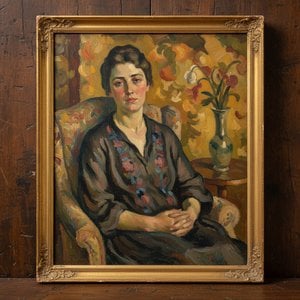
The Solitary Observer of Košice
Born Gyula Jakoby in Košice, within the Kingdom of Hungary, the man who would become known as Július Jakoby lived a life that mirrored the fringes of the society he painted. His early years were marked by a struggle for survival, a period of hardship that shaped the perspective of a man who would eventually become a central figure in Slovak modernism. He was a painter of Hungarian ancestry, yet his soul was deeply rooted in the small-town atmosphere of Košice. His existence was that of a loner, an observer navigating the complexities of human connection and isolation.
His formal training took him to the Hungarian University of Fine Arts and the School of Drawing and Drawing Teacher in Budapest. These formative years provided the technical foundation for a career that would span various mediums, from oil painting and pastel to drawing and even stone and ceramic mosaics. His work was never merely decorative; it was an attempt to capture the macrocosm of the human condition through the lens of his immediate surroundings.
A Language of Symbolism and Form
The visual language Jakoby developed was a complex blend of influences. His style reflected the secessionist expressionism of Konštantín Kövári-Kačmárik, merged with the Hungarian symbolism found in the works of Károly Férenczy and József Rippl-Rónai. This synthesis allowed him to move beyond simple representation, using the human figure to explore deeper, often unsettling, psychological truths. He focused heavily on the themes of man and society, often portraying individuals caught in the quiet, heavy moments of existence.
His technical approach was diverse, yet always purposeful. Whether working in the soft textures of pastel or the permanence of mosaic, his subjects remained consistent. He sought to document the people and the atmosphere of his hometown, turning the streets and social structures of Košice into a stage for his explorations of the human spirit. His notable works, such as Woman Act (1932), By the river (around 1950), and Architect's portrait (around 1962), demonstrate this enduring preoccupation with the individual within a social context.
Legacy in the Slovak Landscape
Though he lived much of his life on the periphery, his presence in the history of Slovak art is undeniable. His achievements are recognized through his inclusion in major institutions, including the Slovak National Gallery, the National Gallery in Prague, and the Hungarian National Gallery. The largest collection of his output is held by the East Slovak Gallery in Košice, the city that served as both his home and his primary subject.
Jakoby passed away in Košice in 1985, leaving behind a body of work that remains a significant part of the region's modernist history. His life and his art are physically commemorated in his hometown, where a statue stands in the center of Košice, ensuring that the man who spent his life observing the world is not forgotten by the people he so intently studied.
الأسئلة والأجوبة
أين يمكن استكشاف أعمال Július Jakoby الفنية مصنفة حسب الموضوع؟
يمكن استكشاف أعمال Július Jakoby حسب الموضوع عبر صفحة دليل المواضيع الخاصة بالفنان.
هل يمكنني استكشاف أعمال Július Jakoby عبر الكلمات المفتاحية؟
للعثور على أعمال Július Jakoby حول موضوع معين، يمكنك زيارة صفحة حسب الكلمات المفتاحية الخاصة بالفنان، والتي تجمع الأعمال الفنية حسب الكلمات المفتاحية.
أين يمكنني مشاهدة أعمال Július Jakoby الفنية بترتيب زمني؟
يمكنك الاطلاع على الجدول الزمني لأعمال Július Jakoby عبر صفحة التسلسل الزمني للأعمال الفنية التي ترتب الأعمال الفنية حسب تاريخ إنشائها.