Early Life and Artistic Beginnings
James Sillett, born in Norwich in May of 1764, emerged from a milieu steeped in provincial artistic tradition. His father, also named James Sillett, was an heraldic painter—a profession that initially shaped the young artist’s hand and eye. This early apprenticeship instilled a meticulous attention to detail and a foundational understanding of draftsmanship, qualities that would become hallmarks of his mature style. Norwich at this time was not merely a regional center but a burgeoning hub for artistic innovation, foreshadowing the rise of the celebrated Norwich School of painters. While contemporaries like John Crome and John Ninham also began their careers in heraldry, Sillett’s path soon diverged, leading him towards London and a broader exploration of artistic possibilities.
The move to London proved pivotal. Employed as a copyist by the Polygraphic Society—an institution dedicated to reproducing artworks for wider dissemination—Sillett honed his observational skills and absorbed the stylistic nuances of established masters. He also claimed studies at the Royal Academy between 1787 and 1790, though records remain inconclusive regarding his formal enrollment. This period was crucial in expanding his repertoire beyond heraldic work; he began to experiment with miniature painting, a demanding art form requiring both precision and delicacy.
A Versatile Talent: Still Life, Landscape, and Botanical Illustration
Sillett’s artistic versatility quickly became apparent upon his return to Norwich. He exhibited consistently at the Royal Academy from 1796 until 1837, showcasing a diverse body of work that encompassed still lifes, landscapes, and botanical illustrations. His still life paintings, particularly those depicting fruit, flowers, and game, are celebrated for their realism and vibrant color palettes. These were not merely representations of objects but carefully constructed arrangements imbued with a sense of quiet elegance. He possessed an exceptional ability to capture the textures and luminosity of natural forms, rendering each petal, leaf, and feather with remarkable accuracy.
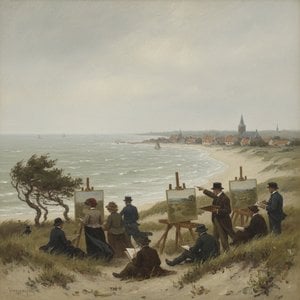
While his still lifes garnered significant acclaim, Sillett’s landscapes reveal a more nuanced artistic sensibility. Though less numerous than his other works, these scenes demonstrate a keen observation of light and atmosphere, often infused with an academic style that distinguished him from some of his Norwich School peers. His botanical illustrations, however, stand as testaments to his scientific precision and artistic skill. These meticulously detailed renderings were not only aesthetically pleasing but also served practical purposes, frequently employed in the illustration of books on natural history.
Norwich Society and Local Contributions
Sillett’s commitment to the Norwich art community was unwavering. He became an honorary member of the Norwich Society of Artists before relocating back to his hometown in 1810. In 1815, he ascended to the presidency of the society, a position that underscored his standing among local artists. However, disagreements over artistic direction led to a schism within the group the following year, resulting in the formation of a new organization—the Norfolk and Norwich Society of Artists. This period reflects Sillett’s dedication to fostering artistic dialogue and promoting regional talent.
Beyond his role as an artist and administrator, Sillett actively contributed to local scholarship. Around 1804, while residing in King's Lynn, he undertook the illustrations for William Richards’s *History of Lynn*, a project that showcased his topographical skills and provided valuable visual documentation of the town’s architecture and landmarks. Later, in 1826, he published *A Grammar of Flower Painting*, an instructional guide reflecting his mastery of botanical subjects and demonstrating his commitment to art education.
Legacy and Historical Significance
James Sillett's artistic legacy lies in his ability to seamlessly blend technical skill with a refined aesthetic sensibility. He was not a revolutionary innovator like Crome, but rather a consummate professional who excelled in multiple genres. His paintings offer a glimpse into 19th-century English life, capturing the beauty of natural forms and the architectural character of Norfolk’s towns and landscapes.
Art historian Derek Clifford rightly praised Sillett's still lifes as his most accomplished works, noting their delicacy of touch and attention to detail. His paintings accurately depict 19th-century architecture and nature, providing valuable historical documentation alongside artistic merit. Though often overshadowed by more prominent figures within the Norwich School, Sillett’s contributions were essential in shaping the region's artistic identity. He left behind a daughter, Emma Sillett, who continued the family tradition of flower painting, ensuring that his legacy would endure.
الأسئلة والأجوبة
هل يمكنني فرز أعمال James Sillett الفنية حسب اللون؟
تُصنف صفحة تدرج الألوان أعمال James Sillett الفنية حسب اللون.
ما مدى شهرة الأعمال الفنية لـ James Sillett؟
تستعرض صفحة إحصائيات الزيارات الخاصة بـ James Sillett إحصائيات مستخرجة من أعمال الفنان المدرجة على هذا الموقع.
ما هي المشاعر التي تعبر عنها أعمال James Sillett الفنية؟
تتيح لك صفحة ركن الأجواء الخاصة بـ James Sillett تصفح أعمال الفنان مرتبةً حسب الحالة المزاجية.