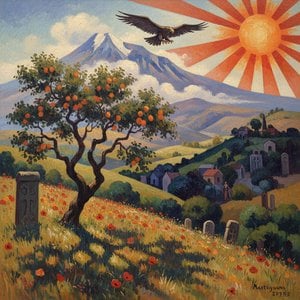
The light of Alexandrapol
Hrant Stepanyan began his life in 1918 in Alexandrapol, also known as Gyumri, Armenia. His early years were shaped by the quiet rhythms of this Armenian town. He spent his formative time studying at the Art secondary school in Yerevan, finishing his studies there in 1937. Later, he moved to Riga, Latvia, to attend the Art academy, graduating in 1946 under the guidance of professor Arijs Skride.
His approach to the canvas was rooted in realism. He looked at the world through a lens of clarity and light. In his hands, colors became lucid, and spaces felt filled with air. He did not seek to distort what he saw but rather to capture the truth of life as it appeared. His work often reflected a deep connection to nature, where impressions grew more sincere and spontaneous over time.
A hand for the portrait
While his interests spanned many forms, the portrait remained his most personal territory. He approached each face with a focus on precise characteristics and inner depth. These portraits were not merely about likeness; they captured the essence of the individual through subtle nuances in paint. His ability to render human images with sharp lines and psychological weight allowed him to explore the variety of everyday life.
Beyond the human figure, his brush moved through other landscapes and subjects:
- Historical paintings that documented significant narratives.
- Genre paintings capturing scenes of daily existence.
- Landscapes and seascapes that studied the external world.
- Still lifes that focused on the beauty of objects.
Recognition and legacy
In 1939, during an exhibition celebrating the 1000th anniversary of the Armenian national epos David of Sassoun, his work titled Armenians’ Eviction received high appreciation. This period marked a significant moment in his early career. His later years saw his work finding homes in several important institutions, including the National Art Gallery of Armenia and the Tretyakov Gallery in Moscow.
He passed away in Yerevan in 1980. His presence remains in the collections of the Museum of Yerevan, the Charent’s Museum of Science and Literature, and the Museum of Patriotic War. Through posthumous albums and catalogues, his way of seeing—the idea that life itself holds an inexhaustible beauty—continues to be documented for those who study the Armenian classical tradition of the 20th century.
الأسئلة والأجوبة
أين ومتى وُلد Hrant Stepanyan؟
وُلد Hrant Stepanyan في Gyumri عام 1918.
هل يمكن عرض أعمال Hrant Stepanyan وفق تسلسل زمني؟
يمكنك الاطلاع على الجدول الزمني لأعمال Hrant Stepanyan عبر صفحة التسلسل الزمني للأعمال الفنية التي ترتب الأعمال الفنية حسب تاريخ إنشائها.
ما هي الأسماء المستعارة أو الأسماء الأخرى التي يُعرف بها Hrant Stepanyan؟
يُعرف Hrant Stepanyan أيضاً باسم Arshak Stepanyan.
أين يمكنني مشاهدة أعمال Hrant Stepanyan الفنية مرتبة حسب الأجواء؟
يمكنك تصفح أعمال Hrant Stepanyan حسب الحالة المزاجية عبر صفحة ركن الأجواء الخاصة بالفنان، والتي ترتب الأعمال الفنية وفقاً لمشاعرها المسجلة.