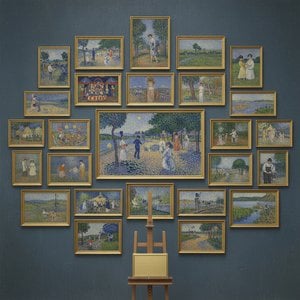
George Taylor (1914 - 1996) – A Pioneer of Landscape Painting
George Augustine Taylor (born August 30, 1895; died January 5, 1996) was a British artist renowned for his evocative depictions of the English countryside and particularly his pioneering exploration of immersive environments within art. His work stands apart from many contemporaries due to its profound engagement with phenomenology—the study of experience—and its deliberate manipulation of space and perception to evoke emotional resonance. Taylor’s artistic journey began in Macclesfield, Cheshire, where he was born into a family steeped in tradition and nurtured by an early fascination for the natural world. His formative years were spent on his father's farm nestled within a secluded valley, fostering a lifelong connection with landscape and inspiring his distinctive artistic vision.- Early Influences: Taylor’s artistic sensibilities were shaped by exposure to Minimalism and Land Art movements spearheaded by artists like Walter de Maria. The monumental ‘Lightning Field,’ 1977—a vast expanse of steel poles arranged in a grid pattern—proved particularly influential, prompting him to conceive of ambitious installations that sought to envelop viewers within singular spatial experiences.
- Bretton Hall and Phenomenological Exploration: He pursued his artistic education at Bretton Hall University of Leeds, where he immersed himself in sculptural form and constructed environments. Guided by tutor John Penny, Taylor embraced the philosophical ideas of Gaston Bachelard—specifically ‘intimate immensity’—which posits a fundamental link between architectural spaces and our subjective experience.
- Notable Works: Among his most celebrated pieces are “Wallflowers,” a series of paintings exploring the interplay of light and shadow within enclosed landscapes, and “Anstruther Wester,” which captures the grandeur of the Scottish coastline with meticulous detail and atmospheric perspective. These works exemplify Taylor’s commitment to conveying not merely what he sees but how it feels—a deliberate effort to transport the viewer into the artist's sensory world.
Technique and Artistic Vision
Taylor’s artistic technique was characterized by a masterful command of oil paint, achieved through painstaking layering and blending that resulted in surfaces imbued with remarkable luminosity and depth. He favored muted palettes—often dominated by earthy tones—reflecting his deep appreciation for the subtle nuances of natural color. However, what distinguished Taylor from many other painters of his era wasn’t merely technical proficiency; it was a conceptual framework rooted in phenomenology. He sought to create environments that actively engaged the viewer's senses and emotions, mirroring Bachelard’s assertion that space is not simply an objective container but rather a formative element shaping our consciousness.- Spatial Illusion: Taylor skillfully employed techniques of perspective and tonal gradation to generate illusions of depth and scale within his canvases—a deliberate departure from representational conventions prevalent in earlier art movements.
- Material Engagement: He meticulously crafted environments using materials like feather-lined passages and carefully positioned steel poles, aiming to stimulate tactile sensations and heighten the viewer’s awareness of their physical presence within the artwork.
Legacy and Recognition
George Taylor's contribution to British landscape painting is recognized as significant for its pioneering exploration of immersive environments and its philosophical underpinning. His work stands apart from many contemporaries due to its profound engagement with phenomenology—the study of experience—and its deliberate manipulation of space and perception to evoke emotional resonance. He was awarded the Royal Society of Beaux Arts Medal (RSBA) in 1983, acknowledging his artistic achievements and furthering his reputation as a visionary artist. His enduring influence can be seen in subsequent artists who embraced similar approaches to spatial representation and sensory engagement—artists who sought to capture not just what is visible but also what is felt within the artwork itself.- Influence on Contemporary Art: Taylor’s ideas resonated with later generations of artists interested in exploring the relationship between art and perception, shaping discussions about how artworks can affect our emotional states and alter our understanding of space.
Selected Paintings
الأسئلة والأجوبة
هل يمكنني تصفح أعمال George Taylor حسب الحالة المزاجية؟
يمكنك تصفح أعمال George Taylor حسب الحالة المزاجية عبر صفحة ركن الأجواء الخاصة بالفنان، والتي ترتب الأعمال الفنية وفقاً لمشاعرها المسجلة.
كم عدد الأعمال الفنية المتاحة لـ George Taylor؟
يمكنك تصفح 7 أعمال فنية من أعمال George Taylor في صفحة كافة الأعمال الفنية.
كيف يمكنني استعراض كافة الأعمال الفنية للفنان George Taylor؟
يمكن تصفح جميع أعمال George Taylor على هذا الموقع عبر صفحة كافة الأعمال الفنية الخاصة بالفنان.