A Life Forged in Hardship and Precision
The trajectory of Carl Johan Brummer begins not in a studio, but in the industrial grit of a Norrköping clothing factory. Following the death of his mother, the young boy from Nyköping is pulled from his schooling to labor for five years. This period of manual toil precedes a sudden shift toward academia in Lund, where he earns his student examination in 1840. The transition from factory worker to art student marks the definitive pivot in his life.
He moves to Copenhagen, entering the Royal Danish Academy of Fine Arts. Between 1840 and 1847, his hands learn the delicate discipline of miniature painting. He masters the art of working on ivory, a medium that demands absolute control and a steady gaze. By the time he settles in Stockholm in 1847, he has become a sought-after portraitist for the Copenhagen social circles, capturing faces on tiny, precious surfaces.
The Miniature and the Landscape
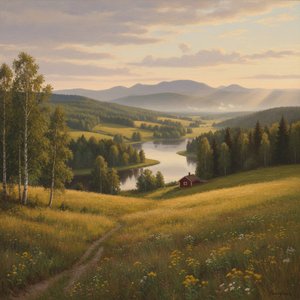
Brummer’s output is defined by a staggering volume of work, specifically in the realm of portrait miniatures. He produces between 300 and 400 of these small-scale works, often utilizing watercolor on ivory or paper. While his miniatures secured his place in society, his curiosity pulled him toward the Swedish countryside. He sought out the light and character of specific regions to fuel his genre scenes and landscapes:
- Dalarna
- Gästrikland
- Skåne
These excursions allowed him to move beyond the controlled environment of the portrait studio and into the open air of the Swedish landscape.
A Quiet Departure
The later years of Brummer’s life are marked by a retreat from the public eye. He lives a secluded existence in Stockholm, often characterized by poverty and a perceived social oddity. He is described by his contemporaries as a man who avoids the crowd, a recluse who eventually relies on a small pension from an aristocratic fund starting in 1867. His presence in the art world becomes a shadow of his former productivity.
Even in this period of isolation, his hand remains active. His studies and sketches are left behind, eventually finding their way to exhibition in Stockholm in 1871. His legacy survives through specific collections, including the Nationalmuseum’s engraving and drawing collection, Malmö Museum, and Gripsholm.
الأسئلة والأجوبة
في أي مدينة ودولة وُلد Carl Johan Brummer؟
وُلد Carl Johan Brummer في Nyköping، في Sweden.
أين يمكن استكشاف أعمال Carl Johan Brummer الفنية مصنفة حسب الموضوع؟
يمكن استكشاف أعمال Carl Johan Brummer حسب الموضوع عبر صفحة دليل المواضيع الخاصة بالفنان.
أين يمكنني مشاهدة أعمال Carl Johan Brummer الفنية في معرض ثلاثي الأبعاد؟
يمكنكم القيام بزيارة افتراضية: حيث تستعرض صفحة متحف ثلاثي الأبعاد الخاصة بـ Carl Johan Brummer أعمال الفنان في معرض ثلاثي الأبعاد.
كيف تطور فن Carl Johan Brummer بمرور الوقت؟
تتجلى المسيرة المهنية لـ Carl Johan Brummer مرحلة تلو الأخرى في صفحة مسيرة فنية: وهي عبارة عن خط زمني أفقي للأعمال الفنية، مُصنفة ضمن فصول تمثل كل حقبة من مسيرته.