Winslow Homer: A Pioneer of American Realism
Winslow Homer (February 24, 1836 – September 29, 1910) was an American landscape painter and illustrator, best known for his marine subjects. He is considered one of the foremost painters of 19th-century America and a preeminent figure in American art in general. Largely self-taught, Homer began his career not as a painter, but as a commercial illustrator at the age of twelve, working for Harper's Weekly. This experience honed his observational skills and ability to capture scenes with clarity and detail – qualities that would define his later work.
Unlike many artists of his time who received formal academic training in Europe, Homer’s early artistic development was largely self-directed. He began his career not as a painter, but as a commercial illustrator at the age of twelve, working for Harper's Weekly. This experience honed his observational skills and ability to capture scenes with clarity and detail – qualities that would define his later work.
Early Life and Beginnings
Born in Boston, Massachusetts, on February 24, 1836, Winslow Homer emerged as a pivotal figure in 19th-century American art. His mother was a gifted amateur watercolorist and Homer's first teacher. She and her son had a close relationship throughout their lives. Homer took on many of her traits, including her quiet, strong-willed, terse, sociable nature, her dry sense of humor, and her artistic talent.
His father was a volatile, restless businessman who was always looking to “make a killing.” When Homer was 13 years old, Charles gave up the hardware store business to seek a fortune in the California gold rush. When that failed, Charles left his family and went to Europe to raise capital for other get-rich-quick schemes that did not pay off.
Artistic Development & Style
Initially, Homer’s illustrations focused on scenes of rural life in New England. He gradually transitioned to painting, initially working in watercolor and then mastering oil paints. His early paintings often depicted idyllic pastoral scenes, but his style evolved dramatically over time.
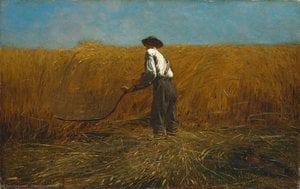
His artistic style is characterized by his use of bold brushstrokes and vivid colors. In The Return of the Gleaner, he employs a range of earthy tones to convey a sense of warmth and tranquility. The painting’s composition is well-balanced, with the woman positioned centrally and the wheat stalks extending outwards from her. This creates a sense of depth and dimensionality, drawing the viewer's eye into the scene.
- The use of light and shadow adds to the overall atmosphere of the painting, with the warm sunlight casting a gentle glow over the scene.
- The woman’s facial expression is serene, conveying a sense of contentment and peace.
- The surrounding landscape, including the wheat field and distant trees, is beautifully rendered, showcasing Winslow Homer's skill as a landscape artist.
Symbolism and Emotional Impact
“The Return of the Gleaner” transcends mere depiction; it embodies Homer’s profound engagement with the human condition. The woman’s posture—bent but resolute—represents resilience in the face of hardship, mirroring the struggles of rural America during a period marked by economic uncertainty and social upheaval.
Homer's masterful technique – particularly his layering of brushstrokes and meticulous attention to detail – captures not only the visual beauty of the landscape but also its emotional resonance. The painting speaks to themes of labor, perseverance, and connection with nature—values that resonated deeply within Homer’s artistic vision.
Handmade Oil Painting Reproductions
Handmade oil painting reproductions of The Return of the Gleaner are available at https://WahooArt.com, allowing art lovers to own a piece of history. The website also features other works by Winslow Homer, including The Return of the Gleaner and Girl with Pitchfork. For more information on the artist and his works, visit https://WahooArt.com or the The Phillips Collection website.



 معاينة الحجم الحقيقي
 اشترِ لوحة مرسومة يدويًا
 مشاركة
 مشاركة
 التفاصيل
 الدليل

 تحميل الملف
 قطع مشابهة
 الأشعة السينية
 عرض شرائح
 الإحصائيات

 عرض المزيد






































 خيار الزجاج متاح فقط للمقاسات التي تقل عن 110 سم




![Indian Tobacco Shop Sign [reverse, Indian Facing Right] — وينسلو هومر, Contemporary Realism](/media/artworks/images-thumb/74/22/7422432cafc295265ef3b7f7fa62d35d.jpg)


