A Visceral Encounter with Mortality
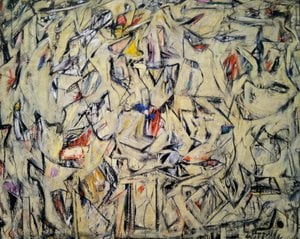
In the hauntingly rendered depths of Willem de Kooning’s 1948 masterpiece, “Night,” viewers are not merely observers but participants in a profound existential drama. The painting presents a striking, unsettling juxtaposition: a female face emerges from the shadows, only to be overlaid with the stark, skeletal imagery of a skull. This collision of beauty and decay establishes a central preoccupation that has defined much of de Kooning’s illustrious career. It is an image that refuses to offer comfort, instead forcing a confrontation with the fragility of life. The subject matter transcends simple portraiture, acting as a window into the human condition where the vitality of femininity battles against the encroaching darkness of mortality.
The emotional resonance of the piece is amplified by its place within the heart of Abstract Expressionism. Born from the profound disillusionment and psychological upheaval of the post-World War II era, "Night" embodies the movement's characteristic intensity. De Kooning abandons the safety of realism to prioritize raw feeling over precise form. There is a palpable sense of anxiety woven into every stroke, reflecting a period when artists were grappling with the trauma of global conflict and the terrifying uncertainties of a new atomic age. To stand before this work is to feel the weight of that historical tension, making it an essential piece for those who appreciate art that speaks to the deepest, often unspoken, layers of the human psyche.
The Language of Gesture and Texture
Technically, "Night" is a masterclass in the action painting style that would soon define the New York School. De Kooning utilized a bold, visceral palette—dominated by deep blacks, fiery reds, and jarring yellows—to create a sense of movement and instability. His technique relies heavily on thick impasto, where layers of oil paint are applied with such vigor that the canvas takes on a three-dimensional, sculptural quality. These heavy, deliberate strokes do not merely depict a scene; they record the physical and emotional energy of the artist himself. The texture is so dense that it creates a rhythmic, almost turbulent surface, mirroring the internal chaos of the subject matter.
Beyond the central figures, the composition is enriched by subtle, enigmatic elements that invite endless reinterpretation. A checkered pattern drifts through the background, adding a layer of geometric tension and depth that contrasts sharply with the organic, fluid forms of the face and skull. The presence of fragmented motifs—hints of a bird or perhaps a distant car—suggests a world in flux, where the boundaries between the subconscious and reality are perpetually blurred. For the discerning collector or interior designer, this painting offers more than just visual impact; it provides a sophisticated focal point that commands attention through its complexity, making it a timeless addition to any space dedicated to profound artistic expression.
الأسئلة والأجوبة
ما هي المساحة التي تتناغم مع ألوان "Night" للفنان ويليم دي كونينغ؟
بفضل لوحة ألوانه التي تتميز بـ Neutrals، يُنصح بوضع "Night" للفنان ويليم دي كونينغ في Living Room؛ حيث تُعد الألوان أحد الأسباب وراء هذا الاقتراح.
ما هي الموضوعات التي تظهر في "Night" للفنان ويليم دي كونينغ؟
تُصور "Night" للفنان ويليم دي كونينغ: skull imagery, female figure, color palette, texture contrast, geometric pattern, symbolism, emotional expression.
كيف يربط عمل "Night" للفنان ويليم دي كونينغ بين Abstract Expressionism والوطن الأم للفنان؟
أُنجز العمل الذي ينتمي إلى مدرسة Abstract Expressionism بعنوان "Night" على يد فنان وُلد في هولندا.



 معاينة الحجم الواقعي
 اطلب نسخة مرسومة يدويًا
 إرسال
إرسال مشاركة
 عرض التفاصيل
 دليل الأعمال الفنية للطلاب

 تحميل
تحميل
 قطع مشابهة
 الأشعة السينية
 عرض شرائح متتابع
 Q&A
Q&A الإحصائيات

 اقرأ المزيد






































 خيار الزجاج متاح فقط للمقاسات التي تقل عن 110 سم


![Abstract Composition [triptych] — Vaclav Vytlacil, Abstract Expressionism](/media/artworks/images-thumb/08/3c/083c0675045645fd42d4e6c6d63f1ced.jpg)