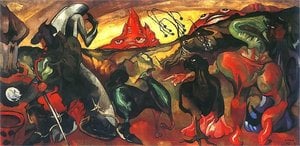
A Dialogue of Souls: The Enigmatic Encounter in Two Heads
In the hauntingly beautiful portrait Two heads, created in 1920 by the visionary Polish master Stanisław Ignacy Witkiewicz, we are invited into a private, almost breathless moment of human connection. The canvas presents a striking duality, capturing two women locked in an intense, silent exchange. One figure, draped in the somber elegance of a black dress, leans forward with her mouth slightly parted, as if caught mid-sentence or perhaps gasping at a sudden revelation. Opposite her, a woman in a vibrant red dress provides a searing contrast, her presence anchored by the unexpected detail of a bird perched delicately upon her shoulder. This juxtaposition of light and shadow, of stillness and potential movement, creates a psychological tension that draws the viewer into the very heart of their shared gaze.
The technique employed by Witkacy reflects his profound position within the currents of Polish Modernism. The brushwork possesses a certain raw, expressive energy that transcends mere representation, leaning into the depths of Symbolist surrealism. There is a palpable weight to the textures—the sheen of the necklaces, the heavy folds of the fabric, and the organic softness of the bird's plumage all contribute to a sense of tactile reality. Through his masterful use of color, Witkacy does not merely depict clothing; he uses the deep blacks and fiery reds to delineate the emotional temperature of the scene, making the atmosphere feel thick with unspoken meaning and intellectual depth.
Beyond the surface beauty, Two heads serves as a profound exploration of intimacy and the uncanny. The presence of the bird acts as a powerful symbol, perhaps representing nature’s intrusion into human social spheres or acting as a messenger between the two souls. For the discerning collector or interior designer, this piece offers more than just aesthetic appeal; it provides a focal point of immense character. It is an artwork that demands contemplation, making it an ideal centerpiece for a sophisticated gallery wall or a curated study where one seeks to evoke themes of mystery, connection, and the complex layers of the human psyche. To possess a reproduction of this work is to bring a fragment of interwar European avant-garde history into the modern home, offering a timeless window into a moment of profound emotional resonance.
الأسئلة والأجوبة
ما تاريخ وتصميم "Two heads" للفنان ستانيسلاف إغناسي فيتكيفيتش؟
يعود تاريخ "Two heads" للفنان ستانيسلاف إغناسي فيتكيفيتش إلى عام 1920 وينتمي إلى Polish Modernism.
كيف تُوصف لوحة ألوان "Two heads" للفنان ستانيسلاف إغناسي فيتكيفيتش؟
تُوصف لوحة ألوان "Two heads" للفنان ستانيسلاف إغناسي فيتكيفيتش بأنها Earthy، وهي وصف موجز لألوان العمل الفني.
ما نوع العمل الفني "Two heads" للفنان ستانيسلاف إغناسي فيتكيفيتش؟
في الكتالوج، تم تصنيف "Two heads" للفنان ستانيسلاف إغناسي فيتكيفيتش كـ WallArt. وتساعد هذه الفئة في العثور على أعمال مماثلة.



 معاينة الحجم الواقعي
 اطلب نسخة مرسومة يدويًا
 إرسال
إرسال مشاركة
 عرض التفاصيل
 دليل الأعمال الفنية للطلاب

 تحميل
تحميل
 قطع مشابهة
 الأشعة السينية
 عرض شرائح متتابع
 الإحصائيات


 اقرأ المزيد






































 خيار الزجاج متاح فقط للمقاسات التي تقل عن 110 سم