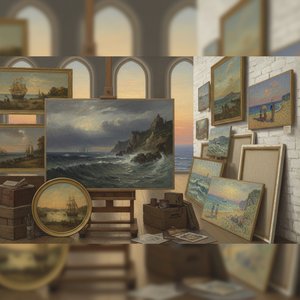
A Coastal Symphony: Long Hope Orkney by Sir John Lavery
Sir John Lavery’s “Long Hope Orkney,” painted in 1917, isn't merely a depiction of a windswept coastline; it’s a poignant meditation on resilience, isolation, and the enduring spirit of a people shaped by both the sea and the shadows of war. This evocative landscape captures a pivotal moment – likely during the tumultuous years of World War I – as evidenced by the presence of military vessels subtly integrated into the scene. Lavery masterfully employs Impressionistic techniques to convey not just what he saw, but also the atmosphere and emotional resonance of the Orkney Islands.
The painting’s palette is dominated by a restrained symphony of blues, greys, and whites, mirroring the often-overcast skies typical of this northern region. These muted tones aren't depressing; instead, they create a sense of quiet contemplation, emphasizing the vastness of the sea and the rugged beauty of the land. Visible brushstrokes—loose, gestural, and layered—are central to Lavery’s style, lending an immediacy and dynamism to the scene. The artist doesn’t strive for photographic realism but rather captures the fleeting effects of light and weather, imbuing the landscape with a palpable sense of movement. The composition itself is carefully balanced: the expansive sky occupies roughly one-third of the canvas, drawing the eye upwards while the water dominates the middle ground, its surface rippling with an implied current. The foreground—a cluster of buildings, docks, and figures – anchors the scene, grounding us in a tangible reality.
The Weight of History & Lavery’s Vision
Understanding “Long Hope Orkney” requires acknowledging the historical context within which it was created. Lavery, a prominent figure in Edwardian society, skillfully navigated the shifting social and political landscape of his time, often depicting scenes of both opulent leisure and the grim realities of war. The inclusion of military vessels strongly suggests this latter element; Orkney’s strategic location made it a vital area for naval operations during WWI. However, Lavery doesn't simply portray conflict. Instead, he imbues the scene with a sense of melancholy and introspection – perhaps reflecting on the impact of the war on the lives of ordinary people, or the enduring connection between humanity and the natural world.
Further research reveals that Lavery’s artistic journey was deeply intertwined with Scottish Impressionism. Influenced by artists like William Burrell, he embraced a looser brushstroke and an emphasis on capturing fleeting moments in time. His portraits of notable figures – Winston Churchill, H.H. Asquith – demonstrate his ability to capture the essence of his subjects, while his wartime scenes offer a stark contrast, revealing a sensitivity to human suffering. The painting’s composition echoes elements found in John Kyffin Williams' landscapes of Wales, sharing a similar focus on capturing atmospheric conditions and the rugged beauty of the British Isles.
Decoding Symbolism & Artistic Technique
Beyond its historical context, “Long Hope Orkney” is rich with symbolic potential. The distant shoreline, shrouded in mist, evokes feelings of isolation and uncertainty – themes frequently explored by artists during periods of upheaval. The figures on the land, indistinct yet present, represent the human element, suggesting a community grappling with challenges while maintaining a connection to their heritage. Lavery’s masterful use of perspective—size diminution as objects recede into the distance—creates a convincing sense of depth and space, drawing the viewer into the scene.
The painting's technique is equally noteworthy. Lavery employs layering and blending colors to create an atmospheric effect, simulating the diffused light characteristic of coastal environments. The visible brushwork adds texture and dynamism, while the loose lines capture the movement of water and clouds. The choice of oil paint on canvas allowed for a rich, luminous finish—a testament to Lavery’s skill as a colorist. The use of muted tones, combined with the expressive brushstrokes, creates a powerful emotional impact, inviting viewers to contemplate the beauty and fragility of the natural world.
Bringing “Long Hope Orkney” Home
WahooArt offers meticulously hand-painted reproductions of Sir John Lavery’s “Long Hope Orkney,” allowing you to experience this remarkable artwork in stunning detail. Each reproduction is created using archival-quality materials and techniques, ensuring that it will retain its beauty and vibrancy for generations to come. Whether displayed as a statement piece in your living room or incorporated into an interior design scheme, this painting’s evocative imagery and historical significance will undoubtedly captivate and inspire.



 معاينة الحجم الحقيقي
 اشترِ لوحة مرسومة يدويًا
 مشاركة
 مشاركة
 التفاصيل

 تحميل الملف
 قطع مشابهة
 الأشعة السينية
 عرض شرائح
 الإحصائيات


 عرض المزيد






































 خيار الزجاج متاح فقط للمقاسات التي تقل عن 110 سم