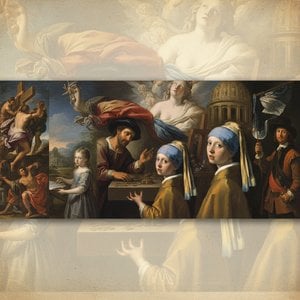
A Divine Dialogue in Shadow and Light
In the quiet, hallowed space of Simone Cantarini’s Saint Matthew and the Angel, the boundary between the earthly and the divine dissolves into a breathtaking moment of shared contemplation. Created around 1645, this masterpiece serves as a profound meditation on faith, learning, and the intimate whispers of spiritual connection. The scene captures the Apostle Matthew not as a distant theological icon, but as a man deeply immersed in the act of study, his focused concentration palpable through the meticulous rendering of his weathered features and the heavy folds of his robes. Beside him, an angelic presence hovers—not with overwhelming grandeur, but with a gentle, guiding grace that suggests a shared intellectual curiosity between the human and the celestial.
The emotional resonance of the work lies in its ability to make the miraculous feel profoundly personal. There is a stillness here, a suspended moment in time where the weight of scripture meets the lightness of divine inspiration. For the discerning collector or interior designer, this painting offers more than mere decoration; it provides an anchor of serenity and intellectual depth, making it an ideal centerpiece for spaces dedicated to reflection, study, or sophisticated classical elegance.
The Mastery of a Baroque Synthesis
Cantarini, often celebrated as il Pesarese, occupies a singular position in the history of the Italian Baroque. This work is a brilliant testament to his ability to synthesize seemingly contradictory artistic movements. From his training under the great Guido Reni in Bologna, Cantarini inherited a refined classical sensibility, evident in the balanced composition and the harmonious, idealized grace of the figures. Yet, he infused this classical foundation with the visceral, dramatic energy of Caravaggism. Through the use of tenebrismo—the stark, theatrical interplay of deep shadows and piercing light—he breathes life into the textures of the scene, from the tactile quality of the parchment to the soft, diffused glow illuminating the saint's face.
This technical virtuosity is further enriched by a subtle nod to Venetian naturalism. The way light dances across the fabric and the atmospheric depth of the background suggest an influence from masters like Tintoretto, adding a layer of painterly richness that prevents the composition from feeling static. It is this precise alchemy of Bolognese order, Caravaggesque drama, and Venetian color that makes Cantarini’s work so enduringly captivating to the modern eye.
Symbolism and Aesthetic Splendor
Every element within the frame of Saint Matthew and the Angel serves a symbolic purpose, weaving a narrative of enlightenment. The book, held by the saint, represents the weight of divine truth and the human endeavor to document the sacred. The presence of the angel acts as the bridge—the celestial messenger that brings wisdom to the mortal realm. This interplay of light and dark is not merely a stylistic choice but a metaphor for the journey from ignorance to illumination.
For those seeking to curate an environment of timeless prestige, a high-quality reproduction of this work offers an unparalleled opportunity to introduce historical gravity and artistic sophistication into a room. The painting’s rich palette of deep earth tones and luminous highlights complements both traditional period interiors and contemporary minimalist settings, providing a window into the soul of the 17th century. To possess such a piece is to invite the quiet, transformative power of the Baroque into one's own sanctuary.



 معاينة الحجم الحقيقي
 التحويل إلى المطبوعات
 مشاركة
 مشاركة
 التفاصيل
 الدليل

 تحميل الملف
 قطع مشابهة
 الأشعة السينية
 عرض شرائح
 الإحصائيات


 عرض المزيد






































 خيار الزجاج متاح فقط للمقاسات التي تقل عن 110 سم