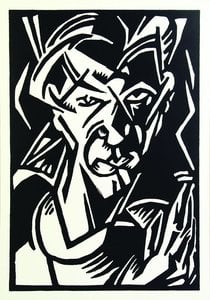
Sandor Bortnyik: Weaver of Shadows and Symbolism
Sandor Bortnyik (1893-1976) remains a profoundly enigmatic figure in the history of Hungarian art, an artist whose haunting works continue to resonate with a potent blend of symbolism, expressionism, and architectural precision. Born in Marosvásárhely, Transylvania – then part of the Kingdom of Hungary – Bortnyik’s life was marked by displacement and artistic evolution, ultimately shaping him into one of the most distinctive voices of his generation. His legacy lies not just in a vast body of paintings and graphic designs, but also in his pivotal role as an educator, fostering a new wave of Hungarian artists within the framework of Bauhaus principles.
Early Life and Influences
Bortnyik’s early artistic training began in Budapest, where he was immediately drawn to the vibrant energy of the Fauvist movement. However, the political upheaval following World War I forced him into exile, ultimately leading him to Weimar in 1922. This relocation proved transformative, immersing him within the revolutionary environment of the Bauhaus school. The principles of functionalism, geometric abstraction, and a focus on craftsmanship profoundly influenced his artistic development. He studied under masters like Johannes Itten and Lyonel Feininger, absorbing their philosophies while simultaneously forging his own unique visual language. The influence of Cubism is readily apparent in his early works, particularly the fragmentation of forms and the exploration of multiple perspectives – a technique he would later masterfully integrate with symbolic imagery.
A Master of Commercial Art and Graphic Design
Despite his engagement with avant-garde movements, Bortnyik’s career was inextricably linked to the world of commercial art. He quickly established himself as a highly sought-after designer of posters, creating striking visual communications for a diverse range of clients – from perfume manufacturers like Savoly to cigarette companies such as Modiano. These posters are not merely advertisements; they are miniature works of art, characterized by bold colors, dynamic compositions, and often imbued with a sense of melancholy or foreboding. His designs were remarkably innovative for their time, introducing modernist-constructivist aesthetics to the Hungarian market.
The Workshop and the Bauhaus Legacy
In 1928, Bortnyik established “The Workshop” (Mühely), a private art school in Budapest that became a crucial incubator for Hungarian artistic talent. Drawing heavily from the principles of the Bauhaus, he emphasized experimentation with materials, techniques, and conceptual approaches. His curriculum fostered a spirit of innovation and encouraged students to challenge traditional notions of art-making. He also served as director of the Hungarian Academy of Fine Arts from 1949 to 1956, shaping the artistic landscape of post-war Hungary. His commitment to education extended beyond formal instruction; he actively sought to expose his students to international developments in art and design, fostering a cross-cultural dialogue that enriched their creative practice.
Themes of Death, Transformation, and the Urban Landscape
Bortnyik’s oeuvre is deeply preoccupied with themes of death, decay, and transformation. His most famous works – often referred to as “tunnel paintings” – depict claustrophobic spaces filled with distorted figures, fragmented forms, and a pervasive sense of unease. These images evoke the psychological anxieties of modernity, reflecting a fascination with mortality and the fragility of human existence. The use of dark colors, dramatic lighting, and symbolic imagery—such as skulls, decaying flowers, and solitary figures—creates an atmosphere of profound melancholy. Yet, amidst this darkness, there is often a glimmer of hope or resilience, suggesting the possibility of renewal and rebirth. His paintings frequently depict urban landscapes, capturing the isolation and alienation of modern life, while also exploring the beauty and mystery hidden within the city’s shadows.
Bortnyik's work continues to be studied and admired for its haunting beauty, technical mastery, and profound exploration of the human condition. He remains a pivotal figure in Hungarian art history, a testament to the power of artistic vision and the enduring legacy of the Bauhaus movement.



 معاينة الحجم الواقعي
 التبديل إلى المطبوعات
 إرسال
إرسال مشاركة
 عرض التفاصيل
 دليل الأعمال الفنية للطلاب

 تحميل
تحميل
 قطع مشابهة
 الأشعة السينية
 عرض شرائح متتابع
 الإحصائيات
 اقرأ المزيد