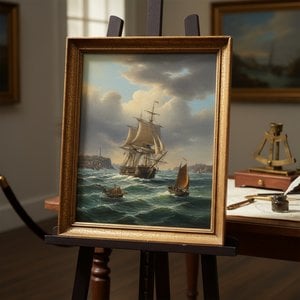
The Father of English Watercolour: The Legacy of Samuel Scott
Samuel Scott, born in London around 1702, remains a figure shrouded in artistic mystery—a testament to the challenges faced by documenting artists of his era. Despite scarce biographical details regarding his formative years and training, Scott emerged as one of Britain’s most prominent landscape painters during the mid-18th century, establishing himself as a pioneer in watercolour technique and profoundly influencing subsequent generations of British artists. His distinctive style—characterized by serene riverside scenes and dramatic seascapes imbued with atmospheric perspective—captured the spirit of his time and cemented his legacy as “the father of English watercolour.”
Scott’s artistic journey commenced in approximately 1720, initially focusing on maritime art. Like many artists of his generation, he was deeply impacted by the works of Willem van de Velde the Younger, owning numerous copies and absorbing a masterful handling of light and texture. This influence is palpable in his early works depicting warships engaged in naval battles, demonstrating a meticulous attention to detail and an understanding of compositional principles rooted in Dutch marine painting traditions. His ability to translate the raw power of the sea into delicate, evocative imagery allowed him to bridge the gap between rigid maritime documentation and fine art.
A Vision of London and the Thames
As his career matured, Scott turned his gaze toward the heart of the British Empire, finding profound inspiration in the bustling waterways of the River Thames. His works serve as a vivid window into 18th-century London, capturing the rhythmic pulse of maritime trade and the daily life of the riverside. In masterpieces such as A Thames Wharf (1757), he presents a bustling depiction of commerce, where the movement of boats and the structure of the wharves tell a story of a city in constant motion. His talent lay in his ability to blend topographical accuracy with a romanticized atmosphere, making the industrial and commercial aspects of London appear both grand and intimate.
Beyond the busy docks, Scott possessed a remarkable gift for capturing the architectural majesty of London’s landmarks. His depictions of the city often utilized an oil on canvas medium to achieve a sense of permanence and grandeur, as seen in The Thames at Westminster Bridge with Barges (1746). In this work, he showcases London’s architectural detail through a Romantic lens, using light and shadow to create a captivating historical atmosphere. Similarly, his View of Somerset House Looking Downstream from the York Water-Tower demonstrates his skill in topographical painting, offering a serene look at the cityscape and the nearby Tower of London, rendered with a precision that honors the structural elegance of the era.
Artistic Collaborations and Historical Significance
The development of Scott's style was also shaped by significant professional partnerships. His collaborative project with George Lambert on six paintings portraying East India Company settlements showcased his versatility and ability to synthesize disparate artistic elements—architecture alongside landscape—reflecting the intellectual currents of the period. This partnership resulted in images that conveyed both grandeur and intimacy, capturing the essence of colonial enterprise while simultaneously celebrating the beauty of natural surroundings. Such works were not merely aesthetic pursuits but served as important historical records of Britain's expanding global reach.
The enduring significance of Samuel Scott lies in his role as a transitional figure who helped elevate watercolour from a medium of mere sketching to a respected form of fine art. His contributions can be summarized through several key artistic pillars:
- Pioneering Technique: He introduced a level of atmospheric depth and light manipulation that would define the English watercolour tradition for decades.
- Maritime Mastery: By blending Dutch marine influences with British subject matter, he created a unique genre of naval and riverine art.
- Topographical Documentation: His detailed renderings of London landmarks provided an invaluable visual archive of 18th-century urban life and architecture.
- Cultural Synthesis: Through his collaborations, he successfully merged the documentation of colonial expansion with the aesthetic beauty of landscape painting.
Through his dedicated observation of the Thames and the sea, Samuel Scott did more than just paint landscapes; he captured the very soul of a maritime nation during a period of immense growth and transformation.



 معاينة الحجم الواقعي
 التبديل إلى المطبوعات
 إرسال
إرسال مشاركة
 عرض التفاصيل
 دليل الأعمال الفنية للطلاب

 تحميل
تحميل
 قطع مشابهة
 الأشعة السينية
 عرض شرائح متتابع
 الإحصائيات
 اقرأ المزيد






































 خيار الزجاج متاح فقط للمقاسات التي تقل عن 110 سم