Opposition: A Surrealist Echo of Discord
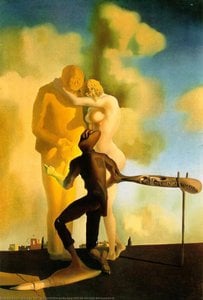
Salvador Dalí’s “Opposition,” painted in 1952, stands as a quintessential embodiment of the Surrealist movement's preoccupation with subconscious exploration and paradoxical juxtapositions. More than just an image on canvas; it’s a visual manifestation of internal conflict—a fractured landscape mirroring the artist’s own turbulent psyche. The painting immediately captivates with its striking duality: a dominant palette of cool blues and whites battling against fiery oranges and reds, colors deliberately devoid of harmonious blending to amplify the sense of instability inherent in Dalí's vision.
- Composition & Perspective: Abandoning traditional perspective entirely, Dalí prioritizes symbolic representation over spatial realism. The vertical axis emphasizes a central division—not merely visual but conceptual—reflecting the core theme of opposing forces at play.
- Formal Elements: Angular lines dominate the composition, creating shards of fractured forms reminiscent of shattered glass or broken pieces. These shapes contribute significantly to the artwork’s unsettling atmosphere and disrupt any illusion of depth. Curved lines appear in the depiction of birds, offering a subtle counterpoint to the rigid geometry.
- Color Theory: The chromatic clash isn't accidental; it serves as a powerful tool for conveying emotional resonance. Cool blues symbolize serenity and contemplation, while warm reds represent passion and aggression—forces perpetually vying for dominance within the artwork’s narrative.
Technique & Material Considerations
Dalí meticulously crafted “Opposition” using oil paints on canvas – a technique that allows for layering of colors and achieving remarkable textural detail despite the overall impression of smoothness. The artist's painstaking brushwork ensures that every fragment retains its individual character, reinforcing the painting’s fragmented aesthetic. Careful attention was paid to surface preparation and pigment mixing, reflecting Dalí’s dedication to artistic precision. Considering the artwork's dimensions (unknown), reproductions would benefit from archival quality canvas and pigments to preserve the original vibrancy and nuance of Dalí’s vision.
Symbolism & Interpretative Layers
Beyond its formal qualities, “Opposition” resonates with profound symbolic significance. The central figure’s division into contrasting colors speaks directly to themes of duality—the interplay between light and darkness, order and chaos—mirroring Dalí's own preoccupation with psychological complexity. Scattered birds symbolize freedom and aspiration, yet their angular forms underscore the fragmentation inherent in the artwork’s core message. The painting invites contemplation on internal struggles and the elusive nature of identity.
Historical Context & Artistic Influence
Created during Dalí’s peak Surrealist period, “Opposition” exemplifies the movement's rejection of rational thought and embrace of dreamlike imagery—a reaction to the anxieties of post-war Europe. Influenced by Freud’s psychoanalytic theories, Dalí sought to tap into the subconscious mind, translating its irrational impulses onto canvas with unparalleled boldness. Its impact extends beyond the art world, establishing Dalí as a pioneer in visual storytelling and cementing Surrealism's legacy as one of the most transformative artistic movements of the 20th century.



 معاينة الحجم الحقيقي
 اشترِ نسخة مطبوعة
 مشاركة
 مشاركة
 التفاصيل

 تحميل الملف
 قطع مشابهة
 الأشعة السينية
 عرض شرائح

 عرض المزيد






































 خيار الزجاج متاح فقط للمقاسات التي تقل عن 110 سم