A Prelude to Pop: The Raw Energy of Lichtenstein’s Abstract Genesis
Before the world came to know Roy Lichtenstein as the master of the Ben-Day dot and the architect of comic-strip chic, there existed a different, more visceral version of his creative soul. His 1960 work, Untitled, serves as a breathtaking window into a pivotal moment of transition, capturing an artist caught in the throes of Abstract Expressionism. In this piece, we encounter a creator unburdened by the irony and mechanical precision that would later define his career. Instead, we find a painter deeply engaged with the spontaneous, the tactile, and the profoundly emotional. It is a rare, intimate glimpse into the laboratory of a genius, where the heavy weight of post-war tension meets the liberating movement of the brush.
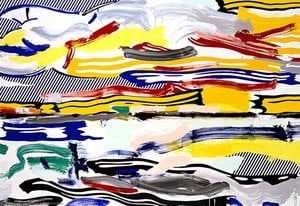
The canvas acts as a battlefield of color and motion, eschewing any recognizable subject in favor of pure, unadulterated feeling. There are no characters here, no narratives to decode—only the rhythmic dance of blues, reds, yellows, greens, and browns set against a muted, pale grey expanse. The composition lacks a traditional focal point, inviting the viewer’s eye to wander through a chaotic yet strangely harmonious arrangement of organic shapes and intersecting lines. This lack of structure is intentional; it mirrors the automatic process favored by the Abstract Expressionists, where the act of painting itself becomes the primary subject, capturing a fleeting moment of psychic energy before it can be codified into form.
Texture and Technique: The Tactile Language of Emotion
To stand before a high-quality reproduction of this work is to appreciate the incredible impasto technique that Lichtenstein employed during this era. Unlike his later, flatter works that mimicked the smoothness of print media, this 1960 masterpiece thrives on depth and physical presence. The paint is applied in thick, vigorous layers, creating a three-dimensional topography that catches the light and casts subtle shadows across the canvas. Each brushstroke feels urgent and decisive, suggesting a rapid, intuitive execution that prioritizes the artist's immediate impulse over meticulous planning.
This heavy texture does more than just add visual interest; it amplifies the painting's emotional resonance. The way the colors overlap and bleed into one another creates a sense of friction and tension, as if the pigments themselves are struggling to find equilibrium. For the collector or interior designer, this piece offers a sophisticated layer of complexity. It provides a focal point that is both intellectually stimulating and visually rich, making it an ideal centerpiece for spaces that demand a sense of movement, history, and raw, artistic authenticity.
A Historical Intersection: From Abstraction to Iconography
Understanding this painting requires situating it within the turbulent art landscape of 1960. This was a year of profound metamorphosis, where the dominance of Abstract Expressionism was beginning to face the rising tide of Pop Art. In this work, Lichtenstein stands at the crossroads. He is utilizing the vocabulary of the old guard—gestural abstraction and emotional intensity—while simultaneously experimenting with the very boundaries that he would soon shatter with his later, more commercialized imagery. It is a bridge between two worlds: the deeply personal, subjective experience of the mid-century painter and the objective, mass-produced reality of the coming decade.
For those seeking to adorn their homes or galleries with art that tells a story of evolution, Untitled (1960) is an incomparable choice. It offers more than mere decoration; it offers a piece of art history. It invites conversation about the nature of creativity and the courage required to abandon one's established style in search of something new. Whether placed in a contemporary minimalist setting or a classic, curated study, this painting brings with it an undeniable aura of prestige, energy, and the enduring spirit of artistic discovery.
الأسئلة والأجوبة
ما مدى حدة الألوان في "Untitled (1960)" للفنان روي ليختنشتاين؟
تُظهر لوحة "Untitled (1960)" للفنان روي ليختنشتاين كثافة لونية Balanced.
ما مدى سطوع "Untitled (1960)" للفنان روي ليختنشتاين؟
إن مستوى الإضاءة المسجل لـ "Untitled (1960)" للفنان روي ليختنشتاين هو Bright Balance.
كيف يمكن وصف الحالة المزاجية لـ "Untitled (1960)" للفنان روي ليختنشتاين؟
تتمتع لوحة "Untitled (1960)" بأجواء Dramatic.



 معاينة الحجم الواقعي
 اطلب نسخة مرسومة يدويًا
 إرسال
إرسال مشاركة
 عرض التفاصيل
 دليل الأعمال الفنية للطلاب

 تحميل
تحميل
 قطع مشابهة
 الأشعة السينية
 عرض شرائح متتابع
 Q&A
Q&A الإحصائيات

 اقرأ المزيد






































 خيار الزجاج متاح فقط للمقاسات التي تقل عن 110 سم