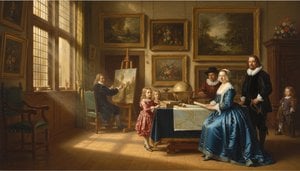
Rembrandt’s Intimate Portrait of Jan Six
Rembrandt van Rijn's “Jan Six,” painted in 1654, isn’t merely a likeness; it’s a carefully constructed tableau brimming with quiet dignity and subtle psychological depth. This remarkable portrait, measuring 112 x 102 cm on canvas, transcends the conventions of its time to offer a glimpse into the character of a prominent Amsterdam cloth merchant – and, perhaps more importantly, into the mind of one of history’s greatest artists.
The subject himself, Jan Six (1618-1700), was a man of considerable influence within the bustling commercial heart of the Dutch Republic. A successful textile trader, he possessed not only wealth but also an intellectual curiosity evident in his holding of a book – a symbol immediately connecting him to the world of learning and civic engagement. The red coat, lavishly trimmed with gold, speaks volumes about his status and prosperity, while the carefully arranged hat and long hair reflect the fashionable attire of the mid-17th century. However, it’s Six's gaze that truly captivates; a direct, almost challenging look directed squarely at the viewer, inviting us into an intimate exchange – as if he were acknowledging our presence within his world.
But “Jan Six” is far more than just a portrait of a man. Rembrandt masterfully employs light and shadow—a hallmark of his signature style—to sculpt Six’s form and imbue the scene with atmosphere. The strong chiaroscuro, particularly evident in the details of the coat and hands, creates a dramatic interplay between illumination and darkness, drawing our attention to key elements while simultaneously suggesting an underlying sense of mystery. The subtle inclusion of two figures in the background – one holding a book, mirroring Six’s own intellectual pursuits – adds layers of complexity and hints at the social connections that shaped his life.
Rembrandt's Artistic Legacy & The Dutch Golden Age
To fully appreciate “Jan Six,” it’s essential to understand Rembrandt’s place within the broader context of the Dutch Golden Age. This period, roughly spanning from the mid-16th to the early 18th centuries, witnessed an unprecedented flourishing of art, science, and commerce in the Netherlands. Rembrandt, born in Leiden in 1606, was a pivotal figure in this cultural explosion, profoundly influenced by both Italian Renaissance masters like Leonardo da Vinci and his contemporaries within the Dutch artistic tradition.
His early training under Pieter Lastman exposed him to dramatic lighting and theatrical composition, while his time in Amsterdam broadened his horizons. Rembrandt’s ability to capture the essence of his subjects – whether portraits or biblical scenes – was unparalleled. He never traveled abroad, yet he absorbed a vast range of artistic influences, creating a uniquely personal style characterized by emotional intensity, psychological insight, and an innovative use of light. His output—approximately three hundred paintings, three hundred etchings, and two thousand drawings—testifies to his prolific creativity and enduring legacy.
Portrait Painting: A Historical Context
The genre of portrait painting underwent a significant transformation during Rembrandt’s lifetime. Initially commissioned primarily by the wealthy elite – monarchs, nobles, and merchants – portraits gradually became more accessible to middle-class patrons seeking to commemorate their families and colleagues. This shift reflected broader social changes within Dutch society, as wealth became more widely distributed and individuals sought ways to assert their status and identity.
Rembrandt’s portraits are not simply representations of physical likeness; they are carefully constructed narratives that reveal the subject's character, social standing, and inner life. He skillfully employed techniques such as asymmetrical composition, subtle gestures, and expressive facial expressions to convey a sense of personality and emotion. “Jan Six” exemplifies this approach, offering a nuanced portrayal of a man who is both dignified and approachable.
Symbolism & Emotional Impact
Beyond the immediate visual elements, “Jan Six” is rich in symbolism. The book represents intellectual curiosity and engagement with the world of ideas, while the red coat signifies wealth and status. Six’s direct gaze challenges the viewer to engage with his personality, inviting us to contemplate his thoughts and motivations. Rembrandt's masterful use of light and shadow further enhances this emotional impact, creating a sense of intimacy and immediacy.
The painting’s enduring appeal lies in its ability to transcend time and connect with viewers on a deeply personal level. It is a testament to Rembrandt’s artistic genius—a portrait that captures not only the likeness of Jan Six but also the essence of a man, a period, and an era.



 معاينة الحجم الحقيقي
 اشترِ لوحة مرسومة يدويًا
 مشاركة
 مشاركة
 التفاصيل

 تحميل الملف
 قطع مشابهة
 الأشعة السينية
 عرض شرائح
 الإحصائيات


 عرض المزيد






































 خيار الزجاج متاح فقط للمقاسات التي تقل عن 110 سم