A Portrait of Intellectual Harmony: Rembrandt Peale’s *Musical Allegory*
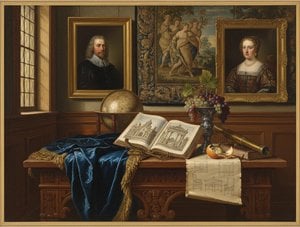
Rembrandt Peale's 1626 painting, *Musical Allegory*, isn’t merely a depiction of a room filled with instruments; it’s a carefully constructed tableau brimming with symbolic resonance and the quiet intellectual fervor of the early Baroque era. The scene unfolds within a richly appointed chamber, bathed in a diffused light that suggests both intimacy and scholarly contemplation. At its heart sits a woman, elegantly dressed and deeply engrossed in a book – not a dramatic gesture, but one of serene absorption, hinting at a mind engaged in profound thought. Around her, an array of instruments—a lute, a recorder, a viola da gamba—are arranged with a deliberate grace, suggesting a shared passion for music and its ability to elevate the spirit. The inclusion of two figures – one standing behind her, seemingly observing, and another on the right, perhaps a student or companion – adds layers of interaction and a sense of communal learning.
Peale’s masterful technique is immediately apparent. He employs a meticulous attention to detail, rendering each instrument with remarkable precision and capturing the subtle textures of fabrics and wood. The use of chiaroscuro—the dramatic contrast between light and shadow—is particularly effective, drawing the viewer's eye to key elements within the composition while simultaneously creating an atmosphere of depth and mystery. The palette is restrained yet sophisticated, dominated by warm browns, golds, and deep reds, colors associated with wealth, knowledge, and artistic patronage during this period. The brushwork itself is smooth and refined, indicative of Peale’s training under his father, Charles Willson Peale, a renowned painter and museum founder who instilled in his children a love for both art and science.
The Language of Music and Learning
Beyond the visual details, *Musical Allegory* speaks volumes about the cultural values of 17th-century Europe. The prominence of music—a cornerstone of aristocratic life—underscores its role as a means of entertainment, education, and social status. The presence of books and scholarly pursuits highlights the burgeoning interest in classical learning and the humanist ideals that were reshaping European thought. This wasn’t simply about appreciating beautiful sounds; it was about cultivating intellect, fostering critical thinking, and connecting with the wisdom of the ancients.
Furthermore, the woman at the center is not a passive recipient of knowledge but an active participant in this intellectual landscape. Her posture, her focused gaze, suggest a mind engaged in deep contemplation—a rare portrayal of female intellect within the artistic conventions of the time. The arrangement of the instruments around her isn’t haphazard; it's carefully orchestrated to create a harmonious composition, mirroring the principles of musical theory and suggesting that art and music are inextricably linked.
Rembrandt Peale: A Legacy in American Portraiture
Born in Bucks County, Pennsylvania, in 1778, Rembrandt Peale was part of a remarkable artistic lineage. His father, Charles Willson Peale, was a pioneering figure in the development of American art, establishing the first public museum in the United States and fostering a spirit of scientific inquiry alongside artistic expression. Rembrandt himself benefited immensely from this environment, receiving rigorous training in painting, sculpture, and natural history—a testament to his father’s commitment to cultivating well-rounded individuals.
Peale's career spanned several decades, during which he produced a prolific body of work that includes portraits of prominent figures such as George Washington and Thomas Jefferson. However, *Musical Allegory* stands apart for its unique blend of artistic skill, symbolic depth, and intimate portrayal of intellectual life. It’s a window into a specific moment in time—a reflection of the cultural values, aesthetic sensibilities, and philosophical currents that shaped early America.
A Reproduction Worth Cherishing
Reproduced with meticulous attention to detail, this artwork captures the essence of Peale's original vision. The vibrant colors and nuanced textures are faithfully reproduced, allowing you to experience the painting’s rich atmosphere and captivating composition from the comfort of your own space. Whether adorning a study, a library, or a salon, *Musical Allegory* serves as a timeless reminder of the enduring power of art to inspire contemplation, foster intellectual curiosity, and celebrate the beauty of human connection.



 معاينة الحجم الحقيقي
 اشترِ لوحة مرسومة يدويًا
 مشاركة
 مشاركة
 التفاصيل
 الدليل

 تحميل الملف
 قطع مشابهة
 الأشعة السينية
 عرض شرائح
 الإحصائيات


 عرض المزيد






































 خيار الزجاج متاح فقط للمقاسات التي تقل عن 110 سم