The Genesis of Neoplasticism – A Quest for Universal Order
Piet Mondrian’s Composition VII, painted in 1913, isn't merely a painting; it’s a distillation of a revolutionary artistic philosophy. Born from the fertile ground of neoplasticism—a movement he co-founded alongside Theo van Doesburg – this work represents a profound shift away from representational art and towards an exploration of pure form and color. Neoplasticism, also known as De Stijl, wasn’t simply about reducing images; it was a deeply spiritual endeavor, aiming to express a new utopian ideal rooted in geometric harmony and order. Mondrian sought to strip away the perceived chaos of the natural world, believing that beneath its surface lay an underlying structure of pure lines, rectangles, and primary colors – red, blue, and yellow – capable of conveying universal truths.
The context surrounding Composition VII is crucial to understanding its significance. Mondrian’s journey began in Paris, where he encountered the burgeoning Cubist movement and was profoundly influenced by its deconstruction of form. However, unlike the fragmented perspectives of Cubism, Mondrian sought a more rigorous simplification. He moved beyond mere representation, striving for an art that transcended the limitations of the visible world and spoke to something deeper – a sense of balance and spiritual harmony. This pursuit led him to meticulously construct his compositions using only these fundamental elements, believing they held the key to unlocking a universal aesthetic.
A Masterpiece of Geometric Precision
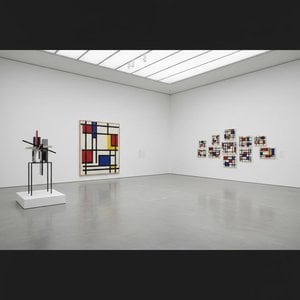
Composition VII is an arresting example of Mondrian’s mature neoplastic style. The canvas explodes with a dynamic yet controlled arrangement of black lines intersecting with precisely delineated rectangles of red, blue, and yellow. These aren't haphazardly placed shapes; each element is carefully positioned to create a visual equilibrium, a sense of tension and release that draws the eye across the surface. Notice how the horizontal and vertical lines dominate, creating a grid-like structure that anchors the composition while allowing for subtle shifts in color and form. The use of black as a defining element isn’t merely a border; it acts as a crucial counterpoint to the vibrant colors, adding depth and emphasizing their relationship.
The painting's power lies not just in its formal elements but also in the emotional resonance it evokes. Many viewers describe experiencing a sense of calm, order, and even spiritual upliftment when contemplating Composition VII. This is no accident; Mondrian consciously designed his works to achieve this effect, believing that pure abstraction could provide access to a higher state of consciousness. The simplicity of the forms, combined with their carefully orchestrated arrangement, creates a visual experience that transcends mere representation, inviting contemplation and offering a glimpse into a world of geometric harmony.
The Legacy of Neoplasticism and a Reproduction Today
Composition VII’s influence extends far beyond the early 20th century. It became a cornerstone of modern art, inspiring countless artists and designers across various disciplines – from architecture to graphic design. Mondrian's principles of reduction and geometric abstraction continue to resonate today, informing contemporary approaches to visual communication and spatial design. The painting’s stark simplicity and powerful composition have made it one of the most recognizable works of abstract art in history.
At WahooArt.com, we are proud to offer meticulously crafted handmade oil painting reproductions of Composition VII. Our skilled artists utilize only the finest materials – archival-quality pigments and canvas – to faithfully recreate Mondrian’s original vision. Each reproduction captures not just the colors and lines but also the subtle nuances of texture and brushwork, ensuring that you receive a piece that is both visually stunning and historically authentic. Owning a reproduction of Composition VII is more than simply acquiring art; it's an opportunity to bring the principles of neoplasticism into your home or office, celebrating the enduring legacy of this groundbreaking artist.
To explore Piet Mondrian’s artistic journey further and delve deeper into the philosophy behind Composition VII, we invite you to visit Neoplasticism Art Movement on WahooArt.com. You can also view Mondrian’s profile and purchase a reproduction directly at Composition VII.
الأسئلة والأجوبة
ما هي لوحة الألوان وما هو الشعور الذي يجمعه "Composition VII"؟
في "Composition VII"، ترافق ألوان Neutrals شعوراً بـ Reflective.
إلى أي فنان يُنسب العمل "Composition VII"؟
تم إبداع "Composition VII" بواسطة بييت موندريان. وتصف المعلومات الواردة في هذه الصفحة العمل الأصلي لـ بييت موندريان.
هل تُظهر لوحة "Composition VII" تباينات قوية بين الضوء والظلال؟
يُسجل التباين بين الضوء والظلال في "Composition VII" بمستوى Bold. ويصف التباين مدى قوة الاختلاف بين المناطق الفاتحة والمظلمة.
عن ماذا يتحدث "Composition VII"؟
تُصور "Composition VII" للفنان بييت موندريان: geometric abstraction, primary colors, grid composition, piet mondrian, neoplasticism, rectangular forms, dynamic balance.
ما هو المكان الأنسب لتنسيق "Composition VII" للفنان بييت موندريان؟
يُنصح باستخدام تنسيق Square لعمل "Composition VII" للفنان بييت موندريان في Living Room. حيث يساهم كل من التنسيق والمساحة معاً في توجيه عملية وضع النسخة المطبوعة.
من الذي أبدع "Composition VII" وبأي أسلوب نُفذت؟
يقف وراء "Composition VII" كل من بييت موندريان وحركة Neoplasticism.
إلى أي حركة فنية ينتمي العمل "Composition VII" للفنان بييت موندريان؟
تنتمي "Composition VII" للفنان بييت موندريان إلى حركة Neoplasticism. وتوفر هذه الحركة السياق الأسلوبي للعمل.
هل يمكنني مشاهدة "Composition VII" كعرض شرائح بملء الشاشة؟
يمكن مشاهدة العرض المتتابع لـ "Composition VII" في صفحة عرض متتابع الخاصة بالعمل الفني.



 معاينة الحجم الواقعي
 اطلب نسخة مرسومة يدويًا
 إرسال
إرسال مشاركة
 عرض التفاصيل
 دليل الأعمال الفنية للطلاب

 تحميل
تحميل
 قطع مشابهة
 الأشعة السينية
 عرض شرائح متتابع
 الإحصائيات

 اقرأ المزيد






































 خيار الزجاج متاح فقط للمقاسات التي تقل عن 110 سم