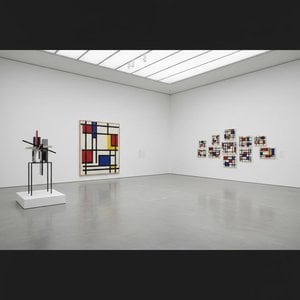
A Symphony of Lines and Light: Deconstructing Piet Mondrian’s *Composition* (1914)
Piet Mondrian's 1914 painting, simply titled *Composition*, offers an arresting glimpse into the evolution of a revolutionary artist. Far from a static landscape, it’s a meticulously constructed exploration of geometric abstraction, a testament to his relentless pursuit of universal harmony through reductive form and color. This work, born during a pivotal period in Mondrian's career – bridging the expressive fervor of Fauvism with the nascent principles of Cubism – reveals an artist actively dismantling traditional representation and building anew from the fundamental elements of line and hue.
The canvas is dominated by a complex grid, composed of interlocking squares and rectangles rendered in a restrained palette. Ochre, blue-gray, and delicate pinks coalesce to create atmospheric tones that seem to shimmer beneath the surface. These aren’t merely decorative colors; they are carefully orchestrated to evoke a sense of depth and spatial ambiguity. Notice how Mondrian employs *scumbling*, a technique involving layering thin washes of paint – a subtle blurring of edges and a softening of form – to suggest light and shadow, mimicking the effects of reflected daylight that he so admired in Monet’s Rouen Cathedral series. This echoes his desire to capture not just what is seen, but the *feeling* of seeing, translating visual experience into an abstract language.
Cubist Roots and a Search for Universal Beauty
The influence of Cubism is undeniable, yet Mondrian doesn't simply replicate its fractured perspectives. Instead, he adopts the Cubist principle of breaking down objects into their essential geometric components – lines and planes – but then elevates these elements to become the primary subject matter. The triangular shapes scattered throughout the composition aren’t decorative flourishes; they are integral to the scaffolding that supports the entire structure, acting as anchors within the grid. This deliberate construction reflects Mondrian's belief in a universal order underlying all things, an order he sought to express through the rigorous logic of geometry.
Interestingly, Mondrian himself described his work as “constructing lines and color combinations on a flat surface, in order to express general beauty with the utmost awareness.” This statement encapsulates the core of his artistic philosophy. He wasn’t interested in depicting specific objects or scenes; he was striving to capture an abstract essence – a distilled representation of harmony and balance. The painting's vagueness, as he famously noted, is intentional, inviting viewers to project their own interpretations onto its carefully arranged elements.
Symbolism and the Pursuit of Harmony
Beyond the purely formal aspects, *Composition* hints at deeper symbolic meanings. The grid itself can be interpreted as a framework for order and stability, while the scattered circles represent moments of disruption or potential energy within that structure. Mondrian’s lifelong quest to find harmony between art and life is powerfully conveyed in this work. He believed that by reducing form to its most essential elements – line and color – he could create a visual language capable of expressing universal truths.
The painting's creation occurred during a period of intense experimentation for Mondrian, as he moved from the vibrant colors of Fauvism towards his signature style. The influence of Monet’s atmospheric studies is palpable, demonstrating Mondrian’s ongoing engagement with capturing light and color in a way that transcends mere representation. *Composition* stands as a crucial bridge between these earlier explorations and the development of his later, more austere works – a vibrant testament to an artist perpetually searching for the perfect balance between form and feeling.
A Timeless Masterpiece: Reproduction Options
WahooArt offers meticulously crafted hand-painted reproductions of Piet Mondrian’s *Composition*, allowing you to bring this iconic artwork into your home or office. Our expert artisans faithfully recreate the painting's nuanced color palette, delicate scumbling techniques, and intricate geometric structure, ensuring an authentic representation that captures the essence of Mondrian’s genius. Available in a range of sizes – from intimate 120 x 101 cm to larger formats – our reproductions are printed on archival-quality canvas using premium pigments for lasting beauty and vibrancy. Consider *Composition* as more than just a decoration; it's an investment in art history, a window into the mind of one of the 20th century’s most influential artists.
الأسئلة والأجوبة
ما الذي يضفيه "Composition" للفنان بييت موندريان على التصميم الداخلي؟
تتناغم الأجواء Calm للوحة "Composition" للفنان بييت موندريان مع المساحة المقترحة لها: Living Room.
ما مدى قوة ألوان "Composition"؟
تُظهر ألوان "Composition" للفنان بييت موندريان تشبعاً بمستوى Muted مع حدة بلغت Balanced.
ما هو اللون الطاغي على تكوين "Composition" للفنان بييت موندريان؟
اللون السائد في "Composition" للفنان بييت موندريان هو Driftwood (#b39b6b).



 معاينة الحجم الواقعي
 التبديل إلى المطبوعات
 إرسال
إرسال مشاركة
 عرض التفاصيل
 دليل الأعمال الفنية للطلاب

 تحميل
تحميل
 قطع مشابهة
 الأشعة السينية
 عرض شرائح متتابع
 الإحصائيات


 اقرأ المزيد






































 خيار الزجاج متاح فقط للمقاسات التي تقل عن 110 سم