A World Within: Decoding Paul Klee’s *Contemplation* (1938)
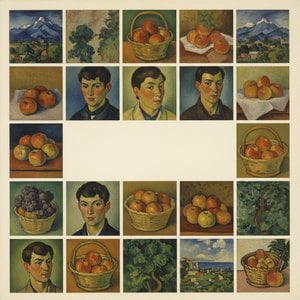
Paul Klee's *Contemplation*, painted in 1938, is a captivating example of his mature abstract style – a visual poem rendered in earthy tones and fragmented forms. Measuring 47 x 65 cm, this work invites prolonged viewing, revealing layers of meaning within its seemingly chaotic composition. It’s a piece that speaks to the anxieties of a world on the brink of war, yet retains Klee's characteristic playful sensibility.
Style and Influences: A Synthesis of Modernism
Klee was a master synthesist, absorbing influences from Expressionism, Cubism, and Surrealism while forging his own utterly unique artistic language. *Contemplation* leans heavily into the expressive power of distorted forms and emotionally resonant color – hallmarks of Expressionism. However, the flattening of space and fragmented figures also echo Cubist principles. Unlike purely abstract works, Klee’s compositions always retain a hint of figuration, a ghost of recognizable shapes that adds to their enigmatic quality. This work is not about *what* it depicts literally, but rather *how* it evokes feeling and thought.
Technique: The Tactile Language of Paint
The artwork’s surface appears richly textured, likely achieved through impasto – the thick application of paint. This technique isn't merely aesthetic; it adds a tactile dimension to the work, emphasizing the materiality of the paint itself and the artist’s physical engagement with the canvas. The brushwork is gestural and free-flowing, creating dynamic lines that suggest movement and energy within the confined space. Klee was deeply interested in color theory, documented extensively in his *Paul Klee Notebooks*, and here he employs a palette of warm browns, ochres, and muted reds to create a sense of introspection and perhaps even melancholy.
Subject & Symbolism: Fragments of Humanity
*Contemplation* presents a dense arrangement of overlapping, stylized human-like figures. These are not portraits in the traditional sense; rather, they are fragmented representations – faces or bodies partially obscured, suggesting anonymity and perhaps even alienation. The lack of clear perspective further contributes to this feeling of disorientation. The recurring motifs and overall composition can be interpreted as symbolic explorations of humanity, isolation, subconscious thought, or the collective anxieties of the pre-war period. Klee often imbued his work with personal symbolism, drawing from mythology, music, and dreams, leaving room for individual interpretation.
Historical Context: A Shadow Over Europe
Painted in 1938, *Contemplation* was created during a turbulent time in European history. Klee, living in Germany at the time, faced increasing persecution as a “degenerate” artist under the Nazi regime. His work was removed from museums and he was eventually forced to flee to Switzerland. While not explicitly political, the sense of unease and fragmentation within *Contemplation* can be seen as reflecting the broader anxieties of the era – a premonition of the impending conflict and societal breakdown.
Emotional Impact & Interior Design
*Contemplation* evokes a complex emotional response. It is not a cheerful or uplifting work, but rather one that invites introspection and contemplation (as its title suggests). The fragmented forms and intense coloration create a sense of unease, while the underlying warmth of the palette prevents it from becoming entirely bleak. In an interior design context, this artwork would serve as a powerful focal point – a conversation starter that adds depth and sophistication to any space. Its earthy tones complement neutral palettes, while its abstract nature allows it to integrate seamlessly into both modern and traditional settings.
It’s a piece for those who appreciate art that challenges, provokes thought, and rewards repeated viewing. Its relatively modest size makes it suitable for smaller rooms or as part of a larger gallery wall.
الأسئلة والأجوبة
ما مدى شهرة العمل الفني "Contemplation" للفنان بول كليه؟
يتمتع "Contemplation" للفنان بول كليه بمستوى شعبية Recognized. ويعكس هذا التصنيف مدى انتشار شهرة هذا العمل الفني.
ما هي النبرة العاطفية التي تصاحب أسلوب Expressionism في عمل "Contemplation"؟
ترافق العاطفة Reflective في لوحة "Contemplation" أسلوبها الـ Expressionism.
ما مدى قوة ألوان "Contemplation"؟
تتميز لوحة "Contemplation" للفنان بول كليه بدرجة تشبع تبلغ Clear Color Presence وكثافة لونية تصل إلى Vivid.



 معاينة الحجم الواقعي
 اطلب نسخة مرسومة يدويًا
 إرسال
إرسال مشاركة
 عرض التفاصيل
 دليل الأعمال الفنية للطلاب

 تحميل
تحميل
 قطع مشابهة
 الأشعة السينية
 عرض شرائح متتابع
 الإحصائيات


 اقرأ المزيد






































 خيار الزجاج متاح فقط للمقاسات التي تقل عن 110 سم