A Symphony of Form and Color: Cezanne’s *Still Life with Apples and Biscuits*
Paul Cézanne's *Still Life with Apples and Biscuits*, painted in 1877, is more than a depiction of fruit and baked goods; it’s a foundational statement within the burgeoning world of modern art. Measuring 38 x 55 cm, this oil on canvas embodies Cézanne’s revolutionary approach to observation and representation – an approach that would profoundly influence generations of artists to come. This work isn't simply *about* apples and biscuits; it’s about how we *see* them, and by extension, how we perceive the world around us.
Deconstructing Reality: Style & Technique
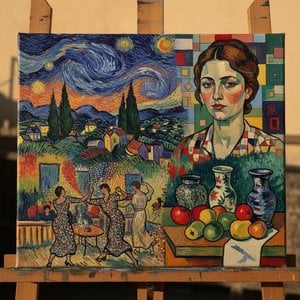
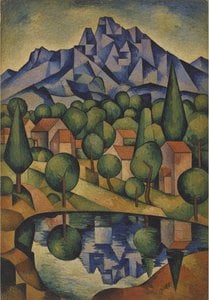
Cézanne is often hailed as a bridge between Impressionism and Cubism, and this painting beautifully illustrates that transition. While retaining elements of Impressionistic color play – note the subtle shifts in light across the apples’ surfaces – *Still Life with Apples and Biscuits* moves beyond merely capturing an *impression* of reality. Instead, Cézanne meticulously constructs a composition using underlying geometric forms. The apples aren't rendered as perfectly round spheres but are subtly faceted, hinting at their three-dimensionality through planes of color. His brushwork is deliberate yet loose, creating texture and depth without sacrificing the overall coherence of the scene. The golden-yellow background, adorned with stylized starbursts, isn’t merely decorative; it actively participates in defining the space and enhancing the vibrancy of the fruit.
Beyond Representation: Symbolism & Emotional Resonance
Still life as a genre has long been imbued with symbolic meaning. Here, the apples – traditionally associated with knowledge, temptation (referencing the biblical story of Adam and Eve), and even mortality – are presented not as narrative elements but as vehicles for exploring formal concerns. The biscuits, representing domesticity and simple pleasures, offer a counterpoint to the more complex symbolism of the fruit. However, it’s the *arrangement* itself that carries emotional weight. The slightly precarious stacking of apples suggests a fleeting moment in time, a sense of impermanence. There's an intimacy to this scene, as if we are observing a private moment of contemplation.
Cézanne’s Legacy: A Pivotal Moment in Art History
Born in Aix-en-Provence in 1839 and passing in 1906, Paul Cézanne spent his life challenging conventional artistic norms. Initially met with resistance, his work gradually gained recognition for its groundbreaking approach to form and color. He rejected the fleeting impressions of light favored by the Impressionists, instead seeking to understand the underlying structure of objects. This pursuit led him to deconstruct forms into their geometric components – a technique that would become central to Cubism, pioneered by artists like Pablo Picasso and Georges Braque. Cézanne’s influence extends far beyond these movements; his emphasis on subjective perception and expressive brushwork continues to inspire artists today. He paved the way for modern art's exploration of abstraction and the artist's individual vision.
Bringing Cezanne Home: WahooArt.com Reproductions
Experience the enduring beauty of *Still Life with Apples and Biscuits* in your own space. WahooArt.com offers meticulously crafted, handmade oil painting reproductions that capture the essence of Cézanne’s masterpiece. Our commitment to quality ensures a stunning addition to any art collection or interior design project.
- Explore the artwork further: /art/list/?Filter=still+life+with+apples+biscuits,still,life,with,apples,biscuits)
- Discover more about Paul Cézanne: /art/list/?Filter=paul+cézanne,paul,cézanne)
- Learn about Post-Impressionism: [https://en.wikipedia.org/wiki/Post-Impressionism](https://en.wikipedia.org/wiki/Post-Impressionism)
Invest in a piece of art history – browse our Cézanne collection at WahooArt.com today.



 معاينة الحجم الواقعي
 التبديل إلى المطبوعات
 إرسال
إرسال مشاركة
 عرض التفاصيل
 دليل الأعمال الفنية للطلاب

 تحميل
تحميل
 قطع مشابهة
 الأشعة السينية
 عرض شرائح متتابع
 الإحصائيات


 اقرأ المزيد






































 خيار الزجاج متاح فقط للمقاسات التي تقل عن 110 سم