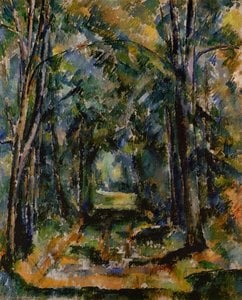
Rocks at Fontainebleau: A Post-Impressionist Masterpiece
Paul Cézanne's "Rocks at Fontainebleau," painted in 1893, is a quintessential example of his post-impressionistic style and a significant contribution to the evolution of modern art. Housed within the esteemed Metropolitan Museum of Art in New York City, this oil on canvas artwork (measuring 73 x 91 cm) invites viewers into a serene yet structurally complex landscape.
Composition and Technique: Deconstructing Nature
The painting depicts a forested hillside near Fontainebleau, France, a location Cézanne frequently visited for inspiration. However, rather than presenting a realistic depiction of the scene, Cézanne employs his signature approach to deconstruct natural forms into geometric shapes. Large, irregular rock formations dominate the foreground, receding into the background through overlapping planes and subtle shifts in color. Vertical tree trunks punctuate the composition, creating a rhythmic interplay between solidity and verticality. A grazing sheep adds a touch of pastoral tranquility, while a chair subtly placed on the right suggests human presence within this natural setting.
Cézanne's technique is characterized by thick impasto application of paint, lending texture and physicality to the canvas. His brushstrokes are loose and expressive, defining contours with broad strokes rather than precise lines. The color palette is predominantly earthy – browns, greens, and grays – creating a harmonious yet somewhat muted atmosphere. Cézanne’s use of color isn't about replicating reality but about conveying his perception of light and form, contributing to the painting's overall sense of depth and volume.
Historical Context: Bridging Impressionism and Cubism
"Rocks at Fontainebleau" emerged during a pivotal period in art history. Cézanne was moving beyond the fleeting impressions of the Impressionists, seeking instead to explore the underlying structure and permanence of objects. His work served as a crucial bridge between late 19th-century Impressionism and early 20th-century Cubism. Artists like Pablo Picasso and Henri Matisse acknowledged Cézanne's profound influence, famously referring to him as "the father of us all." The painting reflects this transition, demonstrating a shift from capturing momentary visual sensations to analyzing the fundamental forms that constitute reality.
Symbolism and Emotional Impact: Contemplation in Nature
Beyond its formal innovations, “Rocks at Fontainebleau” evokes a sense of solitude and contemplation. The rugged landscape, rendered with Cézanne’s characteristic solidity, invites viewers to reflect on the enduring power of nature. The painting isn't about narrative or storytelling; it is an exploration of form, color, and texture—a meditation on the inherent beauty of natural structures. The muted palette and diffused lighting contribute to a feeling of quiet introspection, allowing the viewer to become immersed in the scene’s tranquil atmosphere. It represents not just what Cézanne saw but how he perceived and interpreted it – a testament to his unique artistic vision.
Related Works by Paul Cézanne
Explore more of Cézanne's groundbreaking work:
- A Turn on the Road at Roche-Ruyon: Another landscape showcasing Cézanne’s exploration of form and perspective.
- Madame Cézanne in the Conservatory: A portrait demonstrating his innovative approach to depicting figures within a spatial context.
- Still Life: Cézanne's still life paintings are renowned for their geometric compositions and subtle color variations.



 معاينة الحجم الحقيقي
 التحويل إلى المطبوعات
 مشاركة
 مشاركة
 التفاصيل

 تحميل الملف
 قطع مشابهة
 الأشعة السينية
 عرض شرائح
 الإحصائيات


 عرض المزيد