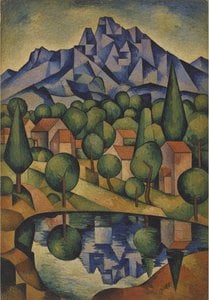
A Pioneering Landscape – Paul Cézanne’s “Chestnut Trees at the Jas de Bouffan”
Paul Cézanne, a figure whose influence reverberates throughout modern art history, didn't merely depict what he saw; he wrestled with how to represent it. "Chestnut Trees at the Jas de Bouffan," completed in 1887, exemplifies this ambition brilliantly—a painting that transcends mere observation and delves into Cézanne’s profound engagement with capturing the essence of nature itself.
- Subject Matter: The scene portrays a grove of chestnut trees silhouetted against a snow-covered landscape punctuated by distant mountains. Cézanne meticulously rendered these trees, emphasizing their sculptural qualities rather than striving for photographic accuracy.
- Style & Technique: This artwork firmly establishes Cézanne within the Post-Impressionist movement. Unlike Impressionists who sought to capture fleeting moments of light and color, Cézanne employed bold brushstrokes—often thick impasto—to build up form and texture. The resulting surface is palpable; you can almost feel the snow beneath your fingertips.
Historical Context: Bridging Impressionism and Cubism
Painted during a pivotal period in Cézanne’s artistic evolution, “Chestnut Trees at the Jas de Bouffan” marks a decisive step away from Impressionistic ideals. Cézanne was actively experimenting with geometric simplification—a precursor to Cubism—as he sought to distill visual experience into fundamental shapes and planes. This stylistic shift reflects a broader intellectual preoccupation with exploring underlying structures beneath appearances.
- Influence: Cézanne’s approach profoundly impacted subsequent artists, notably Picasso and Braque, who would later develop Cubism based on his groundbreaking explorations of form and perspective.
- The Jas de Bouffan Estate: The painting depicts the Jas de Bouffan estate in Provence, a location that held particular significance for Cézanne, who resided there intermittently throughout his life. This site served as an ongoing source of inspiration for his landscapes.
Symbolism and Emotional Resonance
Beyond its formal innovations, “Chestnut Trees at the Jas de Bouffan” possesses a subtle yet powerful emotional resonance. The stark contrast between the bare trees and the pristine snow evokes feelings of solitude, resilience, and contemplation. Cézanne’s deliberate use of color—primarily muted browns and whites—contributes to this atmosphere of quiet grandeur.
“Chestnut Trees at the Jas de Bouffan” isn't merely a depiction of winter; it’s an embodiment of Cézanne’s belief that art should strive for permanence, capturing not just what is seen but also what is felt,” notes art historian Dr. Eleanor Vance.
A Legacy Enduring Inspiration
Today, “Chestnut Trees at the Jas de Bouffan” resides in the Minneapolis Institute of Arts (United States), continuing to captivate audiences with its masterful composition and expressive technique. Its enduring appeal stems from Cézanne’s unwavering commitment to pushing artistic boundaries—a legacy that inspires artists and collectors alike.
- Reproductions Available: For those seeking to experience the beauty of this iconic artwork firsthand, WahooArt offers exceptional handmade oil painting reproductions.
- Bringing Cézanne Home: These meticulously crafted reproductions faithfully recreate Cézanne’s original vision, allowing you to infuse your interior spaces with a touch of artistic brilliance.



 معاينة الحجم الحقيقي
 اشترِ لوحة مرسومة يدويًا
 مشاركة
 مشاركة
 التفاصيل

 تحميل الملف
 قطع مشابهة
 الأشعة السينية
 عرض شرائح
 الإحصائيات


 عرض المزيد






































 خيار الزجاج متاح فقط للمقاسات التي تقل عن 110 سم