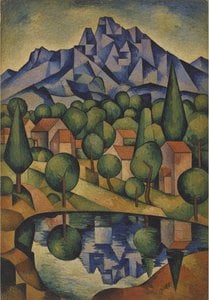
Bather
Paul Cézanne’s “Bather,” completed in 1887, stands as an emblem of Post-Impressionism and a pivotal moment in the artistic evolution toward Cubism. More than just a depiction of a nude figure immersed in water—though undeniably captivating—it embodies Cézanne's revolutionary approach to representation and his profound engagement with the underlying structure of visual experience. This painting transcends mere observation, inviting contemplation on themes of solitude, stillness, and the harmonious relationship between humanity and nature.
Artistic Style and Technique
Cézanne’s distinctive style is characterized by geometric forms and a deliberately restrained color palette—a departure from the shimmering hues favored by Impressionists like Monet and Renoir. He meticulously studied the contours of his subject, employing repetitive brushstrokes that build up to form complex planes of color. These strokes aren't blended smoothly; instead, they retain their individual texture, conveying an impression of palpable materiality and capturing the dynamism inherent in natural forms. Cézanne’s technique prioritizes solidity and volume—he seeks to capture not just what is seen but how it feels—resulting in a visual language that anticipates the radical simplification championed by Picasso and Braque. The painting's muted tones – predominantly ochre, brown, and pale blues – contribute to its serene atmosphere and emphasize Cézanne’s focus on capturing the essence of his subject rather than striving for photographic accuracy.
Historical Context
Initially met with skepticism from critics who deemed Cézanne’s work “primitive” and lacking in conventional beauty, his vision gained acceptance among fellow artists like Camille Pissarro and Ambroise Vollard, who recognized his genius and championed his artistic endeavors. Vollard orchestrated Cézanne's inaugural solo exhibition in Paris in 1895, sparking a broader dialogue about the artist’s oeuvre and solidifying his position as a precursor to modern art. Henri Matisse and Pablo Picasso themselves acknowledged Cézanne’s influence, proclaiming him “the father of us all,” recognizing his pioneering exploration of form and perspective as foundational to subsequent artistic movements like Cubism. Cézanne's work foreshadowed the geometric abstraction that would define the early 20th century, marking a decisive break from Impressionistic idealism.
Proto-Cubism and Section d’Or
Cézanne’s influence extended beyond stylistic innovation; he was instrumental in establishing “Section d’Or,” a collective of artists who embraced Cézanne's aesthetic principles—particularly the use of mathematical harmony derived from the Golden Ratio—as inspiration for their own artistic explorations. Artists like Albert Gleizes, Jean Metzinger, Robert Delaunay, Henri le Fauconnier, Fernand Léger, and Marie Laurencin sought to distill visual experience into simplified geometric forms, mirroring Cézanne’s quest for underlying structure and capturing the essence of his subject matter. This collective's commitment to mathematical precision reflected a broader intellectual preoccupation with scientific inquiry and contributed to the development of Cubism as a transformative force in art history.
Conclusion
“Bather” remains an enduring testament to Cézanne’s artistic vision—a masterpiece that encapsulates his revolutionary approach to representation and foreshadowed the radical stylistic developments of the avant-garde era. Its quiet contemplation, combined with Cézanne's masterful technique, continues to inspire artists and captivate audiences today. For those eager to delve deeper into Cézanne’s legacy or explore reproductions of his celebrated works, visit
Paul Cézanne: Bather on WahooArt. To gain a comprehensive understanding of Post-Impressionism and Proto-Cubism’s impact, consult
Paul Cézanne on Wikipedia. And for a broader appreciation of the Section d’Or collective's contribution to artistic innovation, explore
Section d’Or on Wikipedia. WahooArt specializes in crafting exquisite oil painting reproductions of iconic artworks—including Cézanne's “Bather”—allowing you to experience the beauty and artistry of masterpieces within your own home.
الأسئلة والأجوبة
ما مدى تناغم ألوان "Bather" للفنان بول سيزان؟
تُظهر لوحة "Bather" للفنان بول سيزان تناغماً لونياً Balanced Harmony.
إلى أي حركة فنية ينتمي العمل "Bather" للفنان بول سيزان؟
إن الحركة الفنية المرتبطة بـ "Bather" للفنان بول سيزان هي Post-Impressionism. ويضع هذا التصنيف العمل ضمن مجموعة من الفنانين والأعمال الفنية ذات الصلة.
ما هي تقنية وتاريخ إنشاء "Bather" للفنان بول سيزان؟
أُنجزت لوحة "Bather" في عام 1887، باستخدام Acrylic On Canvas.
ما هو اتجاه لوحة "Bather" للفنان بول سيزان؟
تتميز لوحة "Bather" للفنان بول سيزان بتنسيق Portrait. ويصف هذا التنسيق أبعاد التكوين الفني.
هل يستخدم "Bather" للفنان بول سيزان تباينات قوية أم تناغمات ناعمة؟
في "Bather"، يجتمع Serene التباين مع Balanced Harmony الانسجام.
ما مدى حدة الألوان في "Bather" للفنان بول سيزان؟
تتميز شدة ألوان "Bather" بأنها Balanced. وتصف الشدة مدى قوة ووضوح الألوان.
ما هي تقنية وحجم العمل الأصلي "Bather" للفنان بول سيزان؟
أُنجزت لوحة "Bather" باستخدام Acrylic On Canvas، وتبلغ أبعادها 38 x 50 cm في شكلها الأصلي.
أين تقع لوحة "Bather" ضمن المجموعة الكاملة لأعمال بول سيزان؟
تتشارك لوحة "Bather" مع أعمال بول سيزان الأخرى في أسلوبها الذي ينتمي إلى Post-Impressionism والموضوعات المتكررة: bridging impressionism & cubism, classical art echoes, exploring human form, landscape harmony, formal structure emphasis, revolutionary vision, key piece in cézanne's legacy.



 معاينة الحجم الواقعي
 اطلب نسخة مرسومة يدويًا
 إرسال
إرسال مشاركة
 عرض التفاصيل
 دليل الأعمال الفنية للطلاب

 تحميل
تحميل
 قطع مشابهة
 الأشعة السينية
 عرض شرائح متتابع
 الإحصائيات


 اقرأ المزيد






































 خيار الزجاج متاح فقط للمقاسات التي تقل عن 110 سم