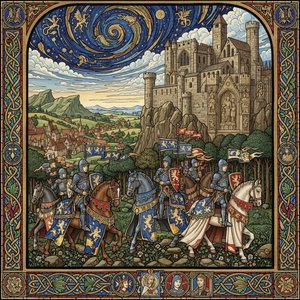
St George and the Dragon: A Pioneering Vision of Renaissance Perspective
Paolo Uccello’s “St George and the Dragon” stands as a testament to the transformative power of artistic innovation during the Early Renaissance. More than just a depiction of a legendary tale—the slaying of the dragon by Saint George rescuing Princess Angelica—it represents a radical reimagining of how artists perceived and rendered space, cementing Uccello’s place among the foremost figures shaping the aesthetic landscape of Florence.
About Paolo Uccello: Born in Pratovecchio around 1397, Paolo di Dono – later known as Uccello – wasn't merely a painter; he was an architect and mathematician who fundamentally altered artistic conventions. His father practiced both barber-surgery and craftsmanship, providing him with practical grounding alongside an appreciation for beauty. From 1412 to 1416, Uccello honed his skills under Lorenzo Ghiberti’s tutelage at the Baptistery workshop in Florence – a crucible of artistic experimentation where groundbreaking ideas flourished.
The Artistic Significance: Mastering Perspective
What distinguishes “St George and the Dragon” from its contemporaries is Uccello's audacious embrace of linear perspective. Unlike artists who relied on illusionistic techniques to create depth, Uccello meticulously calculated angles and lines to achieve a startlingly realistic portrayal of three-dimensional space. This wasn’t simply about making things look bigger; it was about conveying the sensation of actually *seeing* the scene unfold before your eyes—a monumental achievement that foreshadowed developments in Western art for centuries to come.
The painting's composition is deliberately staged, emphasizing the drama of Saint George’s confrontation with the dragon. The horse beneath St George’s feet occupies a crucial position, anchoring the perspective system and drawing the viewer’s gaze into the scene. Careful attention to light and shadow further enhances the visual impact, creating an atmosphere of tension and anticipation.
Symbolism and Narrative Depth
"St George and the Dragon" transcends its surface narrative, serving as a potent allegory for the struggle between good and evil—Christianity versus pagan superstition. Saint George embodies courage and righteousness, battling against overwhelming odds to protect innocence and defend faith. The dragon symbolizes darkness, temptation, and demonic influence, representing forces attempting to corrupt humanity.
The princess Angelica represents purity and virtue, symbolizing the soul’s quest for salvation. Her vulnerability underscores the importance of divine protection in overcoming adversity. Uccello's masterful storytelling elevates the artwork beyond a mere visual spectacle, inviting contemplation on profound moral themes.
Reproductions Available at WahooArt
At WahooArt.com, we offer exquisitely crafted oil painting reproductions of “St George and the Dragon,” meticulously recreating Uccello’s groundbreaking vision with unparalleled accuracy. Our artisans employ traditional techniques to faithfully reproduce every nuance of color and texture, ensuring that you experience the beauty and grandeur of this iconic masterpiece in your own home.
Browse our collection today at WahooArt.com and bring the spirit of Renaissance artistry into your living space!



 معاينة الحجم الحقيقي
 اشترِ لوحة مرسومة يدويًا
 مشاركة
 مشاركة
 التفاصيل
 الدليل

 تحميل الملف
 قطع مشابهة
 الأشعة السينية
 عرض شرائح
 الإحصائيات
 عرض المزيد






































 خيار الزجاج متاح فقط للمقاسات التي تقل عن 110 سم