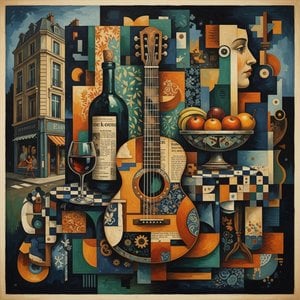
A Symphony of Fragments: Reimagining the Violin
In the transformative landscape of 1912, Pablo Picasso unleashed a visual revolution that would forever alter the trajectory of modern art. His masterpiece, Violin, serves as a profound emblem of the Synthetic Cubist phase, a period where the artist moved beyond the mere deconstruction of reality to actively construct new meanings. This work is not simply a depiction of a musical instrument; it is an intricate dance of geometric planes and layered textures that invites the viewer into a world where boundaries between object and space dissolve. To gaze upon this piece is to witness the birth of a new visual language, one that captures the restless, intellectual energy of early 20th-century Europe.
The composition functions as a complex dialogue between form and surface. Rather than relying on traditional perspective to create depth, Picasso utilizes the technique of collage, masterfully integrating various elements to build a tactile experience. The violin itself acts as the rhythmic anchor of the piece, its neck stretching upward to guide the eye through a sea of overlapping shapes. Scattered throughout this fragmented landscape are evocative traces of everyday life—a boat drifting in the lower corner, the suggestion of a cup, and the presence of a bottle. These elements are not merely decorative; they are fragments of reality reassembled into a poetic, flattened plane that challenges our very perception of what is real.
The Art of Construction: Technique and Innovation
What distinguishes Violin from the analytical dissections of Picasso’s earlier years is its embrace of materiality. During this Synthetic Cubist era, the artist moved away from monochromatic fragmentation toward a more vibrant, additive approach. By incorporating elements that mimic or physically represent different textures, Picasso bridged the gap between fine art and the tangible world. The use of collage allows for a play of light and shadow that feels both structural and ephemeral, creating a sense of movement within a static medium. For the discerning collector or interior designer, this technique offers a unique visual depth that breathes life into any sophisticated space.
The emotional resonance of the work lies in its ability to evoke nostalgia and curiosity simultaneously. There is a certain musicality in the way the shapes intersect, much like the notes of a composition flowing into one another. The interplay of the boat, the instruments, and the domestic objects creates a narrative of fragmented memories, suggesting a world that is being rebuilt from the pieces of the past. It is an intellectually stimulating piece that rewards prolonged observation, offering new layers of meaning with every glance.
A Timeless Addition to the Modern Interior
For those seeking to curate an environment of intellectual depth and avant-garde elegance, a high-quality reproduction of Picasso’s Violin offers unparalleled inspiration. Its balanced composition of neutral tones and structural lines makes it a versatile centerpiece, capable of anchoring a minimalist contemporary room or adding a layer of historical gravity to a classic study. The artwork does not merely occupy space; it commands it, acting as a conversation starter that celebrates the enduring legacy of one of history's greatest geniuses.
Investing in such a piece is an homage to the spirit of innovation. Whether placed in a gallery-style living area or a professional design studio, the Violin brings with it the transformative power of Cubism—a reminder that beauty can be found in the reconstruction of the broken, and that art has the power to redefine our reality.
الأسئلة والأجوبة
ما هو الطابع العاطفي لـ "Violin" للفنان بابلو بيكاسو؟
يرتبط العمل "Violin" بشعور تأملي. ويصف هذا الطابع العاطفي الانطباع الذي يتركه العمل.
إلى أي تيار فني تنتمي "Violin" للفنان بابلو بيكاسو؟
"Violin" هو عمل ينتمي إلى مدرسة Cubism. وتُشير هذه المدرسة إلى التقليد الفني الذي يندرج ضمنه هذا العمل.
ما هو المكان الأنسب لتنسيق "Violin" للفنان بابلو بيكاسو؟
تتمثل حقيقة التنسيق (رأسي) والمساحة الموصى بها (غرفة المعيشة) في المعلومات المسجلة لـ "Violin" للفنان بابلو بيكاسو.



 معاينة الحجم الواقعي
 التبديل إلى المطبوعات
 إرسال
إرسال مشاركة
 عرض التفاصيل
 دليل الأعمال الفنية للطلاب

 تحميل
تحميل
 قطع مشابهة
 الأشعة السينية
 عرض شرائح متتابع
 الإحصائيات


 اقرأ المزيد






































 خيار الزجاج متاح فقط للمقاسات التي تقل عن 110 سم