A Fractured Vision: Picasso’s Cubist Masterpiece
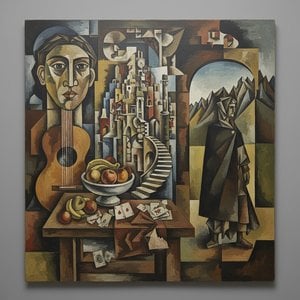
In the annals of twentieth-century art, few works possess the intellectual gravity and stylistic audacity of Pablo Picasso's "The Painter and His Model." Completed in 1937, this painting serves as a profound window into the heart of Cubism, a movement that shattered the traditional mirror of realism to reveal a more complex, multi-dimensional truth. As we gaze upon this composition, we are not merely looking at a portrait of two figures; we are witnessing an ambitious exploration of perception itself. Created against the somber backdrop of the Spanish Civil War, the work vibrates with the anxieties of an era in flux, reflecting a world where the old certainties were being dismantled as surely as the geometric planes on Picasso's canvas.
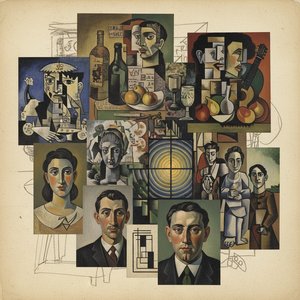
The painting presents a scene that feels both intimate and profoundly disconnected. A man sits with his back turned to the viewer, anchored by a chair, while a woman stands beside him, her form intertwined with the surrounding space. They are joined by the presence of others—shadowy figures that flank the central duo—creating a sense of a shared, yet fragmented, social reality. This arrangement invites the viewer to move beyond a simple observation of subjects and instead engage in a rhythmic dance of sight and interpretation, where every angle offers a new layer of meaning.
The Architecture of Geometry and Light
To understand the technical brilliance of this piece, one must delve into Picasso's masterful application of Cubist principles. Eschewing the soft, atmospheric light of Impressionism, Picasso employs a rigorous deconstruction of form. The figures are broken into angular, intersecting planes that overlap in a way that defies traditional depth. This technique creates a spatial ambiguity that is both disconcerting and mesmerizing; the man and woman appear to exist in multiple viewpoints simultaneously, capturing the essence of how memory and sight actually function—not as a single snapshot, but as a collection of fragmented impressions.
The color palette is intentionally restrained, utilizing a sophisticated arrangement of muted earthy tones. Ochre, deep browns, and slate greys dominate the canvas, lending the work a heavy, contemplative mood. This somber tonality reinforces the conceptual depth of the piece, ensuring that the viewer's focus remains on the structural interplay of light and shadow rather than being distracted by vibrant hues. For the collector or interior designer, this palette offers a timeless elegance, providing a sophisticated focal point that complements both modern minimalist settings and more classical, textured environments.
Symbolism and the Soul of Creativity
Beyond its striking geometry lies a rich tapestry of symbolic resonance. The presence of bowls held by the figures serves as a poignant metaphor for nourishment—not merely the physical sustenance required for life, but the intellectual and spiritual nourishment essential for the creative process. Yet, even these symbols of stability are subject to the Cubist fracture; their broken edges mirror the difficulty of achieving wholeness in an era of political and social upheaval. The very act of painting, represented by the interaction between the model and the artist, becomes a metaphor for the struggle to capture truth within a fragmented reality.
For those seeking to bring a piece of art history into their personal spaces, "The Painter and His Model" offers more than just aesthetic beauty. It provides an emotional anchor—a conversation piece that speaks to resilience, complexity, and the enduring power of human expression. Owning a high-quality reproduction of this work allows one to inhabit the intellectual ferment of 1937, bringing a sense of profound historical depth and avant-garde sophistication to any curated collection or thoughtfully designed interior.



 معاينة الحجم الحقيقي
 اشترِ لوحة مرسومة يدويًا
 مشاركة
 مشاركة
 التفاصيل

 تحميل الملف
 قطع مشابهة
 الأشعة السينية
 عرض شرائح
 الإحصائيات

 عرض المزيد






































 خيار الزجاج متاح فقط للمقاسات التي تقل عن 110 سم